
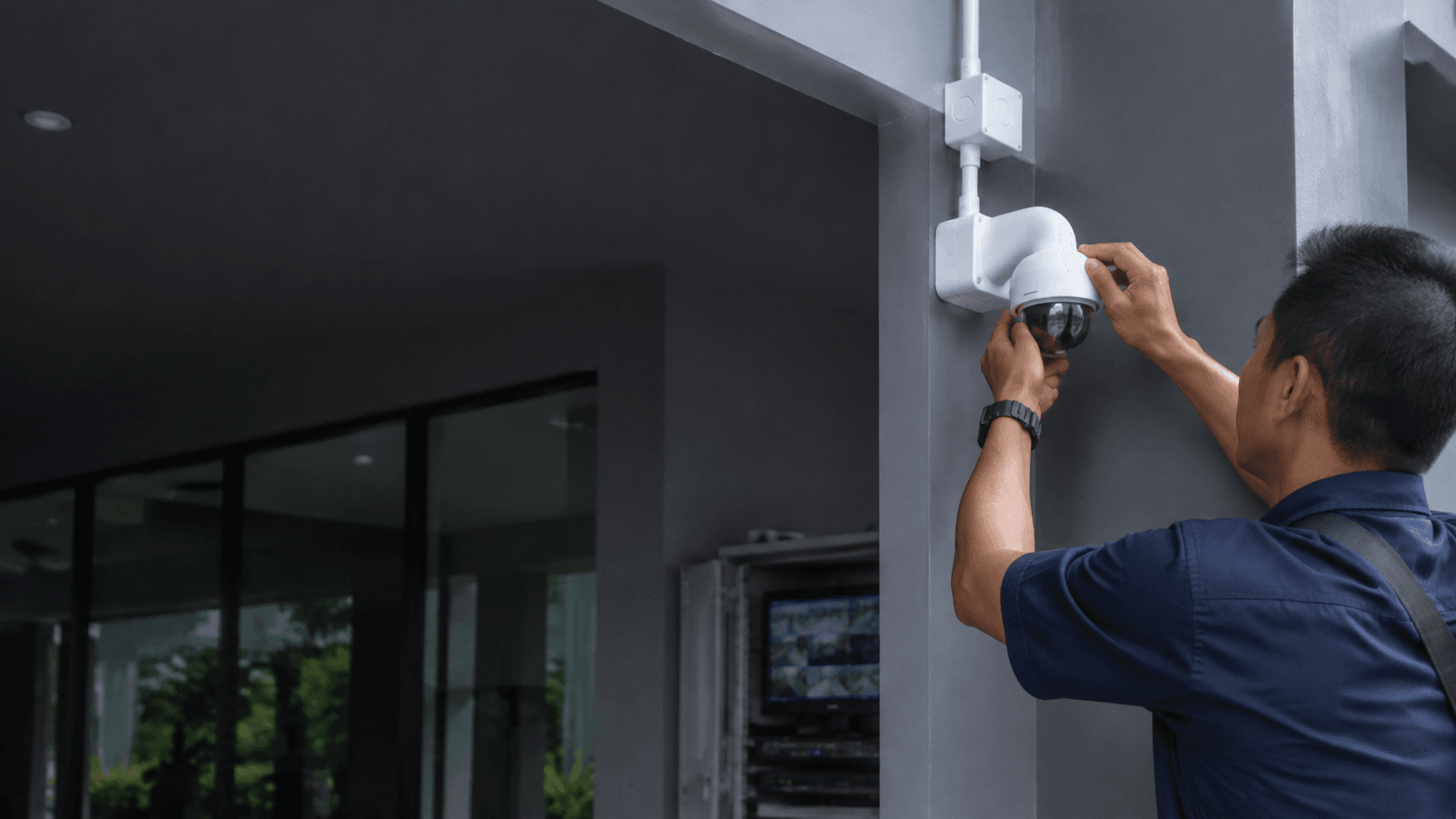
The exact-match query "24 7 security camera" describes a camera or system that keeps recording around the clock. That is different from a motion-triggered camera, which wakes up, records a short clip, then sleeps again. Continuous recording captures the seconds before and after an event, which matters when a clip needs to show how something started rather than only what happened once it was already underway.
Eyonic Sdn Bhd is a security system supplier in Sarawak, Malaysia, working on CCTV and ELV systems. The company's CCTV work covers planning, supply and installation, with camera placement, recording and remote viewing set up for homes, offices, shops and industrial sites. Founder Eric Yong has worked in the industry for more than ten years, with a focus on technical installation of digital security solutions for commercial businesses in Sarawak.
24 7 Security Camera: What Matters Before Choosing
Continuous recording is a storage and power decision before it is a camera decision. A camera that records every second writes far more data than one that records only on motion, so the recorder, drive size and power source all need to match the recording mode. A 24 7 security camera that runs continuously also needs a stable power supply, because a battery camera that sleeps between events cannot record every second without draining quickly.
Eyonic's CCTV installation process follows four stages: site survey, system proposal, installation, and handover. The site survey stage is where placement, lighting and cabling get checked before anything is fixed to a wall. That order matters for continuous recording, because a camera positioned for a motion-triggered clip may not be positioned well for all-day footage.
- Confirm what needs to be recorded continuously and what only needs event clips.
- Check power availability at each camera position, since continuous recording needs constant power.
- Size the recorder and storage for the number of cameras and the retention period required.
- Walk the site to check lighting, sightlines and cabling routes before fixing positions.
- Agree the recording schedule, retention period and remote viewing setup before handover.
Choosing the Right 24 7 Security Camera
The right choice depends on whether the site can support wired power and cabling, how long footage needs to be kept, and whether the camera needs to work in low light. Wired and Power over Ethernet cameras suit continuous recording because power and data arrive over the same cable. Plug-in wireless cameras can also record continuously where a power outlet sits close to the camera position. Battery cameras generally suit event-based recording instead.
Lighting is a separate decision from recording mode. Eyonic recommends checking actual lighting conditions before confirming placement for ColorVu-style cameras, which are designed to produce colour images in low light. A position that looks adequate in daylight can behave differently at night, so the check belongs before installation rather than after.
What is 24 7 security camera recording in practice?
In practice it means the camera writes video to a recorder, memory card or server for every hour of the day, not only when something moves. The trade-off is storage. continuous recording fills a drive faster than event recording, so retention length and drive capacity have to be planned together. A site that wants thirty days of continuous footage needs more storage than one that wants seven.
Storage and retention
Retention is usually the number that decides the recorder. More cameras, higher resolution and longer retention all increase storage demand. Compression standards such as H.265 reduce file size compared with older standards, which stretches the same drive further. The practical question is how far back footage needs to be available if an incident is reported days or weeks after it happened.
Power and cabling constraints
Continuous recording removes the option of relying on battery life. Cameras that record every second need constant power, which usually means cabling to a power source or a PoE connection back to the recorder. On sites where cabling is difficult, that constraint shapes which positions are realistic. Tidy cabling was one of the requirements on Eyonic's KTA Sarawak Sdn Bhd project in Kuching, which needed a practical office setup supporting staff movement, visitor handling and clearer daily site control.
Practical Considerations for 24 7 Security Camera Systems
Placement, lighting and retention are the three variables that most often decide whether continuous recording works as intended. A camera aimed at a doorway captures arrivals and departures; a camera aimed across a wide yard captures movement but may lose detail at distance. Continuous recording does not fix a poor angle, it only means the poor angle is recorded all day.
Public and commercial sites add a second layer. The Kuching Immigration Office project focused on arrival flow, staff areas, visitor movement and dependable daily operation. That combination points to coverage that follows how people actually move through a building, rather than cameras placed only at the perimeter.
| Recording mode | Power need | Storage demand | Best fit |
|---|---|---|---|
| Continuous | Constant power required | Highest | Sites needing full timeline coverage |
| Motion-triggered | Battery possible | Lower | Sites watching for events only |
| Scheduled | Constant power required | Moderate | Sites needing coverage only during set hours |
Retention length, camera count and resolution are the three numbers that set storage demand. A site recording continuously at higher resolution across more cameras will fill the same drive sooner than a smaller setup, so the recorder and drive are chosen against those figures rather than after installation.
Making an Informed Choice About a
The decision usually comes down to whether the site needs a full timeline or only event clips. Continuous recording suits entrances, cash handling areas, public counters and any location where knowing the sequence of events matters. Motion-triggered recording suits low-traffic areas where storage and power are limited.
Cost is part of the picture. Eyonic's published packages sit at RM 1,599 for a Hikvision CCTV package covering camera supply and setup, basic recording configuration and mobile viewing handover; RM 1,599 for a Hikvision alarm system; and RM 1,599 for an autogate package. Larger project work sits in a different range: the Kuching Immigration Office project carried an approximate budget of RM 12,000 to RM 28,000, and the KTA Sarawak Sdn Bhd project an approximate budget of RM 8,000 to RM 18,000.
Two edge cases are worth naming. First, a site that wants continuous recording but has no practical route for constant power will need either a different recording mode or a cabling plan. Second, a site that adds cameras later needs a recorder with spare channels and a drive sized for the final camera count, not the starting one.
For readers in Sarawak weighing a 24 7 security camera setup, the practical next step is to share the location, property type and required system with Eyonic on WhatsApp at +60 11-5111 7959.