
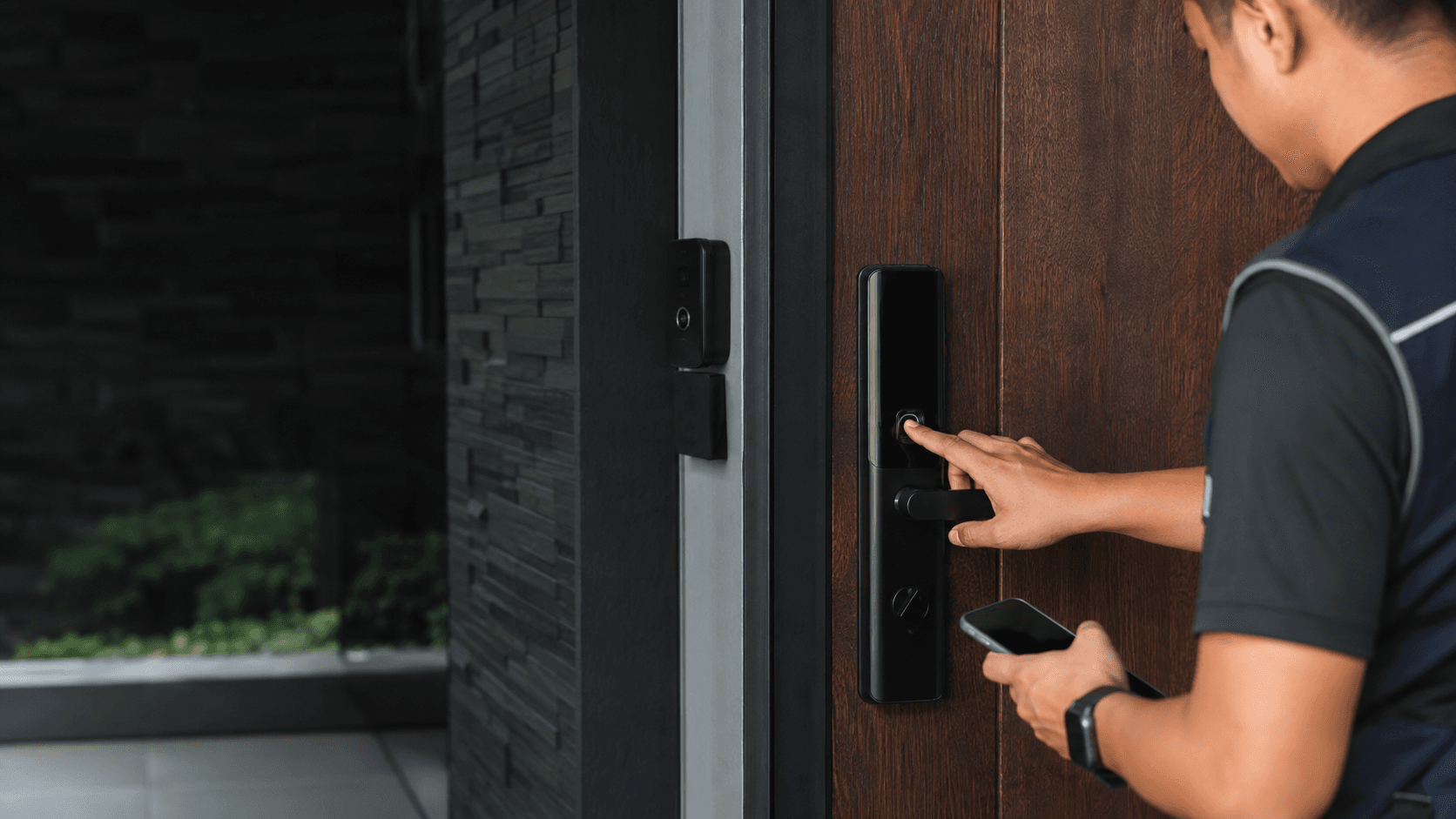
Coverage of this lock is thin and scattered. Retail listings describe finishes and part numbers, a hub page describes app pairing, and a support page covers a different model. None of them answer the question a buyer in Malaysia actually has: will this deadbolt fit the door that is already there, and what happens when the electronics fail.
That gap matters because a deadbolt is a mechanical product before it is a smart one. The electronics sit on top of a bolt that has to travel through a strike plate cut into an existing frame. If the door preparation is wrong, no amount of app configuration fixes it.
What the Kwikset Smart Lock 910 is built to do
The Kwikset Smart Lock 910 is an electronic deadbolt. It replaces a keyed deadbolt with a touchpad and a motor, so entry happens through a code rather than a key. Competitor listings describe keyless entry with PIN codes, temporary and permanent user codes, remote lock status and control through a smart home hub, unlock alerts and wrong-code entry alerts, and SmartKey re-keying.
Two features carry most of the practical weight. User codes let a household or office issue separate credentials instead of copying a key, and Z-Wave communication lets the lock report status to a controller rather than sitting as a standalone device. A lock with codes but no hub connection still works; it simply cannot be checked or controlled from elsewhere.
SmartKey re-keying is the mechanical counterpart. It allows the cylinder to be re-keyed to a different key without replacing the lock body, which matters when a property changes hands or a key is unaccounted for.
Kwikset Smart Lock 910 compatibility questions that decide the purchase
Compatibility splits into two separate problems that are often confused. The first is mechanical. whether the deadbolt fits the door. The second is electronic. whether the lock can talk to a controller the owner already has or intends to buy.
On the electronic side, the recurring theme across competitor pages is Z-Wave. A hub page describes pairing through a specific hub and app, a retailer listing describes compatibility with Z-Wave alarm systems and hubs, and a retailer question page shows buyers asking whether the lock works with named security services and getting inconsistent answers. That pattern is the useful signal: Z-Wave support is not the same as support for every Z-Wave controller, and the platform a lock is certified against is the one to confirm.
On the mechanical side, the supplied evidence does not include a verified specification sheet for the Kwikset Smart Lock 910. Door thickness range, backset, cross-bore diameter and finish options are not confirmed here, so those values should come from the current manufacturer documentation or the seller before an order is placed. A deadbolt that does not match the existing bore and backset is a return, not an installation.
There is also a market question. The supplied evidence does not confirm whether the Kwikset Smart Lock 910 is a current or discontinued model in Malaysia, nor does it confirm local pricing, stock or warranty terms. Those are seller questions, not assumptions.
Door condition, user roles and backup entry
Eyonic's own smart lock guidance states that smart locks work best when the door condition, user roles and backup method are reviewed before installation, and that for business use the choice between a standalone smart lock and an access-control panel is worth checking. That framing applies directly to this model.
Door condition covers more than the bore hole. A door that has swollen, a frame that has shifted, or a strike plate that no longer aligns will cause a motorised bolt to bind. A binding bolt drains batteries and produces the kind of intermittent failure that gets blamed on the electronics. Checking alignment before purchase is cheaper than diagnosing it afterwards.
User roles decide whether a code-based lock is the right tool at all. A home with four residents needs four codes and a way to remove one. An office with staff turnover, shared entrances and a need to know who entered when is usually better served by an access-control panel, because a standalone lock records codes rather than identities.
Backup entry is the third check and the one most often skipped. A code-only lock depends on a battery and a keypad. If the battery fails or the keypad is damaged, the fallback is either a mechanical key override or a second entrance. Whether a key override exists on a specific variant is a detail to confirm against the actual product documentation rather than assume.
How a Kwikset Smart Lock 910 fits a wider security setup
A smart lock is one layer of a property's access and monitoring arrangement, and its value depends on what sits around it. A lock that reports status to a hub is more useful when something acts on that status, such as an alarm system or a camera covering the same entrance.
Eyonic's project work shows how that layering is handled in practice. At the Kuching Immigration Office, the focus was arrival flow, staff areas, visitor movement and dependable daily operation. At KTA Sarawak Sdn Bhd, the requirement was a practical office setup supporting staff movement, visitor handling, tidy cabling and clearer daily site control. Both are movement-and-visibility problems rather than lock problems, and both were scoped around how people actually use the space.
That is the honest framing for a deadbolt. It controls one opening. It does not tell anyone what happened at the gate, and it does not cover a back entrance. Where a property already has CCTV, an alarm system or an autogate, the lock is worth choosing for how it fits that arrangement rather than in isolation.
Eyonic's published packages for comparison sit at RM 1,599 each for a Hikvision CCTV package, a Hikvision alarm system, and an autogate package. Those figures describe Eyonic's own bundled work and are not a price for the Kwikset Smart Lock 910, which is not quoted in the supplied evidence.
What to confirm before ordering a Kwikset Smart Lock 910
The checks below are ordered so that a mechanical failure is caught before money is committed. Each one is a question with a factual answer, not a preference.
- Measure the existing door. thickness, backset, cross-bore diameter and the distance from the bore centre to the edge. Compare against the current manufacturer specification for the exact variant being ordered.
- Confirm the door and frame are sound and that the existing bolt moves freely by hand. A bolt that already binds will not improve once a motor drives it.
- Identify the controller. If remote status and control are required, confirm the specific hub, panel or alarm system the lock is documented to work with, rather than assuming Z-Wave alone is sufficient.
- Decide the user roles. Count how many separate codes are needed, who administers them, and whether a code-based lock or an access-control panel better matches how the space is used.
- Establish backup entry. Confirm whether the variant includes a mechanical key override and identify a second way into the property if the lock fails.
- Ask the seller about local availability, warranty terms and support before ordering, since the supplied evidence does not confirm these for Malaysia.
- Plan the installation. A deadbolt swap on a prepared door is a small job; correcting alignment, enlarging a bore or working on a metal gate is not.
Two edge cases are worth naming. Metal gates and condominium entry doors often have preparation that differs from a standard timber door, and the supplied evidence does not confirm installation requirements for Malaysian door types. Where the door is shared or managed by a building, physical modification may also need approval before any work starts.
Where the property needs more than one controlled opening, or needs a record of who entered rather than which code was used, the deadbolt is the wrong unit and an access-control panel is the right conversation. Eyonic's own guidance makes that distinction for business use.
For a property in Sarawak that needs the lock considered alongside cameras, alarms or gate control, Eyonic can be reached on WhatsApp at +60 11-5111 7959 with the location, property type and required system.