
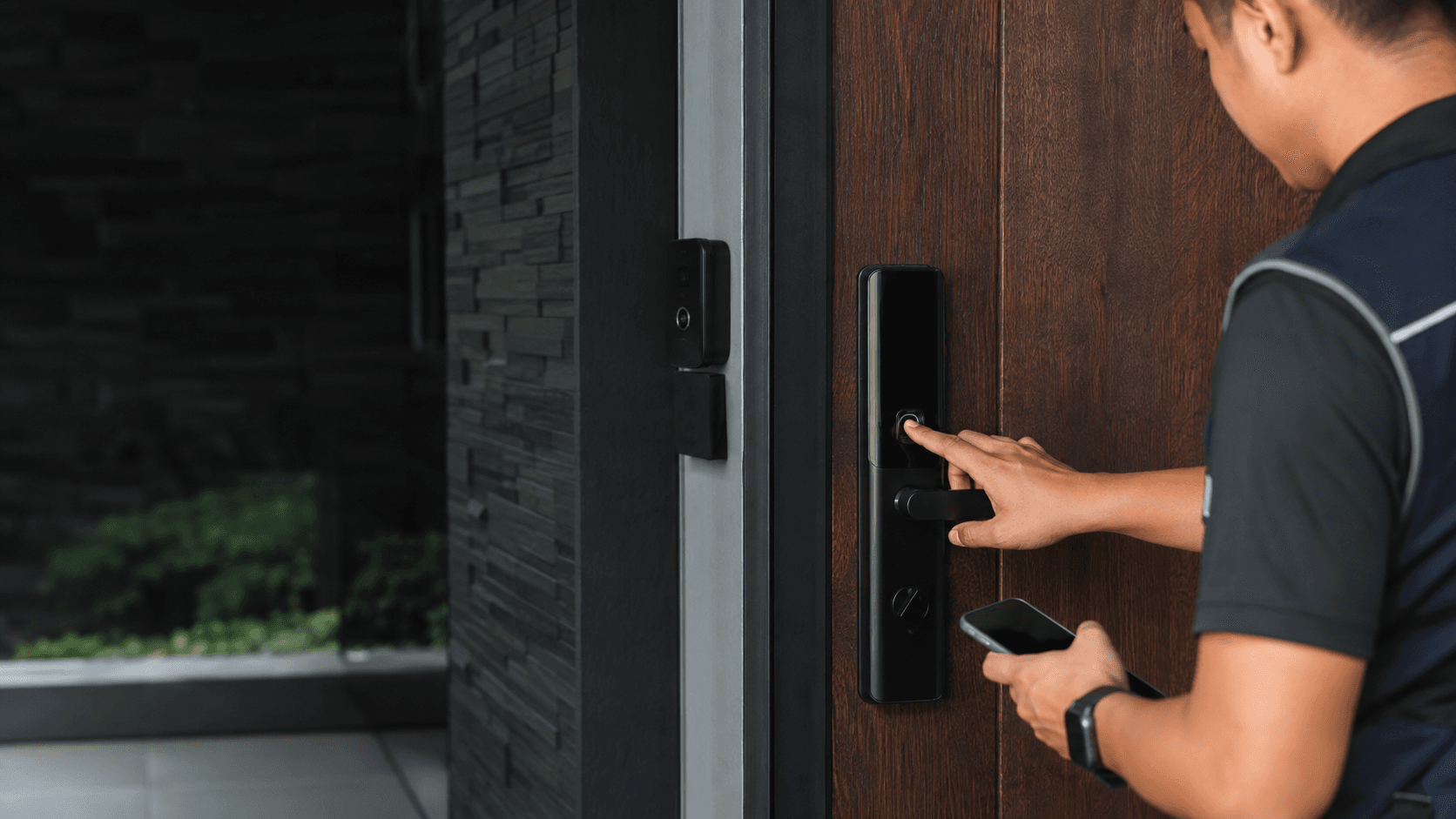
The exact-match query tuya digital door lock describes a category rather than one fixed product. Tuya supplies the cloud platform, modules, and app layer; lock brands build the physical hardware around them. That split explains why two locks that both carry the Tuya name can differ in unlocking methods, wireless protocol, door compatibility, and how access is managed.
This matters in Malaysia because most homes and offices here use mortise-style locks, and the mortise size varies between doors. A lock that fits one door may not fit the next. The sections below cover what the platform actually provides, how to choose a model, and where the practical limits sit.
What is tuya digital door lock?
A Tuya digital door lock is a lock whose smart features run on Tuya's IoT platform. The lock hardware comes from a manufacturer, while the connectivity, app control, and cloud services come from Tuya. That is why the same Tuya Smart or Smart Life app can control locks from different brands.
Tuya's own smart lock solution pages describe a one-stop model covering smart modules, cloud services, apps, and a development platform, aimed at lock and peripheral manufacturers rather than end buyers. The practical consequence for a buyer is that the Tuya name signals app and ecosystem compatibility, not a single specification list.
Typical Tuya-based locks support several unlocking routes at once: fingerprint, numeric PIN, RFID card, mechanical key, and app or remote unlock. Many also log who entered and when, and allow temporary codes for guests, cleaners, or contractors. Wireless options seen across Tuya lock listings include Wi-Fi, Bluetooth, and ZigBee, and some models add a doorbell camera or LCD screen.
What the Tuya platform adds
The platform layer is what separates a Tuya lock from a standalone digital lock. It provides the app, the account system, remote access, and links to voice assistants such as Amazon Alexa and Google Assistant on supported models. It also allows the lock to trigger or respond to other smart devices in the same app.
That ecosystem link is useful when a property already runs other Tuya-compatible devices. It is far less useful when the lock is the only smart device on site, because the app then adds convenience without adding coordination.
Choosing the Right Tuya Digital Door Lock
Selection should start with the door, not the feature list. A lock that cannot fit the existing mortise, or that needs a different door thickness, creates installation work that no app feature compensates for.
- Measure the existing mortise, door thickness, and backset before comparing models.
- Confirm the wireless protocol the site can support, since Wi-Fi, Bluetooth, and ZigBee behave differently.
- Decide which unlocking methods are genuinely needed, then check the model supports all of them.
- Check how many fingerprints, PINs, and cards the lock stores, and whether temporary codes are supported.
- Confirm the backup entry method, usually a mechanical key or an external power point.
- Review who administers users and how access is removed when a person leaves.
- Plan battery replacement and confirm the low-battery warning behaviour.
Eyonic's own smart lock review guidance makes the same point from the installer side: smart locks work best when door condition, user roles, and backup method are reviewed before installation. For business use, the same guidance notes that a standalone smart lock and an access-control panel are not interchangeable, and the choice depends on how many people need controlled entry.
Fingerprint, PIN, card, or app
Fingerprint unlocking suits regular users on a fixed door. PIN codes suit visitors and short-term access. Cards suit staff who already carry a credential. App unlocking suits remote or one-off entry. Most Tuya locks combine several of these, so the real question is which combination matches daily use rather than which list is longest.
One edge case deserves attention: fingerprint readers perform differently for users with worn or very dry prints, and children's prints change over time. A lock with a PIN fallback avoids that problem entirely.
Wireless protocol and what it changes
Wi-Fi locks connect directly to a network, which allows remote control without extra hardware but draws more power. Bluetooth locks work at close range and are usually cheaper to run. ZigBee locks need a hub but tend to be more power-efficient and integrate more cleanly into a larger smart setup.
For a single door in a home, Bluetooth or Wi-Fi is usually enough. For a building with several doors that need coordinated access, a hub-based protocol is the more practical route.
Tuya Smart Digital Fingerprint Door Lock
The fingerprint model is the most common form of Tuya digital door lock sold today. It usually combines a fingerprint reader, a keypad, a card reader, a mechanical key override, and app control in one handle or mortise unit.
Listings for these locks commonly describe app-based security control, compatibility with a range of mortises, reversible handles, and battery power with a USB emergency supply. Those are manufacturer claims attached to specific models, so they should be checked against the exact unit being considered rather than treated as a category-wide guarantee.
Where these locks fit well
A Tuya fingerprint lock fits a home where the household wants to stop carrying keys, and a small office where a handful of staff need entry without a full access-control system. It also fits short-term rental use where temporary codes need to be issued and revoked remotely.
It fits less well where dozens of staff need managed credentials, where entry must be tied to a payroll or HR system, or where the door is a main commercial entrance subject to fire and egress rules. In those cases a dedicated access-control panel is the more appropriate system, which is the distinction Eyonic applies when reviewing business use.
Door condition is the deciding factor
Mortise dimensions, door thickness, and whether the door is metal, solid wood, or glass all affect what can be installed. A glass door or a narrow aluminium frame door often cannot take a standard mortise lock at all. Checking these before ordering avoids the most common failure in this category.
Practical Considerations for
Several constraints apply across the category regardless of brand or model.
Power is the first. These locks run on batteries, and battery life depends on how often the lock is used, whether the radio is always on, and how much the doorbell or camera draws if the model includes one. A low-battery warning is standard, but the backup method still needs to be confirmed and kept accessible.
Network dependency is the second. Remote unlocking and notifications require the lock to be online. If the Wi-Fi drops, local unlocking methods such as fingerprint, PIN, and key continue to work, but app control and remote codes do not. That is a normal limitation rather than a fault.
Access administration is the third. Every person added to the lock is a credential that must be removed when they no longer need access. In shared or staffed properties, that maintenance is the part most often neglected.
Installation is the fourth. A lock that fits the door still needs correct alignment, and a misaligned strike or latch causes the failures users most often report. Eyonic's installation work follows a site survey, system proposal, installation, and handover sequence, and the survey stage is where door and frame condition gets checked.
Cost expectations
Lock prices vary widely by model and feature set, so a single figure would be misleading. For context on what installed security work costs in Sarawak, Eyonic's published packages for CCTV, alarm, and autogate systems are each priced at RM 1,599, and completed office projects have carried approximate budgets of RM 8,000 to RM 18,000 and RM 12,000 to RM 28,000 depending on scope. A single door lock sits well below those figures, but a multi-door access project does not.
Where a Tuya lock is the wrong choice
A Tuya digital door lock is a poor fit when the door cannot take the hardware, when the site has no reliable network and remote access is essential, or when the requirement is audited, centrally managed access for a large number of people. It is also a poor fit where building or fire regulations govern the entrance, since those rules take precedence over convenience features.
Making an Informed Choice About
The decision comes down to three checks: whether the lock physically fits the door, whether its unlocking methods match how people actually enter, and whether the access can be managed and removed cleanly over time. A Tuya digital door lock handles the first two well in most residential and small-office settings. The third depends on how the site is run, not on the lock.
For a single home door, a fingerprint model with PIN and key backup covers the common cases. For an office with staff and visitors, the more useful step is deciding between a standalone lock and a managed access system before choosing a model, because that choice determines what can be added later.
Eyonic Sdn Bhd plans, supplies, and installs security and ELV systems in Sarawak, including smart lock door access, and has completed projects for a public office in Kuching and an engineering consultancy. Share your location, property type and required system with Eyonic on WhatsApp at +60 11-5111 7959 for the next practical step.