
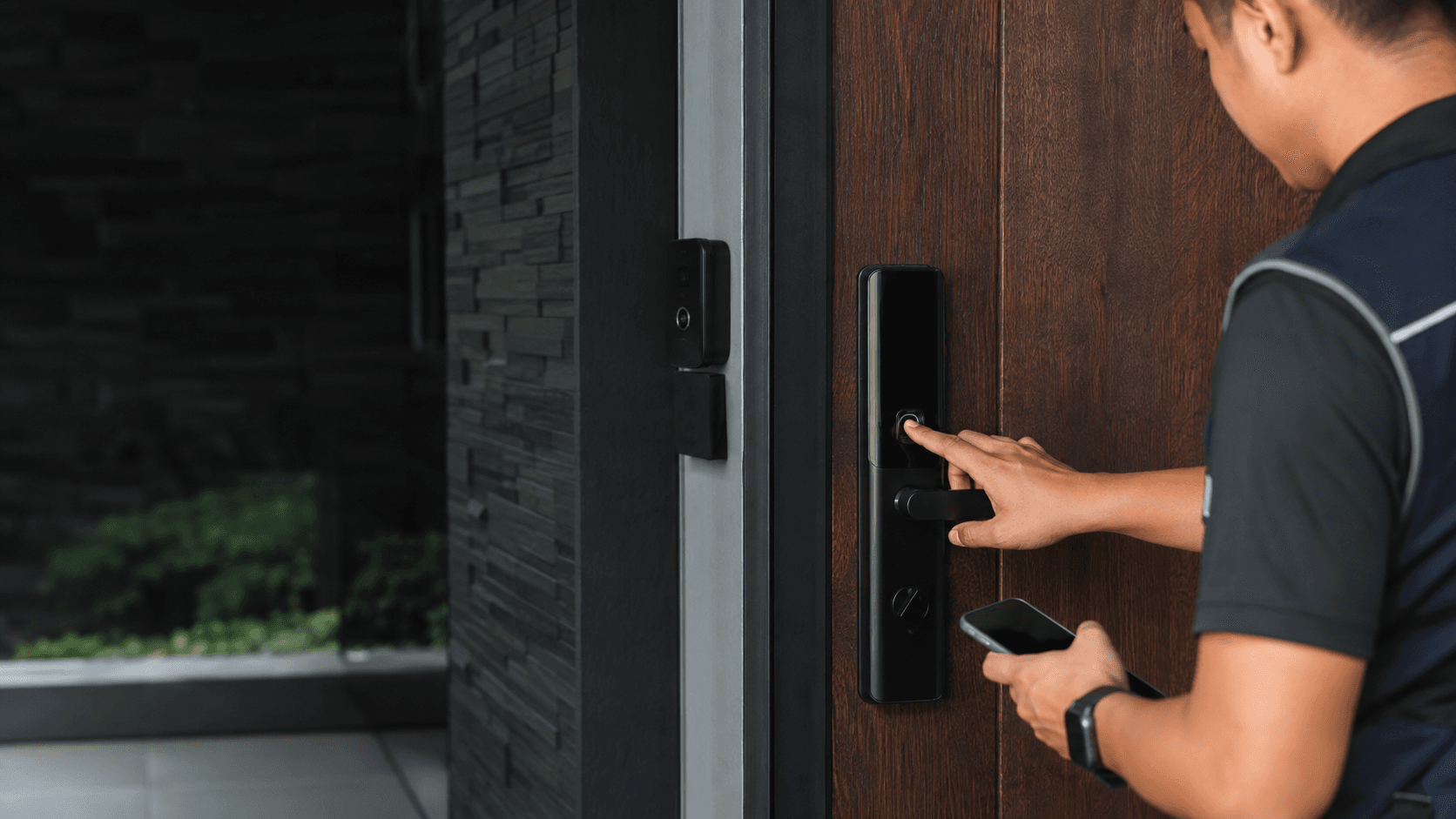
That single sentence is the whole feature in plain terms, but the practical questions sit around it. Readers search for kwikset 620 auto lock because they want to know what the re-lock actually does, how the delay is set, and what to check when the bolt stops coming out on its own. The answers below stay with what the lock is documented to do and what has to be confirmed on site before a unit is fitted.
Kwikset 620 Auto Lock: what the feature does
Auto-lock is an optional re-locking behaviour. After the door is unlocked and opened, the deadbolt extends again on its own after a delay, so the door does not sit unlocked because someone forgot to press the lock button or turn the thumbturn.
The lock is a keypad deadbolt with Z-Wave technology, which means it can also be commanded by a connected system rather than only by the keypad. The auto-lock behaviour belongs to the lock's own re-locking logic; the connected side is what allows status and commands to travel to a hub or panel.
Two practical consequences follow from that split. First, auto-lock is a convenience layer, not a substitute for a deliberate lock-up routine at closing time. Second, because the bolt moves without a person present, anything that obstructs bolt travel will show up as an auto-lock fault rather than as a keypad fault.
What auto-lock does not do
Auto-lock does not decide who is allowed in. Credentials, codes and user roles are handled separately from the re-lock timer. It also does not report a door as secure simply because the timer ran; if the bolt could not extend fully, the lock state and the physical door state can disagree.
How the timed re-lock interval is configured
The re-lock delay is a setting rather than a fixed behaviour, and the lock supports more than one interval. The exact interval values, the default delay and the maximum delay are not confirmed in the material available for this article, so those figures should be read from the current Kwikset documentation for the specific model variant before anything is promised to a user.
Configuration normally happens through the lock's own programming sequence or through the connected system, depending on how the installation is set up. Whether the schedule lives in the lock or in the automation platform is a question the installer has to settle at commissioning, because it changes who to call when the timing drifts.
Setting the interval in practice
- Confirm the door closes and latches cleanly by hand before touching any timing setting, because a timer cannot fix a door that binds.
- Decide the delay against how the door is actually used — a short delay suits a door that is pulled shut immediately, while a longer delay suits a door used with hands full.
- Set the interval through the lock's programming method or the connected system, following the current manufacturer instructions for that variant.
- Test the full cycle several times: unlock, open, close, wait, and watch the bolt extend without assistance.
- Record the chosen interval and the method used, so the next person to service the door knows what was intended.
A re-lock delay that is too short is a common source of complaints, because the bolt can start extending while the door is still moving. A delay that is too long leaves a gap where the door is shut but not secured. Neither is a defect; both are settings.
Why a Kwikset 620 Auto Lock can stop working
When auto-lock stops engaging, the cause is usually mechanical or alignment-related rather than electronic. A deadbolt needs a clear path into the strike. If that path closes up, the lock can refuse to complete the re-lock even though the keypad, the radio and the batteries are all fine.
The checks that matter most are the ones a fitter can see and feel: whether the bolt extends freely with the door open, whether the bolt lines up with the strike when the door is shut, whether the door has moved on its hinges, and whether the mounting has worked loose. A door that has warped with humidity or a frame that has shifted will produce exactly this symptom, and it will do so intermittently at first.
Because no verified cause list for this specific lock is available here, the honest position is that diagnosis starts with the door and the bolt, not with the app. If the bolt moves freely by hand with the door open but stalls when the door is closed, the fault is in the opening, not in the lock.
What to check before assuming a fault
Test the bolt with the door open. If it extends and retracts normally, the lock's mechanism is working and the problem is alignment, strike position or door movement. If it does not move freely even with the door open, the issue is inside the lock or its power source, and that is a different conversation.
Door condition and user roles to check first
Smart locks work best when the door condition, the user roles and the backup method are reviewed before installation. That order matters, because each one changes the others.
Door condition covers more than whether the door closes. It covers the thickness and material of the door, whether the existing bore and bolt hole suit a deadbolt, whether the frame is square, and whether the door is exposed to weather that will move it over time. A door that already needs a shoulder to close will not become reliable because a timer was added.
User roles decide how many credentials exist, who can add or remove them, and whether access should be time-limited. On a home door this is simple. On a business door it is the difference between a standalone lock and an access control panel, and that choice should be made before hardware is ordered rather than after.
Where a standalone lock stops being enough
A standalone smart lock suits a door with a small, stable set of users. Once a door needs scheduled access, per-person permissions, or an audit trail that someone else will review, a panel-based arrangement is the more appropriate structure. Eyonic's own review position is that business use should be checked for exactly this reason, and the Kuching Immigration Office project shows the same logic applied at building scale, where arrival flow, staff areas and visitor movement were treated as one operating picture rather than as separate devices.
Backup entry and access method for business doors
Every powered lock needs a way in that does not depend on the powered part. For a keypad deadbolt that usually means a mechanical key, and the key has to be stored somewhere that is genuinely accessible during a failure — not inside the building the door protects.
For a business door, the backup plan also has to survive a staffing change. If the only person who knows the override is on leave, the backup does not exist. The plan should be written down, held by more than one person, and tested rather than assumed.
There is a second constraint worth naming. A lock that re-locks itself changes how a door is used during busy periods. Staff who prop a door open, or who need to move equipment through repeatedly, will fight a short re-lock delay. That is a workflow question, and it is better answered before the interval is chosen than after.
questions answered before installation
Does auto-lock replace locking up at night? No. It reduces the window where a door is left unlocked after use. A deliberate end-of-day check is still the reliable routine.
Can the re-lock be scheduled to a specific time of day? Time-of-day scheduling is a function of a connected automation system rather than of the lock's own re-lock timer. Whether a given system supports it depends on that system, and compatibility for hubs and panels available in Malaysia is not confirmed in the material used here.
What happens if the bolt cannot extend? The lock cannot complete the re-lock. The door will read as shut while the bolt is not seated, which is why alignment checks belong in routine maintenance and not only in fault-finding.
Is a smart lock the right choice for a shop or office door? It can be, when user permissions and backup entry are planned properly. Where access needs to be scheduled, restricted per person, or reviewed later, a panel-based access control arrangement is usually the better fit.
What should be confirmed before ordering? The door's condition and dimensions, the number of users and their roles, the backup entry method, and whether the door needs to integrate with an existing system. Those four answers determine the hardware, and none of them can be settled from a product page.
For a door that has to keep working every day, the sensible sequence is a site survey, a system proposal, installation, and handover — the same sequence Eyonic uses for its security work in Sarawak. Share the location, property type and required system on WhatsApp at +60 11-5111 7959 to move that forward.