
That figure is a starting reference for a small installed package rather than a per-camera rate. Larger sites carry wider budgets: Eyonic records an approximate RM 12,000 to RM 28,000 range for the Kuching Immigration Office project and RM 8,000 to RM 18,000 for the KTA Sarawak Sdn Bhd office setup in Kuching.
What drives bullet camera price
Four cost layers sit behind most quotations, and each one moves the total independently.
- Camera specification — resolution, fixed or motorised lens, infrared or full-colour night vision, and whether a microphone is built in.
- Recording and storage — recorder channels, hard drive capacity, and whether recording sits on a recorder or on a memory card inside the camera.
- Cabling and power — cable runs, connectors, power supplies, and whether power travels over the network cable or through a separate line.
- Installation labour — mounting height, bracket type, cable routing, and the time needed to configure remote viewing and hand over the system.
Two cameras with the same resolution can land far apart on price once lens type and night-vision technology differ. A fixed-lens model covers one angle permanently; a motorised zoom lens can be adjusted remotely after mounting, which suits gates, car parks and long driveways where the exact framing is hard to judge from the ground.
Choosing the right Bullet Camera
Bullet Camera selection starts with the scene, not the specification sheet. A long, narrow view such as a perimeter fence, a driveway or a loading bay suits the bullet shape because the housing points straight at the target and accepts longer lenses than a dome.
Resolution sets how much detail survives at distance. Higher megapixel counts help identify faces and number plates further from the camera, but they also increase storage consumption and network load, so a mixed system often costs less than fitting the highest resolution everywhere.
Night performance is the specification most likely to disappoint after installation. Infrared models render black-and-white images in darkness, while full-colour night vision depends on ambient light being present. Eyonic advises checking actual lighting conditions before confirming placement for ColorVu-style cameras, because a position that looks bright during a daytime survey can behave differently after dark.
What is a bullet camera?
A bullet camera is a cylindrical security camera mounted on a bracket, usually aimed along a wall, fence line or building exterior. The shape allows a longer lens and a longer housing than a dome, which is why bullet models are common for outdoor perimeter work and for covering distance rather than a wide indoor field.
Bullet camera price. what changes between models
Analog and HD-over-coax bullet cameras generally cost less than network models because they reuse existing coaxial cabling and a hybrid recorder. Network bullet cameras cost more per unit but carry power and data over one cable, support higher resolutions, and integrate with network video recorders and analytics.
Specialist variants sit above both. Licence plate recognition models, thermal or hybrid thermal-optical units, and panoramic bullet cameras with very wide fields of view all carry a premium over a standard fixed-lens camera, and they are usually specified only where the scene genuinely requires them.
Practical considerations before confirming a system
Camera count is the single largest multiplier on total cost. A shopfront may need two or three cameras to cover the entrance, counter and rear access, while a warehouse or office with separate visitor and staff routes needs more positions and longer cable runs.
Storage planning matters as much as camera choice. More cameras, higher resolution and continuous recording all consume hard drive space, and a recorder sized for the initial camera count may need replacing if the system expands later. Sizing the recorder for expected growth usually costs less than a second installation visit.
Installation conditions affect labour. Tidy cable routing, safe mounting heights and access to power all take time, and a site with difficult ceiling access or long outdoor runs will carry more labour than a compact single-storey building.
Public and commercial sites add a further layer. The Kuching Immigration Office project focused on arrival flow, staff areas, visitor movement and dependable daily operation, which shows how camera placement follows the movement pattern of a building rather than a simple count of entrances.
How installation is sequenced
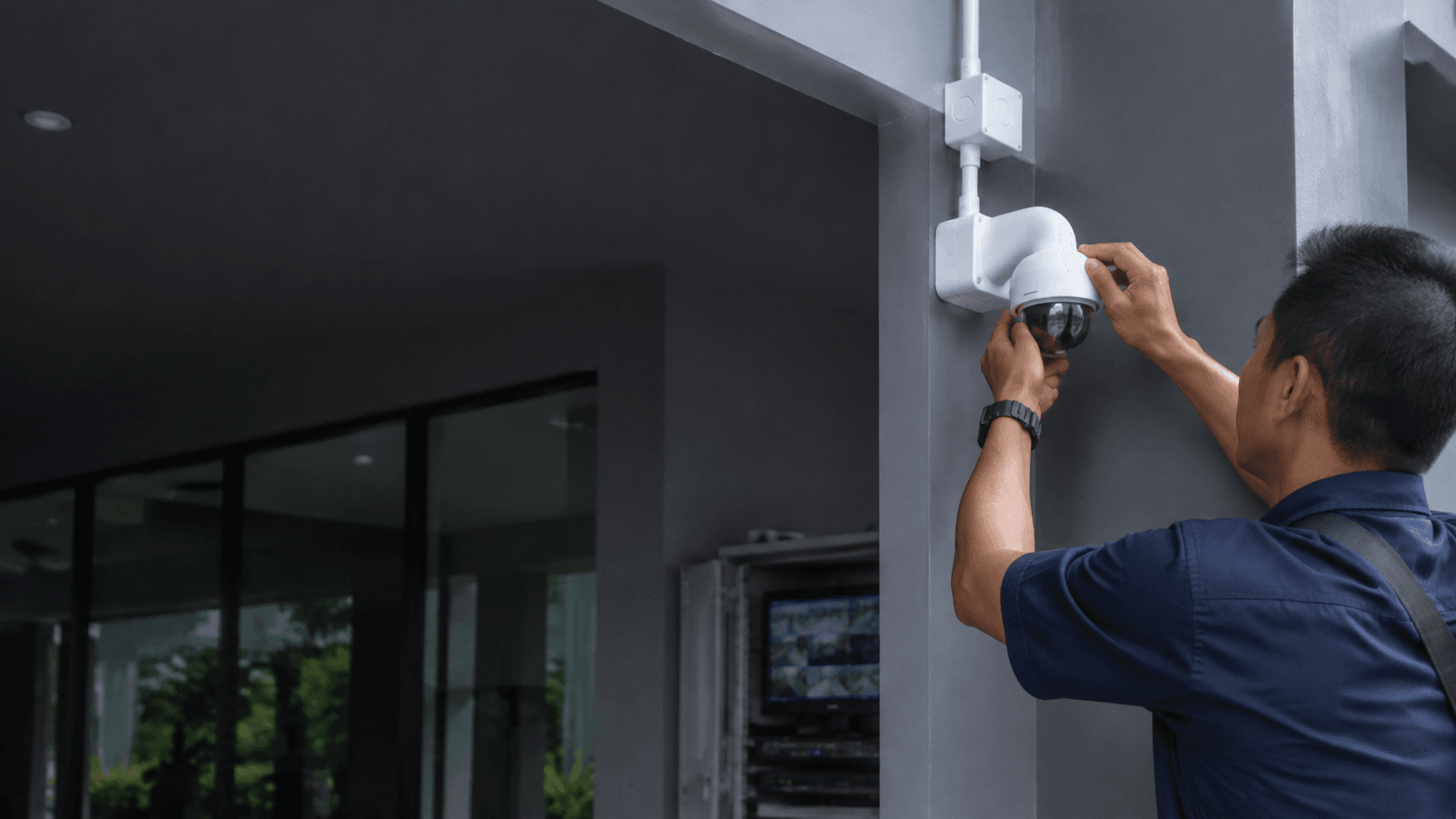
Eyonic's CCTV installation process runs through site survey, system proposal, installation and handover. The survey stage is where camera positions, lighting conditions and cable routes are confirmed, and it is the point at which a budget estimate can be matched to an actual layout.
Making an informed choice about
A useful comparison separates the camera cost from the installed system cost. Two quotations can list similar cameras and still differ substantially once recorder capacity, cabling, power and configuration time are included.
For a small property, the RM 1,599 Hikvision CCTV package is a practical reference point because it bundles camera supply and setup, basic recording configuration and mobile viewing handover. For larger or multi-zone sites, the project ranges recorded by Eyonic give a more realistic expectation of what a full installation involves.
Where the requirement is unclear, the survey stage resolves it. Eric Yong, founder of Eyonic Security Systems, has worked in the industry for more than ten years and is experienced in technical installation of digital security solutions for commercial businesses in Sarawak, which is the context in which camera positions and budgets are usually settled.
Share your location, property type and required system with Eyonic on WhatsApp at +60 11-5111 7959 for the next practical step.