
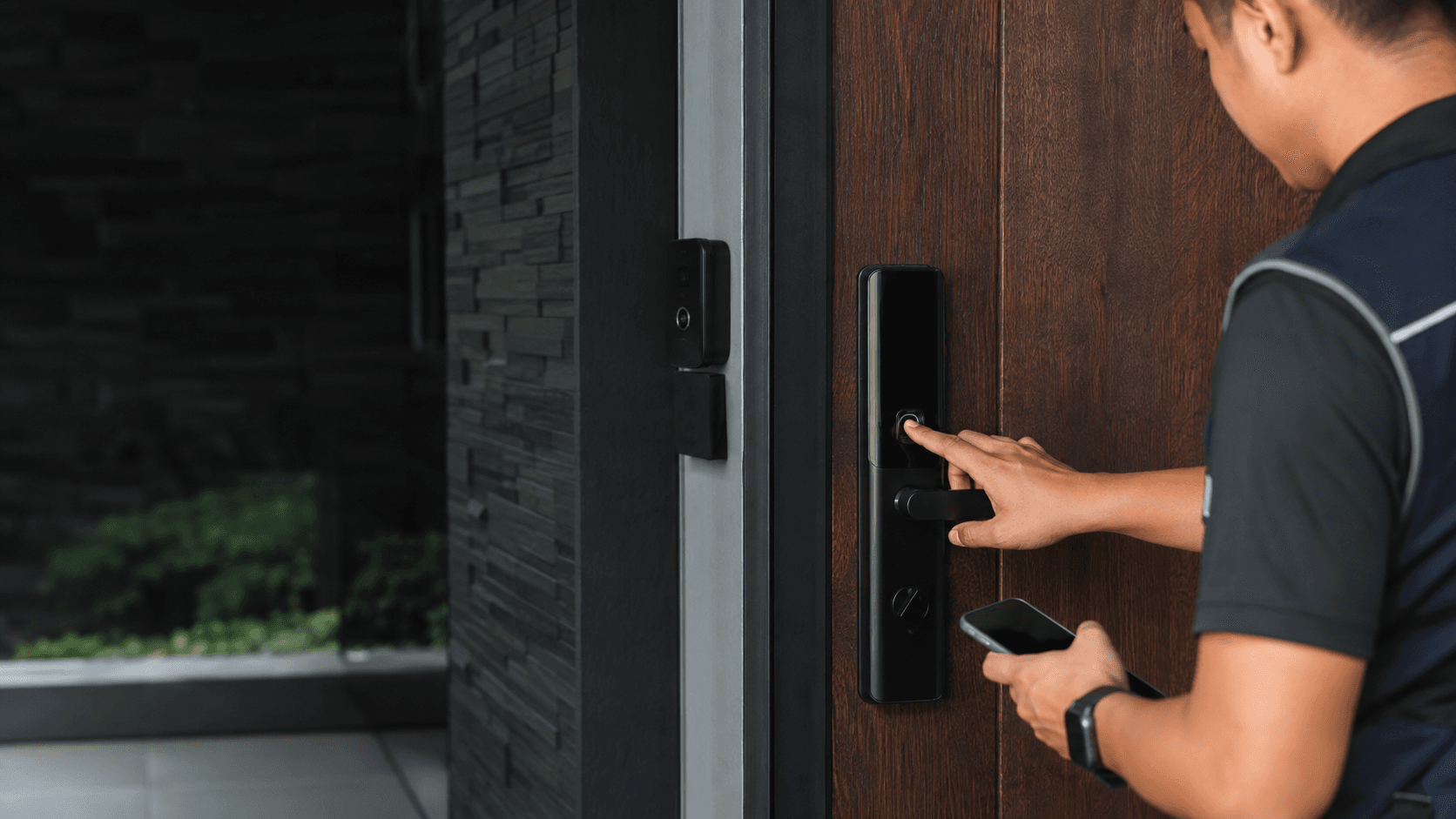
Yale and August sit under one product family, and the locks in that family are sold as keyless entry hardware for doors. Eyonic lists smart lock door access among the access control options it reviews, and the company's own guidance is that smart locks work best when the door condition, user roles and backup method are reviewed before installation.
That guidance matters more than any single feature list. A lock that opens by code, phone or keypad changes who can enter, when they can enter, and what happens when the phone battery dies or the network drops. The sections below cover what the product family is, how keyless entry behaves in daily use, what door conditions decide whether it fits, and how a Sarawak property can plan supply and installation.
Yale August Smart Lock. What It Is and Where It Fits
The Yale August Smart Lock is best understood as a family of keyless door locks rather than one single model. Yale and August products share app-based control, and Eyonic's product review page groups smart lock door access under access control, described as good for controlled convenience when user permissions and backup entry are planned properly.
That description sets the boundary. A smart lock is an access control device for a door, not a full security system. It decides who passes through one opening. It does not record video, it does not raise an alarm on its own, and it does not replace a CCTV or alarm installation.
Where it fits well.
- A home main door where the household wants to stop carrying keys.
- An office entrance where staff and visitors need different levels of access.
- A shop back door or staff entrance that needs a record of who entered.
- A rental unit where codes can be issued and withdrawn between tenants.
Where it fits poorly.
- A gate or outdoor opening exposed to direct rain, unless the specific model is rated for it.
- A door with a damaged frame, a misaligned strike plate or a deadbolt that does not throw cleanly.
- A high-traffic public entrance where dozens of people pass every hour and an access control panel is the more appropriate choice.
Eyonic's review page states that for business use, the company usually checks whether a standalone smart lock or an access-control panel is more appropriate. That check is the difference between a lock that works for years and one that gets bypassed because it slows people down.
Keyless Entry, Codes, and App Control
Keyless entry replaces the physical key with a credential. Depending on the model, that credential is a numeric code entered on a keypad, a phone running the companion app, or a fingerprint on a touch keypad. Competitor product pages describe the same pattern across the range: entry codes, scheduled access, an activity feed, and auto-lock behaviour.
The practical value is not the removal of the key. It is the ability to issue access and withdraw it without changing hardware. A code given to a cleaner can be set to work on Tuesdays only. A code given to a contractor can be deleted the day the work finishes. A code given to a family member can stay active indefinitely.
Three things decide whether that convenience holds up:
- Site survey. Eyonic's installation process begins with a site survey, which is where the door, frame, deadbolt and existing hardware are checked against the lock being proposed.
- System proposal. The survey findings become a proposal covering the lock, the credentials, and how the door is used through the day.
- Installation. The lock is fitted and configured, including code setup and app pairing.
- Handover. Users are shown how to lock, unlock, issue codes and handle a failed credential or a flat battery.
Handover is where most smart lock problems are prevented. If nobody knows how to get in when the app will not connect, the lock becomes a liability rather than a convenience.
Backup entry is not optional
Every keyless lock needs a second way in. That may be a mechanical key override, a keypad that works without the app, or a documented process for a dead battery. Eyonic's stated review criteria for smart locks include the backup method, which is the right place to start the conversation rather than the last item on the list.
For a business, the backup question extends further. If the person who administers the app is unavailable, who can still open the door? If the internet is down, does the lock still accept codes? These are operational questions, not product questions, and they belong in the proposal stage.
Door Condition and Deadbolt Compatibility
Deadbolt compatibility is the single most common reason a smart lock installation does not go ahead as planned. A smart lock replaces or attaches to the existing deadbolt, so the deadbolt has to be in a condition that supports it.
What gets checked before confirming a model:
- Whether the door has an existing deadbolt, and whether that deadbolt throws and retracts smoothly.
- Whether the door thickness and backset match what the lock is designed for.
- Whether the door frame is square and the strike plate aligns without forcing.
- Whether the door is sheltered or exposed to rain and direct sun.
- Whether the door is a single leaf, a double leaf, or part of a metal gate assembly.
A deadbolt that sticks in the dry season and swells in the wet season will cause a motorised lock to report jams or drain its batteries faster. Fixing the door before fitting the lock is cheaper than replacing the lock later.
Malaysian doors add their own variables. Metal doors, fire-rated doors, and doors in multi-tenant buildings may have restrictions on what can be fitted or who is allowed to modify the opening. In a rented unit or a stratified building, the management or landlord may need to approve the change before any hardware is ordered.
What cannot be confirmed without documentation
Exact dimensions, battery life figures, wireless protocol, supported app versions, weather ratings and the full list of compatible deadbolts all depend on the specific model. Those details should come from the manufacturer's documentation for the exact model being quoted, not from a general product family description. A proposal that names the model and cites its documentation is more useful than one that describes the range.
Yale August Smart Lock Planning for Homes and Businesses
Planning a Yale August Smart Lock installation starts with the user list, not the hardware list. The lock has to serve the people who actually use the door, and those people usually fall into distinct groups.
For a home, the groups are household members, regular visitors such as a cleaner or gardener, and occasional visitors such as contractors or relatives. Each group needs a different level of access and a different way to withdraw it.
For a business, the groups are staff, management, visitors and after-hours contractors. The access pattern is more complex, and the consequences of a lost credential are higher. This is where Eyonic's review guidance is most relevant: for business use, the company usually checks whether a standalone smart lock or an access-control panel is more appropriate.
A standalone smart lock suits a small office with one controlled entrance and a handful of staff. An access-control panel suits a site with multiple doors, a reception desk, or a requirement to integrate with existing systems. Choosing the wrong one means either paying for capacity that is never used or outgrowing the lock within a year.
Eyonic's completed work in Sarawak shows the kind of planning involved. The Kuching Immigration Office project focused on arrival flow, staff areas, visitor movement and dependable daily operation. The KTA Sarawak Sdn Bhd project supported staff movement, visitor handling, tidy cabling and clearer daily site control. Both are examples of access and movement being planned around how a site actually operates, which is the same thinking that applies to a single smart lock on a single door.
Multi tenant and shared buildings
Shared buildings add constraints. A lock on a unit door is usually the tenant's responsibility, but a lock on a common entrance is not. Where a building already has an access control system, adding a standalone smart lock to one door can create two separate access records that nobody reconciles. In that situation, the better answer is often to extend the existing system rather than bolt on an independent lock.
Installation Handover and Daily Use
Installation is a short job when the door is ready and a longer job when it is not. The work itself involves fitting the lock to the existing deadbolt position, aligning the strike, pairing the lock to the app, setting up codes and permissions, and testing lock and unlock cycles with the door closed.
Daily use settles into a small number of actions: unlocking on arrival, locking on departure, issuing a code when someone new needs access, and removing that code when they no longer do. The activity feed records what happened, which is useful for a business and reassuring for a home.
Two failure modes are worth planning for. The first is a flat battery, which is why the backup entry method matters. The second is a lost or shared credential, which is why codes should be individual rather than shared. A single code used by five people cannot be withdrawn without disrupting all five.
Eyonic's approach to placement decisions elsewhere in its work is to check actual conditions before confirming a position. The same principle applies here. the door should be checked in person, in its real condition, before a model is confirmed.
Cost Support and Next Practical Step
Eyonic publishes package pricing for its core installation work. The Hikvision CCTV Package, the Hikvision Alarm System and the Autogate Package are each listed at RM 1,599, covering supply, setup and handover for those systems. Smart lock supply and installation is quoted separately because the scope depends on the door, the model and the number of users.
For larger access and security work, Eyonic's published project budgets give a sense of scale. The Kuching Immigration Office project carried an approximate budget of RM 12,000 to RM 28,000, and the KTA Sarawak Sdn Bhd project carried an approximate budget of RM 8,000 to RM 18,000. Those figures cover broader site work, not a single lock, and they are useful mainly for understanding how access and security projects are scoped.
Before committing to a model, three things should be settled:
- The door. Its type, thickness, existing deadbolt and exposure to weather.
- The users. Who needs access, how often, and how access is withdrawn.
- The backup. What happens when the battery is flat, the phone is lost or the network is down.
Eyonic Sdn Bhd is a security system supplier in Sarawak working across CCTV, alarm, autogate, intercom and access control, with planning, supply and installation for homes, offices, shops and industrial sites. Eric Yong, the founder, has been in the industry for more than 10 years and works on technical installation of digital security solutions for commercial businesses in Sarawak.
Share your location, property type and required system with Eyonic on WhatsApp at +60 11-5111 7959 for the next practical step.