
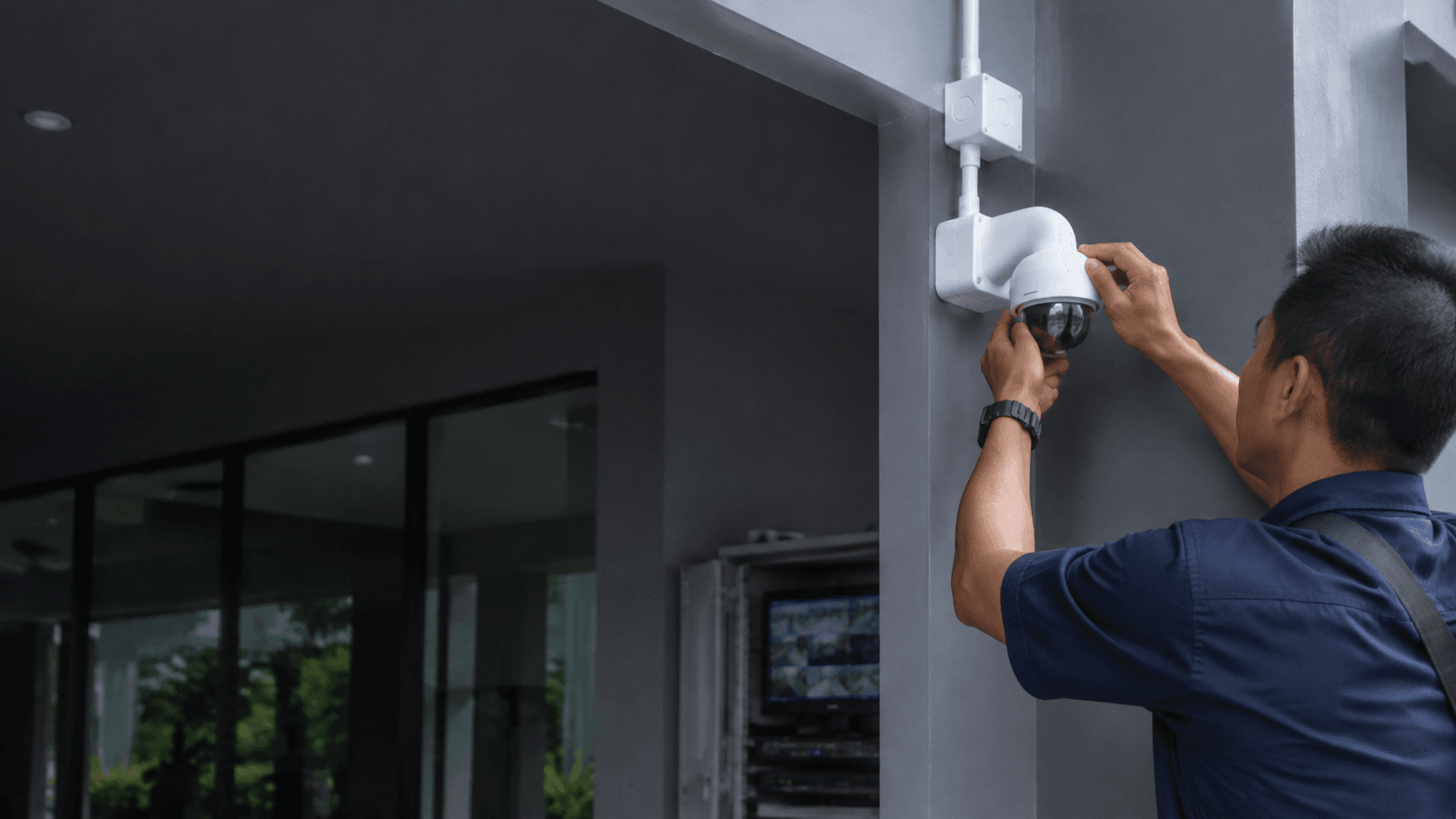
The exact-match query "wireless surveillance system" covers two different purchases that share one label. One is a camera kit that streams over Wi-Fi to a network video recorder. The other is a broader wireless security system where sensors, alarms and cameras report over radio or Wi-Fi to a hub. Both remove long cable runs. Neither removes the need for power at each device unless the camera runs on battery or solar.
- Confirm what the site must cover: entry points, arrival flow, staff areas, visitor movement or a mix.
- Check power and network conditions at each proposed camera position before committing to placement.
- Decide between a Wi-Fi camera kit with a recorder and a hub-based wireless security system.
- Agree on storage, retention and who reviews footage, then confirm the installation scope.
- Complete a site survey, installation and handover with mobile viewing tested on the owner's devices.
Wireless Surveillance System. What Matters Before You Choose
The first decision is not brand or resolution. It is whether the site can support wireless transmission at the points that actually need coverage. A camera position with a weak signal produces gaps in recording regardless of how good the camera is.
Eyonic's CCTV installation process runs through site survey, system proposal, installation and handover, which places the survey before any equipment commitment. That order matters for wireless work because signal strength, obstruction and interference are site-specific.
Lighting is the second constraint. Eyonic advises checking actual lighting conditions before confirming placement for ColorVu-style cameras, because low-light performance depends on what light is genuinely present at night rather than what the specification sheet suggests.
Choosing the Right Wireless Surveillance System
Wireless equipment splits into three practical categories, and the right one depends on whether the site has power at each camera position and whether footage must be retained locally.
| Type | Power | Best fit | Main trade-off |
|---|---|---|---|
| Wi-Fi camera kit with NVR | Mains at each camera | Shops, offices and homes with accessible power points and a central recording point | Depends on stable Wi-Fi between camera and recorder |
| Battery or solar camera | Battery or solar | Positions where running power is impractical | Charging cycles and reduced continuous recording |
| Hub-based wireless security system | Mains or battery | Sites wanting intrusion alerts alongside cameras | Camera coverage is usually secondary to sensor coverage |
A wireless surveillance system with mains-powered cameras and a recorder suits sites that need continuous recording and local storage. Battery and solar models suit positions where cabling power is genuinely difficult, but they trade continuous recording for placement freedom.
What Is a Wireless Surveillance System?
A wireless surveillance system is a camera setup where video travels to a recorder, hub or cloud service without a dedicated video cable run from each camera. Power still reaches most cameras by cable, so "wireless" describes the video path rather than the whole installation.
This distinction explains most mismatches between expectation and result. A buyer expecting no cabling at all may still need power at each camera, while a buyer expecting wired reliability may find that a well-planned Wi-Fi link performs consistently once signal is verified on site.
How Wireless Transmission Actually Works
Each camera encodes video and sends it over Wi-Fi or a proprietary radio link to a receiver. The receiver writes to a hard drive, memory card or cloud account. Signal quality at the camera position, not the recorder, determines whether that stream stays intact.
Interference from neighbouring networks, thick walls and metal structures all reduce usable range. This is why placement is confirmed on site rather than from a floor plan alone.
Practical Considerations for Wireless Surveillance System Projects
Storage and retention shape both cost and usefulness. Local recording on a recorder or memory card avoids recurring subscription fees, while cloud storage adds remote access convenience at an ongoing cost. The choice should follow how long footage must be kept and who needs to review it.
Remote viewing is the feature most often tested last and relied on most. Handover should include mobile viewing set up and confirmed on the devices the owner actually uses, not only on an installer's phone.
For sites with public footfall, coverage priorities differ from a home. Eyonic's project for the Kuching Immigration Office focused on arrival flow, staff areas, visitor movement and dependable daily operation, which shows how a public-facing site distributes coverage across movement routes rather than concentrating on a single entrance.
For commercial offices, a comparable project for KTA Sarawak Sdn Bhd supported staff movement, visitor handling, tidy cabling and clearer daily site control. Cabling tidiness matters more in wireless work than it first appears, because cameras still need power and a neat power route protects both the installation and the building finish.
Where Wireless Fits and Where It Does Not
Wireless fits rented premises, finished interiors, heritage buildings and sites where running video cable would be disruptive or expensive. It also fits staged rollouts where coverage is added over time.
Wireless is a weaker fit where continuous high-resolution recording across many cameras must be guaranteed, where the wireless spectrum is already congested, or where no reliable power exists at the required positions. In those cases a wired backbone with wireless only at the difficult points is usually the more dependable design.
Making an Informed Choice About Coverage
Budget expectations vary widely with scope. Eyonic's published package pricing starts at RM 1,599 for a Hikvision CCTV package covering camera supply and setup, basic recording configuration and mobile viewing handover. Comparable packages for an alarm system and an autogate setup are also listed at RM 1,599 each.
Larger commercial work scales well beyond that. Eyonic's Kuching Immigration Office project carried an approximate budget of RM 12,000 to RM 28,000, and the KTA Sarawak Sdn Bhd office project an approximate budget of RM 8,000 to RM 18,000. Those ranges reflect scope, camera count and site conditions rather than equipment alone.
Eric Yong, founder of Eyonic Security Systems, has worked in the industry for more than 10 years and is experienced in technical installation of digital security solutions for commercial businesses in Sarawak. That background is relevant to wireless work mainly at the survey stage, where signal and lighting conditions decide whether a design will hold up in daily use.
Share the location, property type and required system with Eyonic on WhatsApp at +60 11-5111 7959 to move from comparison to a site-specific assessment.