
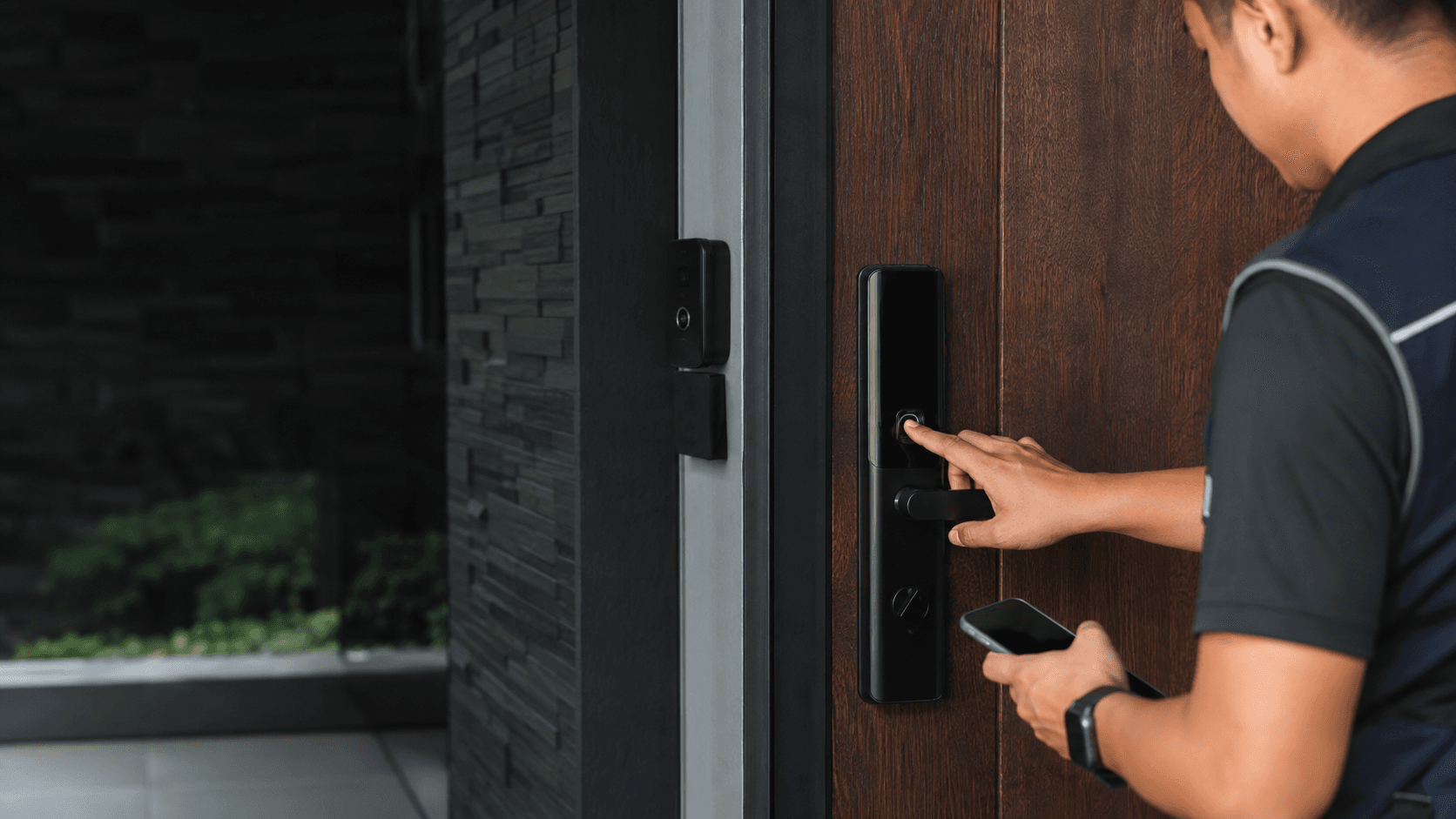
The term covers electronic deadbolts and lever locks that open when a correct code is entered on a keypad or touchscreen. The lock body still sits in the same door preparation as a conventional lock, so the change is mostly in how entry is granted and withdrawn rather than in how the door is built.
Eyonic Sdn Bhd plans, supplies and installs security and ELV systems in Sarawak, and its product reviews list Smart Lock Door Access as suitable for controlled convenience when user permissions and backup entry are planned properly. That framing matters because a smartcode door lock is an access decision, not just a hardware purchase.
What a Smartcode Door Lock Changes at the Door
A smartcode door lock changes who can open a door and how that permission is removed. With a mechanical key, every copy of the key is a permanent credential that cannot be cancelled without re-keying the cylinder. With a keypad, each person can hold a separate code, and removing one code does not disturb anyone else's entry.
That difference shows up in daily routines. A household can give a cleaner or a relative a code for a set period and delete it afterwards. An office can issue codes to staff and keep a separate arrangement for visitors, so the front door does not need to be propped open during busy periods.
The lock itself is usually a standalone device. It reads the code, drives the bolt or latch, and runs on its own power source. Nothing about that requires a network connection, which is why keypad entry works during an internet outage. Where a site needs central records, time-based rules or integration with other systems, the same door may be better served by an access control panel instead.
Eyonic's work at the Kuching Immigration Office focused on arrival flow, staff areas, visitor movement and dependable daily operation. Those are the same questions a smartcode door lock raises at a smaller scale: who arrives, which door they use, and whether the arrangement still works on an ordinary Tuesday.
Smartcode Door Lock Features Buyers Compare
Buyers tend to compare the same handful of characteristics, and most of them are about fit rather than novelty.
Entry method. Keypad and touchscreen models both accept a code. Some locks also accept a mechanical key as a fallback, which is the difference between a lock that can be opened when the electronics fail and one that cannot.
User codes. The number of separate codes a lock supports determines whether it suits a family, a small office or a building with rotating staff. A lock with a small code capacity forces shared codes, and a shared code cannot be withdrawn from one person without affecting everyone who uses it.
User roles. Some locks separate a programming code from everyday user codes. That separation lets an owner add or delete entry codes without handing over the ability to change lock settings.
Door condition. The existing door and frame decide whether a lock can be fitted at all. Door thickness, the backset distance from the door edge to the bore hole, the cross-bore diameter, and whether the frame has a suitable strike all affect the outcome. A door that has swollen, dropped or been repaired around the lock area may need work before any electronic lock fits properly.
Standalone or panel-based. A standalone smart lock suits a single door with a modest number of users. An access control panel suits a site that needs multiple doors, scheduled access, or a record of who entered and when. Eyonic checks which of the two is more appropriate for business use rather than assuming the lock is always the answer.
Backup entry. The fallback method deserves as much attention as the keypad. A mechanical key override, an external power point for a depleted battery, or a second entrance are all ways to avoid being locked out.
Smartcode Door Lock Planning Checklist
Planning before purchase avoids most of the problems that appear after installation. The checks below follow the order Eyonic uses when reviewing smart lock door access.
- Inspect the door and frame. Confirm the door thickness, backset, bore diameter and strike condition, and note any swelling, misalignment or previous repair around the lock area.
- List the people who need entry and what each of them should be able to do. Separate everyday users from anyone who needs to change settings or issue codes.
- Decide the backup method before installation. Confirm whether a mechanical key override is available, where the key will be kept, and how the lock behaves when its battery is depleted.
- Choose between a standalone smart lock and an access control panel. A single door with a small user group points to a standalone lock; multiple doors, scheduled access or entry records point to a panel.
- Confirm the installation scope in writing, including who supplies the lock, who fits it, and what happens if the existing door preparation does not match the new hardware.
The same sequence applies to a home, a shop or an office. The answers change, but the order does not, because a lock chosen before the door is measured may not fit, and a code plan written after installation usually ends up with shared codes.
Smartcode Door Lock Limits and Backup Entry
A smartcode door lock has real limits, and knowing them in advance is what keeps the arrangement dependable.
The most common failure is a depleted battery. When the lock loses power, the keypad stops responding, and entry depends entirely on whatever fallback was planned. If no mechanical key override exists and no external power point is available, the door may need to be opened by other means.
Forgotten or mistyped codes are the second common issue. A lock with a small number of user codes encourages sharing, and a shared code cannot be traced to one person or withdrawn cleanly. Where accountability matters, a panel-based system with individual credentials is the more suitable choice.
Door hardware is the third constraint. Some doors cannot accept an electronic lock without modification, and some frames will not hold a strike plate securely enough for repeated daily use. In those cases the honest answer is that the door needs attention first.
When something goes wrong, the response depends on which of these three situations applies.
- If the battery is depleted, use the planned backup method, then replace the battery and re-check the code settings afterwards.
- If a code is forgotten or needs to be withdrawn, use the programming code to delete or replace that individual code rather than changing every user's entry.
- If the door hardware is unsuitable, stop and have the door or frame assessed before fitting an electronic lock, because forcing hardware onto a poor door preparation shortens the life of the lock and the door.
Eyonic's product review guidance notes that smart locks work best when door condition, user roles and backup method are reviewed before installation. That order also makes troubleshooting simpler, because each failure has a known answer rather than an improvised one.
Smartcode Door Lock Next Step in Sarawak
For properties in Sarawak, the practical next step is a site review rather than a product selection. Eyonic's installation process runs through site survey, system proposal, installation and handover, and the same sequence applies to door access work.
A survey establishes the door measurements, the number of users, the backup arrangement and whether a standalone lock or an access control panel fits the site. It also separates a single-door requirement from a wider security plan, since door access often sits alongside CCTV, alarm and intercom systems on the same property.
Eyonic's published packages for CCTV, alarm and autogate systems are each priced at RM 1,599, covering supply, setup and handover for those systems. Door access is quoted separately because the scope depends on the door and the number of users, and no verified price for smartcode door lock supply or installation in Malaysia is available to publish here.
Eric Yong, founder of Eyonic Security Systems, has worked in the industry for more than 10 years and is experienced in technical installation of digital security solutions for commercial businesses in Sarawak. That experience is most useful at the survey stage, when the door condition and user roles are still open questions.
Share the location, property type and required system with Eyonic on WhatsApp at +60 11-5111 7959 for the next practical step.