
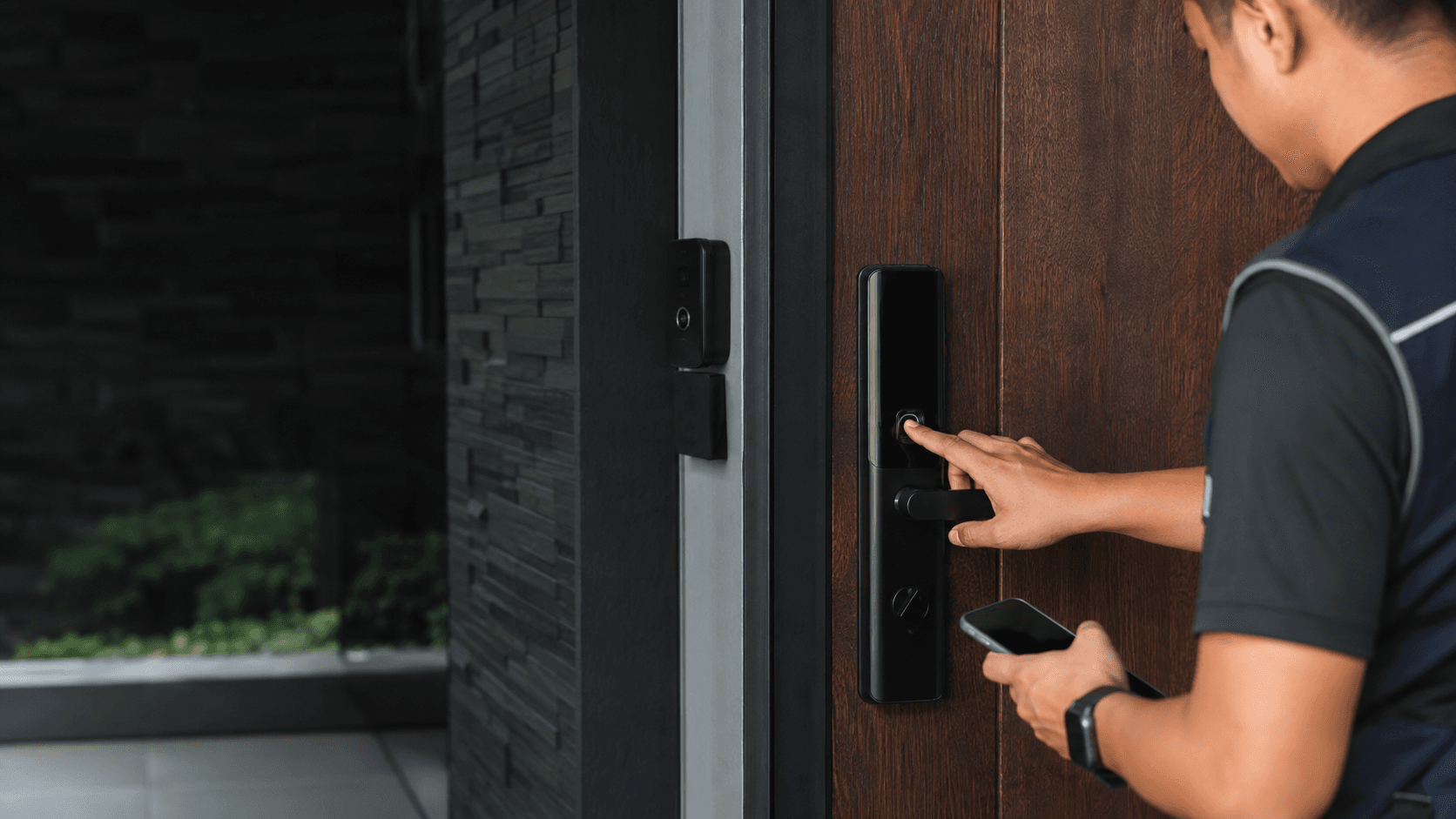
The feature exists so a door does not stay unlocked after someone walks away. On most Kwikset electronic locks the setting is off by default, and it is switched on or off through the lock's own keypad or interior programming buttons rather than through a physical switch. Kwikset also documents app-based control for locks that pair with the Kwikset App, and IFTTT applets for scheduled locking on supported smart locks.
Kwikset Auto Lock. What Matters Before Choosing
Three things decide whether the feature is useful in a given doorway: which lock model is fitted, how the setting is reached on that model, and how long the delay is before the bolt throws. Kwikset publishes separate support answers for each of these, which is a signal that the sequence is not identical across the range.
Auto-lock is a convenience and a risk control at the same time. It removes the human step of pressing the lock button, but it also means the bolt can extend while the door is still open or while someone is still moving through it. On a door that is propped open for deliveries or airflow, an auto-lock that fires on a timer will simply fail to seat, and the lock will report or behave as though it did not complete.
What is kwikset auto lock?
Kwikset Auto Lock is the automatic re-locking behaviour built into Kwikset electronic locks. After the door is unlocked and the delay period passes, the lock motor extends the bolt without anyone pressing the lock button. Kwikset describes the feature on the Aura Deadbolt, the Powerbolt 2, the SmartCode 888, and the 264 Deadbolt, and the company treats it as a lock setting rather than a separate product.
The default state matters. Kwikset documents Auto-Lock as off by default on the SmartCode 888, so a newly installed lock will not re-lock itself until the setting is changed. That default is deliberate. it lets the installer and the owner confirm the door closes cleanly before the bolt starts moving on its own.
How the setting is reached on different models
Kwikset splits the instructions by model because the entry point differs. The Powerbolt 2 and the 264 Deadbolt use keypad and programming-code sequences. The SmartCode 888 uses the program button and the lock button, with indicator lights confirming the change. The Aura Deadbolt and app-connected locks can be adjusted through the Kwikset App. IFTTT applets cover scheduled locking on supported smart locks.
That spread is the practical reason a single universal instruction does not exist. A homeowner reading a generic guide can follow a sequence that belongs to a different lock and conclude the feature is broken, when the real issue is that the button layout or the programming code entry is different.
Choosing the Right Kwikset Auto Lock
Model choice should follow the door and the people using it, not the feature list. A deadbolt on a main entrance, a keypad lock on a staff door, and an app-connected lock on a rental unit all place different demands on auto-lock.
- Confirm the door closes and latches under its own weight before enabling any automatic re-locking.
- Identify the exact Kwikset model on the lock body or in the installation paperwork.
- Find the model-specific Auto-Lock instructions rather than a general guide.
- Decide whether the lock will be programmed at the keypad, through the interior buttons, or in the Kwikset App.
- Set the delay long enough for normal entry and exit, then test it with the door both closed and held open.
- Record the programming code and the chosen setting so a later change does not require starting over.
Step five is where most dissatisfaction originates. A delay that feels generous on a quiet afternoon feels short when arms are full, and a delay that is too long removes most of the security benefit. The setting is a compromise, and it is worth revisiting after a week of real use rather than leaving it at whatever was entered during installation.
Smart Locks | Kwikset
Kwikset's smart lock range is the wider category that Auto-Lock sits inside. These locks allow remote locking and unlocking from a phone, and they are sold as residential door hardware rather than as commercial access control. The distinction matters when a property has staff, tenants, or shared entrances, because residential smart locks are designed around a household rather than around a managed user list.
For a business entrance, the more useful question is whether a standalone smart lock is the right device at all, or whether an access-control panel with managed permissions fits better. A standalone lock with auto-lock enabled gives consistent re-locking but limited visibility over who entered and when. A managed system costs more and needs more planning, and it answers questions a standalone lock cannot.
Practical Considerations for Kwikset Auto Lock
Auto-lock interacts with battery life, door alignment, and the way a household actually moves. None of these are exotic, but each one changes whether the feature helps or annoys.
Battery draw rises when the motor runs more often. A lock that re-locks itself several times a day will consume more than one that is locked manually, and a low battery on an auto-locking door is a different problem from a low battery on a manual one, because the door may be left unsecured without anyone noticing. Kwikset's own support material treats battery readiness as part of the setup check, which is consistent with that risk.
Door alignment is the second constraint. A bolt that meets resistance will not seat reliably, and an automatic lock gives no feedback that a person would notice the way a stiff manual turn would. Seasonal movement in a wooden frame is enough to change this, so a setting that worked in one month can stop working in another.
The third constraint is household pattern. Auto-lock suits a door that is normally closed and normally locked. It suits poorly a door that is left open for pets, deliveries, or ventilation, because the lock will attempt to secure a door that is not in a position to be secured.
Where auto lock fits and where it does not
Auto-lock fits a main entrance that is closed most of the day, a secondary door that is easy to forget, and any door where the person leaving is carrying something. It fits less well on a gate, a door that is routinely propped, or an entrance where a queue of people passes through continuously.
For properties in Sarawak with a mix of entrances, the sensible approach is to treat the door lock as one layer and the wider system as another. Eyonic Sdn Bhd plans, supplies, and installs CCTV and ELV systems for homes, offices, shops, and industrial sites, and the company's project work has included the Kuching Immigration Office, where arrival flow, staff areas, and visitor movement shaped the design. A door that re-locks itself and a camera that records who approached answer different questions, and both are more useful when the entry sequence is understood first.
Making an Informed Choice About
The decision comes down to whether automatic re-locking removes a real failure in daily use. If a door is regularly left unlocked by accident, the feature addresses that directly. If the door is already locked reliably, the feature adds battery draw and a new failure mode without solving anything.
Two checks settle most of the uncertainty. First, confirm the exact model and read the instructions written for it, because the programming sequence is model-specific. Second, test the delay with the door in the condition it is normally in, not in a best-case state. A setting that passes both checks is likely to stay useful.
Where the door is part of a larger entry, the lock decision is worth making alongside the rest of the setup rather than after it. Eyonic's installation process runs through site survey, system proposal, installation, and handover, which is the same order that suits a door lock: understand the doorway, choose the device, fit it, then confirm the behaviour with the people who use it.
For readers comparing options in Malaysia, the practical next step is to share the location, property type, and required system with Eyonic on WhatsApp at +60 11-5111 7959.