
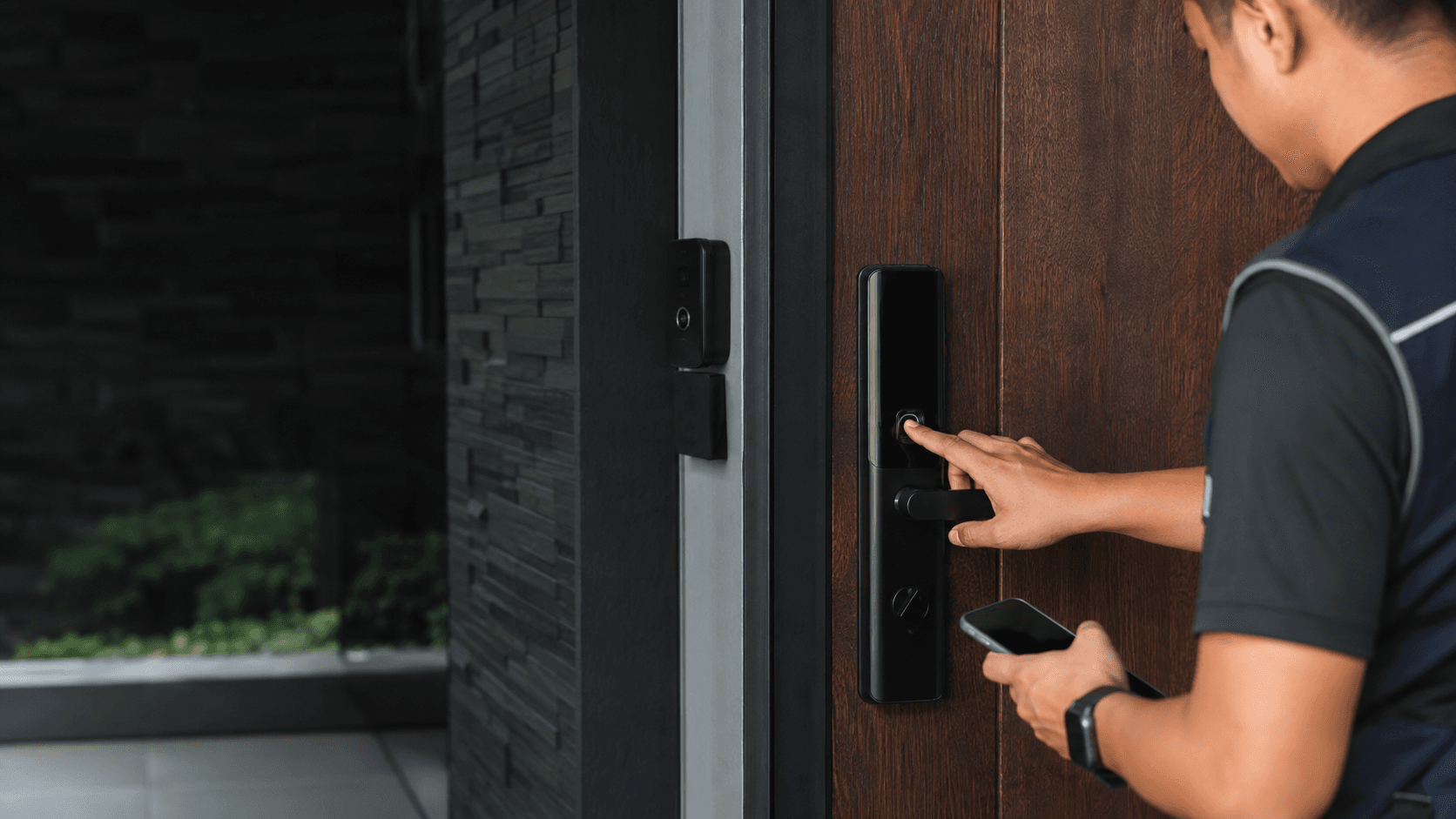
The exact-match query "z wave door knob" describes a narrow slice of the smart lock market. Most Z-Wave hardware sold today is a deadbolt, a single-cylinder lock that replaces only the top lock on a door. A knob or lever lock replaces the lower handle assembly, and far fewer of those ship with Z-Wave radios inside. That gap between what buyers search for and what retailers stock explains why the query keeps surfacing in forums rather than product pages.
Z-Wave is a wireless protocol that lets a lock talk to a hub instead of a phone directly. The lock joins a mesh network, the hub issues commands, and the lock reports state back. That architecture matters because it determines which hubs work, how far the signal reaches, and whether the lock keeps functioning when the internet drops.
Z Wave Door Knob. What Matters Before Choosing
Three constraints decide most purchases: lock format, hub compatibility, and whether the door already has a deadbolt above the handle.
- Confirm the door's existing hardware. A knob or lever lock replaces the handle; a deadbolt replaces the upper lock. Some doors have both, and replacing only one leaves the other manual.
- Check the hub's device list before buying. Z-Wave locks pair through a controller, and a lock absent from that list will not appear in automations.
- Verify the backset and bore hole. Residential doors commonly use a 60 mm or 70 mm backset, and a mismatched lock will not seat in the existing hole.
- Decide on backup entry. Keypad codes, a physical key, or a mobile app each fail differently during a power or network outage.
- Plan user permissions if the door serves staff, tenants, or visitors. Standalone locks and access-control panels handle multiple users very differently.
Eyonic's own review of smart lock door access notes that smart locks work best when door condition, user roles, and backup method are reviewed before installation, and that for business use the choice between a standalone smart lock and an access-control panel deserves a deliberate check. That guidance applies directly to the Z Wave Door Knob question, because a knob-style lock on a high-traffic door behaves nothing like the same lock on a bedroom.
What Is a Z Wave Door Knob?
A Z Wave Door Knob is a door handle lock that contains a Z-Wave radio, allowing it to be controlled through a compatible hub rather than only a key or keypad. The category is small. Retail listings for Z-Wave door locks are dominated by deadbolts, and the knob and lever options that exist tend to come from a handful of brands.
The practical distinction is what gets replaced. A deadbolt swap leaves the existing handle in place, so the door keeps its original knob and the new lock adds smart control at the top. A knob or lever swap replaces the handle itself, which changes the door's appearance and its mechanical feel. Buyers who want the whole door to look consistent often prefer the second approach, but the product pool is thinner.
Z-Wave itself is not the only option in that format. Forum threads on Home Assistant and SmartThings show users weighing Z-Wave against Zigbee, Wi-Fi, and Tuya-based locks when hunting for a lever or knob model, and several participants note that the well-known Z-Wave brands are exactly the ones they were trying to avoid. That is a useful signal. the Z Wave Door Knob category is defined as much by what is missing as by what is available.
Choosing the Right Z Wave Door Knob
Brand concentration is the first thing to understand. Schlage, Kwikset, and Yale appear repeatedly across retail listings and community discussions as the names buyers already know, and a Home Assistant thread explicitly frames its request as looking for a lever or knob lock "other than Schlage, Kwikset, and Yale." That phrasing tells the reader something concrete: the mainstream Z-Wave lock brands are well covered, and the alternatives are where the research effort goes.
Yale's own Z-Wave collection page lists compatibility with Ring Alarm, Samsung SmartThings, and Wink, and describes control through a smart home app or keypad. Schlage's Connect page positions its Z-Wave deadbolt as controllable from anywhere through a Z-Wave smart home system. Both are deadbolt-first product lines, which is the recurring pattern.
For lever and knob formats specifically, the SmartThings community thread surfaces the Kwikset SmartCode 912 Electronic Tustin Lever with Z-Wave Technology as a named example. That is one of the few concrete lever-format Z-Wave products visible in the competitor set, and it illustrates the general shape of the market: a small number of named models rather than a broad catalog.
Hub compatibility and protocol trade-offs
A Z-Wave lock only becomes smart once it joins a controller. The lock pairs to a hub, the hub exposes it to automations, and the user's phone talks to the hub. If the hub is not present or the lock is not on its supported device list, the lock still works as a keypad or keyed lock but delivers none of the automation value.
Zigbee and Wi-Fi locks solve the same problem through different radios. Wi-Fi locks connect directly to a home network without a hub, which simplifies setup but puts the lock on the same network as everything else. Zigbee locks need a hub like Z-Wave does, and the two mesh protocols are not interchangeable. A household already running a Z-Wave network has a reason to stay with Z-Wave; a household starting fresh has more freedom.
Matter has entered the conversation as well. Yale's lineup includes a Matter-capable smart lock, and community threads reference Matter support when discussing which locks will remain useful. Matter does not replace Z-Wave, but it changes how buyers think about future compatibility.
Security and mechanical limits
Community discussion raises lock bumping as a concern, with one participant asking whether Kwikset locks remain vulnerable to bump keys even after upgrading to smart hardware. The honest answer is that electronic control and mechanical security are separate layers. A Z-Wave radio adds convenience and audit capability; it does not change the cylinder's resistance to physical attack.
That distinction matters for anyone choosing a Z Wave Door Knob for a door that protects something valuable. The smart layer handles who entered and when. The mechanical layer handles whether the door can be forced. Both deserve attention, and neither substitutes for the other.
Practical Considerations for Z Wave Door Knob Installations
Installation follows the same broad sequence as other electronic access work. Eyonic's CCTV installation process runs through site survey, system proposal, installation, and handover, and the same logic applies to door hardware: the survey step is where door condition, existing bore holes, and user roles get settled before anything is ordered.
Door condition is the most common surprise. Older doors may have non-standard backsets, worn strike plates, or frames that have shifted enough to bind a heavier lever assembly. A lock that fits a showroom door may not fit the door in front of the installer.
Power and network are the second consideration. Battery-powered Z-Wave locks avoid wiring but introduce battery replacement into the maintenance schedule. Mains-powered access control avoids that but requires wiring to the door, which is a different scope of work.
For multi-user doors, the choice between a standalone smart lock and an access-control panel becomes the deciding factor. Eyonic's product review guidance notes that for business use, the appropriate check is whether a standalone smart lock or an access-control panel suits the situation better. A standalone lock handles a household well. A door with rotating staff, tenants, or visitors usually needs the panel.
Where hardware fits
Homes with an existing Z-Wave hub and a door that needs a handle replacement are the clearest fit. The lock joins the existing network, the hub already manages other devices, and the buyer avoids adding a second protocol.
Rental properties with turnover are a reasonable fit when the lock supports temporary codes and the owner can revoke access remotely. The Z-Wave layer makes revocation possible without a site visit.
High-security perimeter doors are a weaker fit for a knob-format lock on its own. A deadbolt carries more of the physical security load, and the knob or lever is better treated as the convenience layer.
Doors without an existing deadbolt are an edge case worth flagging. Replacing only the knob leaves the door secured by a single lock, which is a downgrade from a door that had both a deadbolt and a handle lock.
R/zwave on Reddit. Seeking Good Zwave Door Knob non Deadbolt
A Reddit thread in r/zwave titled "Seeking good zwave door knob (non deadbolt)" captures the exact problem this query describes. The post, attributed to u/maddog1956, drew 6 votes and 7 comments, and the title itself states the constraint: the poster wanted a knob, not a deadbolt. The thread could not be crawled for full analysis due to the site's restrictions, so the visible signal is the title and its framing rather than the discussion inside.
What the title confirms is that the search is real and the supply is thin. A buyer asking specifically for a non-deadbolt Z-Wave lock is asking for a product category that major brands largely do not fill. The Home Assistant thread reaches the same conclusion from a different angle, with users asking for lever or knob locks outside the three dominant brands and accepting Wi-Fi or Tuya alternatives when Z-Wave options run out.
The practical takeaway from both threads is that a Z Wave Door Knob purchase usually involves either accepting a deadbolt, accepting a different protocol, or accepting a less familiar brand. Each trade-off has a different cost.
Making an Informed Choice About Hardware
The decision comes down to which constraint the buyer can live with. Staying with Z-Wave and a known brand usually means a deadbolt rather than a knob. Staying with a knob or lever format usually means a different protocol or a smaller brand. Replacing the whole door assembly is a third path that resolves the format question but changes the project scope.
For properties in Sarawak, the practical next step is a site check before ordering. Eyonic's project work for the Kuching Immigration Office focused on arrival flow, staff areas, visitor movement, and dependable daily operation, and the KTA Sarawak Sdn Bhd project addressed staff movement, visitor handling, and tidy cabling. Both illustrate that door hardware decisions sit inside a larger access pattern rather than standing alone.
Eyonic's founder Eric Yong has worked in technical installation of digital security solutions for commercial businesses in Sarawak for more than 10 years, and the company's smart lock review guidance reflects that installation experience: door condition, user roles, and backup method come before product selection.
Share your location, property type and required system with Eyonic on WhatsApp at +60 11-5111 7959 for the next practical step.