
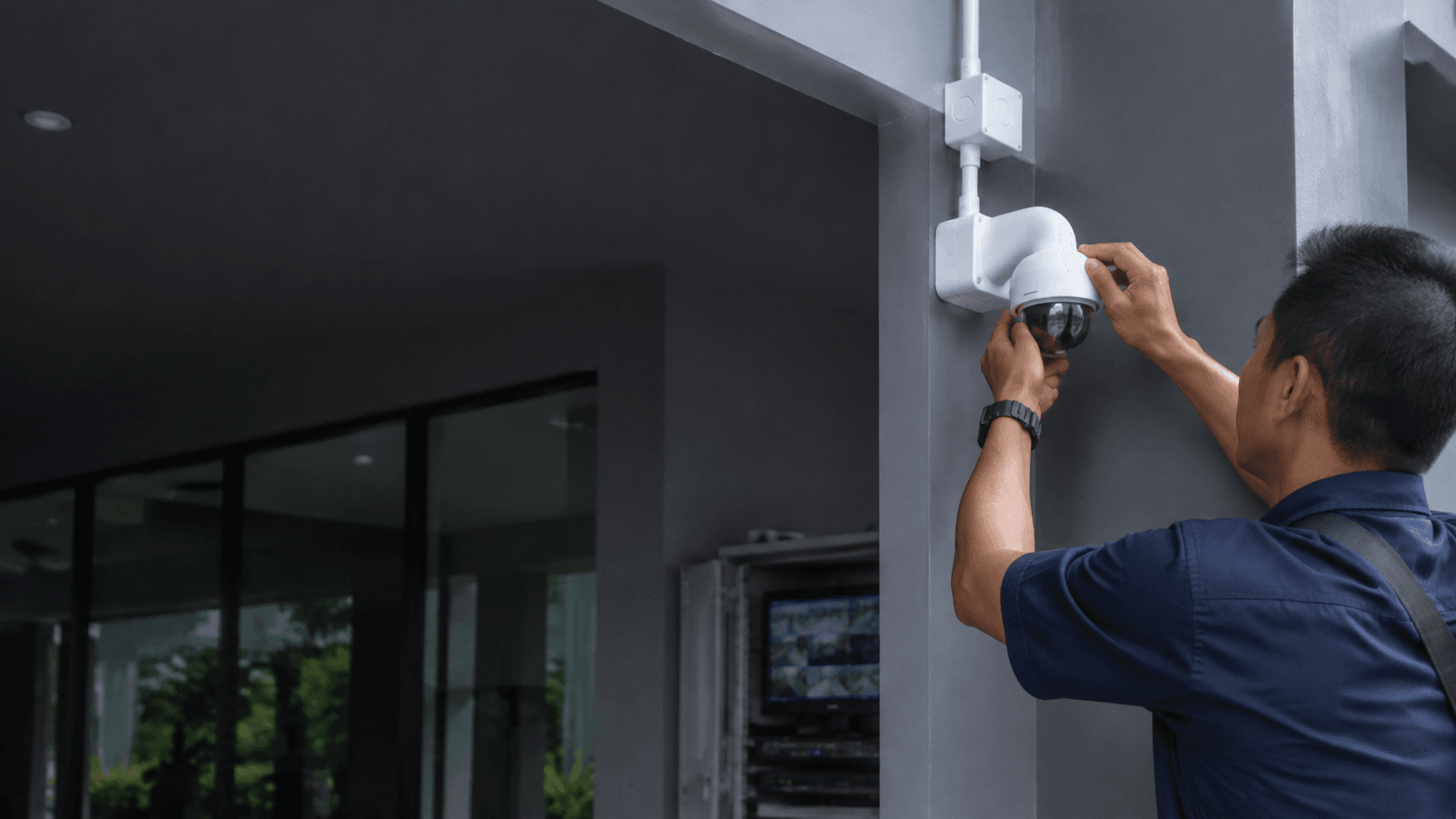
Comcast sells the device under the Xfinity Video Doorbell name, and the support documentation describes a wired installation that reuses an existing chime box and transformer. The camera side of the product is what most buyers are actually shopping for: a front-door view, motion alerts, two-way audio, and recorded clips that appear alongside other Xfinity cameras in one app.
This guide covers what the hardware needs before purchase, how it fits a wider camera setup, where it struggles, and how the same decision plays out for households in Malaysia that cannot subscribe to Xfinity service at all.
Xfinity Doorbell Camera. What Matters Before You Choose
Three constraints decide whether this product is even a candidate: wiring, gateway, and service region. Skip any one of them and the device cannot be activated.
- Confirm an existing wired doorbell with a working chime box and transformer at the door.
- Confirm an Xfinity Internet plan with a compatible Xfinity Gateway in the home.
- Confirm the address sits inside an Xfinity service area, since activation runs through the Xfinity app.
- Check the Xfinity Home Security or Smart Home plan tier, because camera and doorbell limits depend on it.
- Decide between self-installation and professional installation through the partner Xfinity names for the job.
- Review placement before drilling, since the field of view and Wi-Fi signal both change with height and angle.
The wiring requirement is the one that eliminates the most homes. Battery-only doorbells and doors with no chime box fall outside the supported installation path, and the published instructions assume an existing chime circuit that can be isolated at the breaker before work begins.
Choosing the Right Xfinity Doorbell Camera Setup
The device is rarely bought alone. Xfinity documents a limit of up to 6 Xfinity Cameras and Video Doorbells connected through the Xfinity app, which makes the doorbell one slot in a small system rather than a standalone gadget.
That ceiling shapes the plan. A household that wants a front door, a back door, a driveway, and an indoor view is already using four of the six slots. Adding a second doorbell plus two more cameras reaches the cap, and any further coverage has to come from a different platform.
Where the doorbell fits best
The strongest fit is a home that already pays for Xfinity Internet, already uses the Xfinity app for other devices, and has a standard wired doorbell at the front entrance. In that situation the doorbell joins an existing account, shares one notification stream, and avoids a second app.
A weaker fit is a property with no Xfinity service, a rental where wiring cannot be modified, or a door position with no practical route for low-voltage cable. Those cases need a different product category entirely.
Self-installation versus professional installation
Xfinity publishes a self-installation path that covers the chime kit, the mounting bracket, the wiring terminals, and activation through the app. The same documentation points to a third-party installation partner for households that prefer not to work near doorbell wiring.
The trade-off is straightforward. Self-installation costs less and keeps control of placement, but it puts the breaker, the chime terminals, and the bracket alignment in the homeowner's hands. Professional installation removes that risk at a higher upfront cost and depends on scheduling availability.
What Is an Xfinity Doorbell Camera and How Does It Work?
An Xfinity Doorbell Camera is a wired doorbell with a built-in camera that sends live video, motion alerts, and recorded clips to the Xfinity app. Pressing the doorbell button triggers a notification, and two-way audio allows a conversation through the app.
The device depends on the home network rather than a cellular link. Video quality, alert reliability, and live view all degrade when the doorbell sits far from the gateway or behind dense masonry, which is why placement guidance appears repeatedly in Xfinity's own troubleshooting material.
Recording behaviour is tied to the subscription. Xfinity's support pages separate live viewing from 24/7 Video Recording, and the recording option is not available on every plan or every camera generation. Buyers who assume continuous recording is included by default are often surprised at activation.
Common problems and their causes
Xfinity's troubleshooting documentation groups the recurring issues into a few families: device light patterns that indicate setup, connection, or power faults; missing 24/7 recording; no live video; absent or excessive motion alerts; two-way audio failures; and a white ring or glare in the image.
Glare and echo usually trace back to placement and audio settings rather than hardware failure. Too many motion alerts typically come from a field of view that includes a road, a walkway, or moving foliage, and the fix is an area setting rather than a replacement unit.
Video Doorbells and Smart Doorbell Cameras in a Wider Security Plan
A doorbell camera covers one approach. It does not cover a gate, a rear yard, a car porch, or an internal corridor, and it does not record when the network is down.
For properties outside Xfinity's service areas, including Malaysia, the same functional goal is met with locally supplied and installed systems. Eyonic Sdn Bhd, a security system supplier in Sarawak, plans, supplies, and installs CCTV and ELV systems for homes, offices, shops, and industrial sites, with a process built around site survey, system proposal, installation, and handover.
That process matters for door coverage specifically. A site survey establishes where the entrance actually sits relative to light, cable routes, and recorder location, and a proposal fixes camera placement before any drilling happens. Eyonic's completed work includes the Kuching Immigration Office, where the scope centred on arrival flow, staff areas, visitor movement, and dependable daily operation, and the KTA Sarawak Sdn Bhd office project, which covered staff movement, visitor handling, tidy cabling, and clearer daily site control.
Lighting is the other variable that separates a useful entrance camera from a decorative one. Eyonic's product review guidance recommends checking actual lighting conditions before confirming placement for ColorVu-style cameras, because a specification sheet does not describe how a specific porch or corridor behaves after dark.
What a doorbell camera cannot replace
Doorbell cameras are event-driven. They capture a person approaching the door and the conversation that follows. They do not provide continuous perimeter coverage, they do not integrate with an alarm panel by default, and they do not survive a power cut without a backup arrangement.
Households that need gate control, alarm zones, intercom, and camera coverage as one coordinated system are usually better served by a planned installation than by adding a single consumer device to an existing door.
Practical Considerations for Buyers
Cost, contract, and region are the three practical filters. The doorbell itself is one line item, but the Xfinity Internet plan, the gateway, and any Home Security tier are recurring costs that continue for as long as the device is used.
Region is the harder limit. Xfinity service is tied to specific service areas, and activation runs through the Xfinity app against an Xfinity account. A buyer outside those areas cannot complete setup regardless of hardware availability, which is why the product appears on marketplaces as a device without a usable service path for many international addresses.
For Malaysian properties, the realistic comparison is not Xfinity versus another brand of doorbell. It is a subscription-dependent device versus a locally installed system with no ongoing platform fee. Eyonic's published packages sit at RM 1,599 for a Hikvision CCTV package, RM 1,599 for a Hikvision alarm system, and RM 1,599 for an autogate package, each covering supply, configuration, and handover rather than a recurring service charge.
Questions buyers ask before committing
Does the doorbell work without Xfinity Internet? No. Activation and viewing both run through the Xfinity app against an Xfinity account and gateway.
Can it be installed on a door with no existing wiring? The published installation path assumes an existing wired chime and transformer. Doors without that circuit fall outside the supported setup.
How many cameras and doorbells can share one account? Xfinity documents a limit of up to 6 Xfinity Cameras and Video Doorbells connected through the Xfinity app.
Is continuous recording included? Not universally. Xfinity's support material treats 24/7 Video Recording as a separate capability that may not appear on every plan or device.
What happens during a network outage? Live view and alerts depend on the home network, so an outage interrupts both until connectivity returns.
Making an Informed Choice About an
The decision reduces to a single question: does the property already sit inside Xfinity's service area with an active Internet plan and a wired doorbell? If yes, the device integrates cleanly with the Xfinity app and shares a camera limit with the rest of the account. If no, the same front-door coverage has to come from a locally installed system.
For Sarawak properties, that local path starts with a site survey rather than a product choice, because entrance lighting, cable routing, and recorder placement determine which camera actually performs. Eric Yong, founder of Eyonic Security Systems, has worked in technical installation of digital security solutions for commercial businesses in Sarawak for more than 10 years, and the company's project record covers both government and engineering consultancy sites.
Share your location, property type and required system with Eyonic on WhatsApp at +60 11-5111 7959 for the next practical step.