
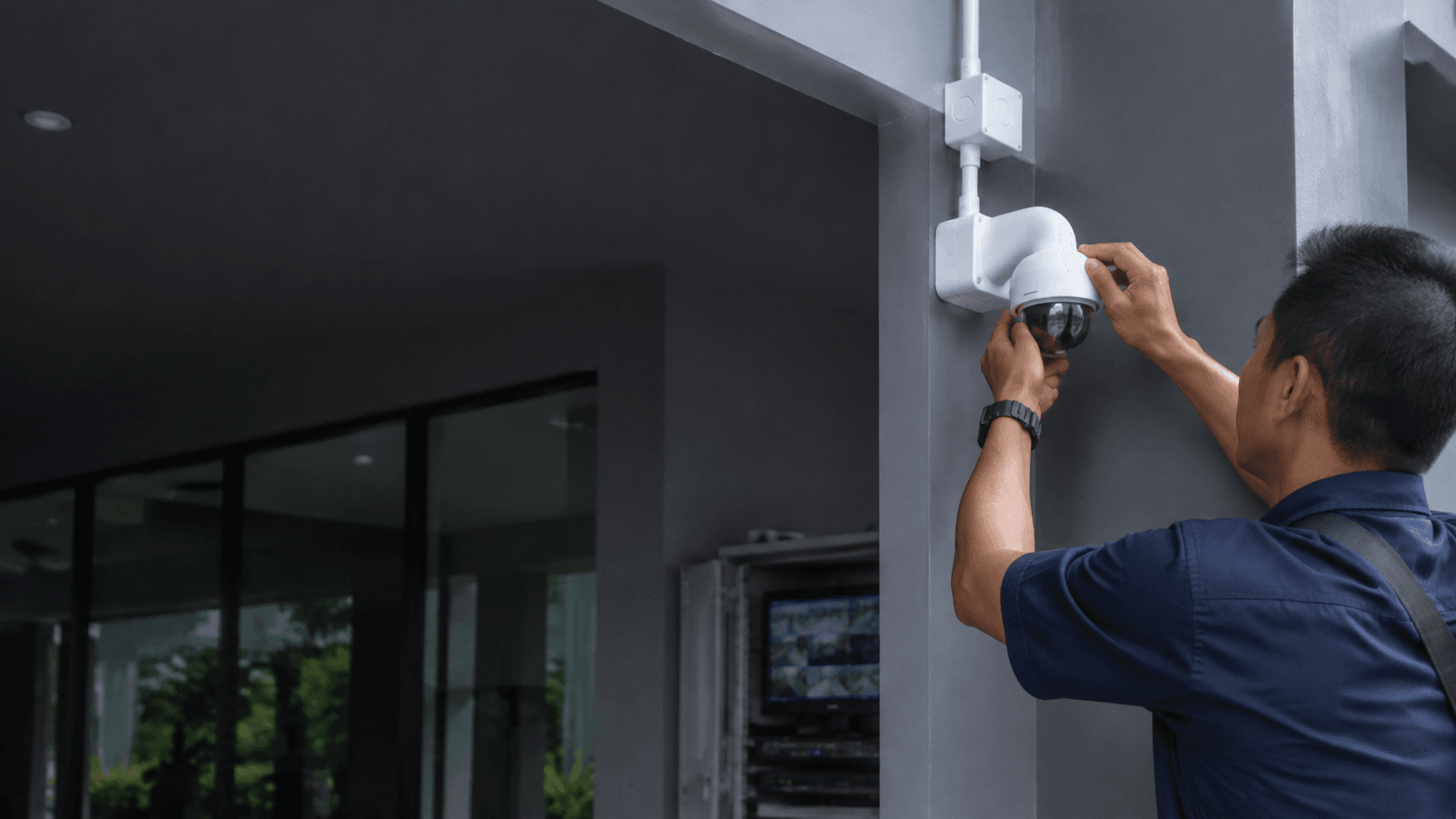
The phrase "camara dahua wifi" is Spanish, and most pages ranking for it are Spanish retail listings or Dahua's own regional catalogue. That leaves a practical gap for readers in Malaysia, where the real questions are about wireless range, power, and who installs the camera. Dahua's MENA catalogue lists a Wireless Series that includes indoor fixed-focal Wi-Fi cameras, pan-tilt Wi-Fi cameras, and a Wi-Fi NVR, so the range is built around plug-and-play wireless surveillance rather than a single model.
What the Dahua wireless range covers
Dahua's Wireless Series is organised by form factor and by how the camera connects. The catalogue groups indoor fixed-focal Wi-Fi cameras, pan-tilt Wi-Fi cameras, and a Wi-Fi NVR, and it also lists 4G cameras and camera accessories in the same wireless family.
That structure matters because "wireless" describes two different things in practice. A Wi-Fi camera still needs power, so the wireless part is the video path back to a recorder or phone rather than the power supply. A 4G camera changes the backhaul again, using a mobile network instead of a local Wi-Fi router.
Dahua's own product pages for this series are the only reliable place to confirm which models are current, what resolution each one records, and which wireless standard it uses. Those details are not fixed across the range, so a model name is the minimum needed before any specification can be quoted.
Wireless camera or wired camera. what changes on site
The choice between a wireless camera and a wired one is mostly a site decision, not a brand decision. Wireless suits locations where running cable is difficult, disruptive, or expensive, such as a finished interior wall, a rented shop unit, or a point that sits far from the recorder.
Wired cameras, including PoE models, carry both power and data on one cable. That removes the need for a power outlet at the camera and generally gives a more stable connection, but it requires a cable route back to the recorder or switch.
Wireless cameras trade that cabling work for a dependency on signal quality. Walls, metal structures, and distance from the router or access point all affect the link, and a weak link shows up as dropped frames or lost recording rather than a clean failure. A site survey is the point where that risk gets measured instead of guessed.
Where wireless tends to fit better
Wireless fits best where the camera position is fixed but the cable route is not practical, and where the property already has usable Wi-Fi coverage at that spot. It also suits smaller setups where a Wi-Fi NVR or a phone-based viewing setup is enough, rather than a full multi-camera recorder installation.
Camara Dahua Wifi placement and lighting checks
Placement decides more of the final image than the camera model does. The camera needs a clear view of the area that matters, an angle that avoids pointing straight into a light source, and a mounting height that keeps the face of anyone approaching within the frame.
Lighting deserves its own check before placement is confirmed. Eyonic's guidance on ColorVu-style cameras is to check the actual lighting conditions at the site rather than assume the camera will handle them, because a position that looks adequate in daylight can behave very differently after dark. The same discipline applies to any camera chosen for night performance.
For a wireless camera there is a third check: signal at the exact mounting point. A position that works on a test bench can fail once the camera is fixed to a wall, so the signal should be verified where the camera will actually sit.
Camara Dahua Wifi installation steps in Sarawak
Eyonic's documented CCTV installation process runs through four stages, and the same sequence applies to a wireless camera job.
- Site survey — check the camera positions, the lighting at each position, the Wi-Fi signal at the mounting point, and the power available nearby.
- System proposal — set out the camera positions, the recording and remote viewing arrangement, and the scope of work before anything is installed.
- Installation — mount the cameras, connect power, configure recording, and set up remote viewing.
- Handover — test the system with the people who will use it and confirm how to view footage remotely.
Eyonic has completed work for the Kuching Immigration Office, covering arrival flow, staff areas, visitor movement, and dependable daily operation, and for KTA Sarawak Sdn Bhd, covering staff movement, visitor handling, and tidy cabling. Both are Kuching projects, which is the practical reference point for readers in Sarawak.
One limit is worth stating plainly. The available Eyonic material describes Hikvision cameras and ELV systems, and does not confirm that Eyonic supplies or installs Dahua WiFi cameras specifically. Anyone who wants a Dahua wireless camera installed should confirm brand availability before treating an installation date as fixed.
What to confirm before ordering
Ordering a wireless camera before confirming the site details is the most common way these projects go wrong. The checks below are the ones that change the order.
Confirm the exact model and its wireless standard, because a camera that only works on one band may not suit a property where that band is congested. Confirm the power source at the mounting point, since a wireless camera still needs power. Confirm where footage is stored, whether on a memory card, a Wi-Fi NVR, or another recorder, because that decision affects both cost and how long footage is kept.
Confirm who installs it and what the scope covers. A camera bought online and installed by a general contractor is a different arrangement from a supplied-and-installed package with a handover, and the difference shows up when something needs adjusting later.
For readers comparing options, Eyonic's published packages are Hikvision-based: a Hikvision CCTV Package at RM 1,599, a Hikvision Alarm System at RM 1,599, and an Autogate Package at RM 1,599. Those figures are for the listed packages and do not represent Dahua WiFi camera pricing, which is not confirmed in the available material.
Share the location, property type, and required system with Eyonic on WhatsApp at +60 11-5111 7959 for the next practical step.