
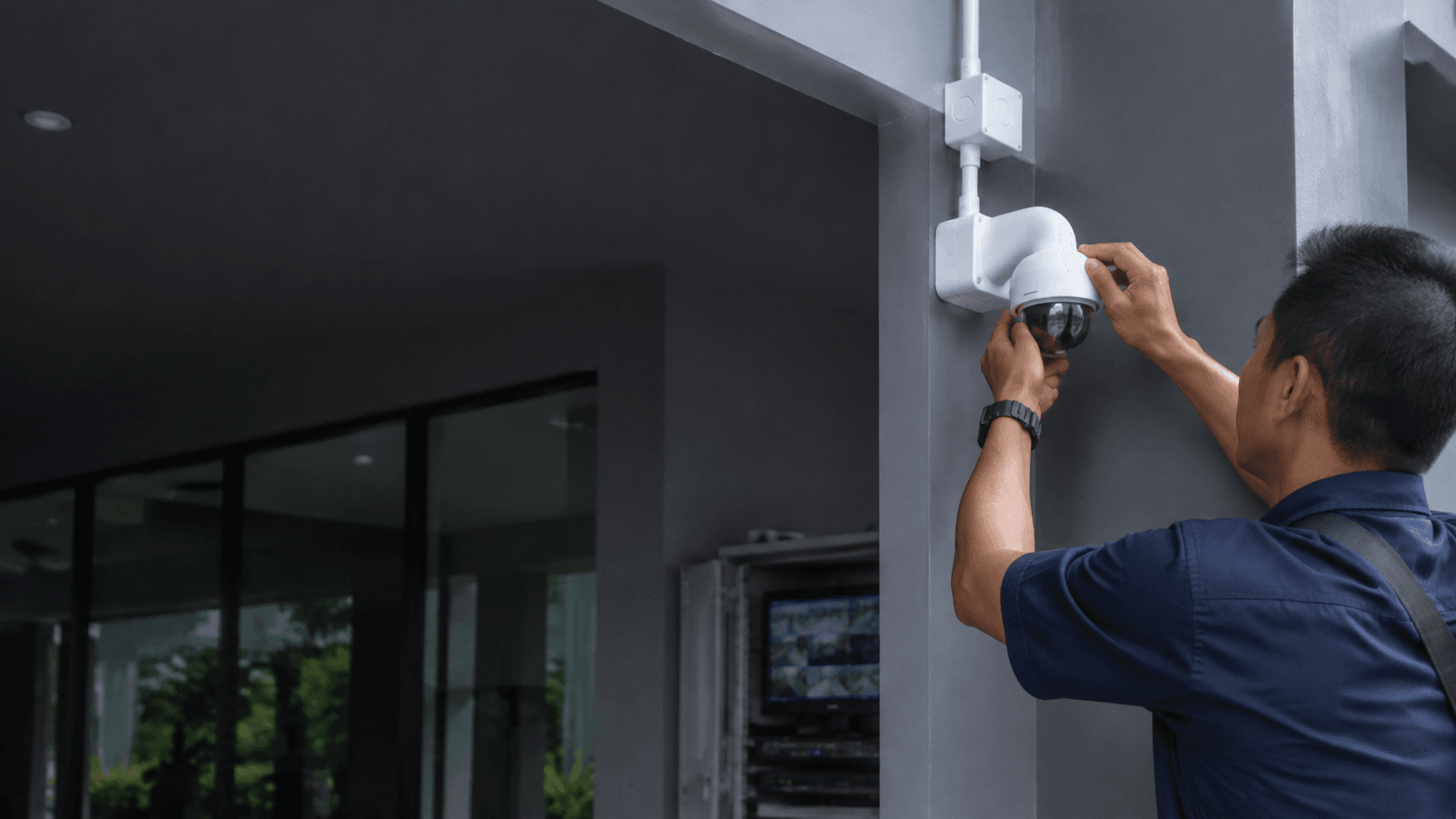
The brand sits in the professional surveillance market, which is why searches for wisenet cctv in Malaysia tend to surface manufacturer pages, marketplace listings, and app store entries instead of a local planning guide. That gap matters, because the equipment is only one part of a working system. Cabling routes, recorder location, storage, network access, and who reviews footage all shape whether the installation holds up after handover.
Wisenet CCTV. brand, cameras and recorders
Wisenet is the camera and recorder brand name tied to Hanwha Vision, a manufacturer whose product pages describe security cameras and video surveillance lines. The naming is the first thing to untangle: older listings and marketplace entries sometimes label the same family as Samsung Wisenet, while current manufacturer material uses Hanwha Vision. Both refer to the same lineage, and the brand has been carried across camera series, recorders, and a mobile viewing app.
What the brand covers, in broad terms, is a camera range plus the recording and viewing layer that sits behind it. Cameras capture the scene. A recorder stores the footage and serves it back. Software or a mobile app provides remote viewing. That three-part structure is common to most professional CCTV brands, and it is the structure a buyer is really choosing between, not just a logo on a housing.
Two cautions belong here. First, no supplied evidence in this article states Wisenet or Hanwha Vision technical specifications, resolutions, lens options, storage limits, or model numbers, so none are quoted. Second, no supplied evidence states Wisenet CCTV pricing in Malaysia, warranty terms, support arrangements, or local availability. Those details must come from the manufacturer's own documentation or an authorised local channel before any commitment.
Why the brand-versus-installer distinction matters
A brand page tells a reader what exists. An installer tells a reader what fits a specific building. Those are different jobs, and confusing them is how projects end up with cameras pointed at the wrong area or a recorder placed where nobody wants to service it. The competitor set analysed for this topic is dominated by browsing pages, which is exactly why the planning conversation is the missing piece.
What Wisenet CCTV covers in a real installation
In a real installation, the brand name recedes and four practical layers take over: where cameras go, how footage is recorded, how it is viewed remotely, and how the system is handed over. Each layer has its own failure mode.
Camera placement decides what the system can ever prove. A camera aimed at a corridor junction sees movement in two directions; the same camera aimed at a blank wall sees nothing useful. Placement also interacts with lighting. Eyonic's own product review guidance recommends checking actual lighting conditions before confirming placement for ColorVu-style cameras, and the same discipline applies to any low-light camera decision: the site's real light at the real hours is the input, not a brochure claim.
Recording is the second layer. A recorder needs a location with power, ventilation, and reasonable access for maintenance, and it needs enough storage for the retention period the site actually wants. Retention is a business decision before it is a technical one. A shop reviewing a week of footage and a public office reviewing a month have different requirements, and the recorder specification follows from that answer.
Remote viewing is the third layer. It depends on the site's network and on who is authorised to look. A system that only works on one phone in one office is not the same as one that lets a manager check a site from elsewhere. The fourth layer is handover. the point where the people who will live with the system learn how to use it.
Where Wisenet CCTV fits and where it does not
Professional camera lines generally suit sites that want a planned, multi-camera deployment with central recording: offices, shops, industrial premises, and public-facing buildings. They are a heavier choice than a single consumer camera for a small home, where a simpler setup may cover the need. The honest trade-off is planning effort against system coherence. A planned system costs more attention up front and behaves more predictably later.
Wisenet CCTV planning questions before any purchase
Planning starts with questions, not products. The answers determine which cameras, how many, and where the recorder lives.
- Site survey. walk the property and record entry points, movement routes, lighting at different hours, and existing cabling or network points.
- System proposal. translate the survey into camera positions, recorder location, retention expectations, and viewing access.
- Installation. mount, cable, configure recording, and set up remote viewing.
- Handover. confirm the people responsible can review footage, export clips, and know who to contact for support.
That sequence mirrors Eyonic's own CCTV installation process, which runs through site survey, system proposal, installation, and handover. The order is not decorative. Skipping the survey means the proposal is guesswork, and skipping handover means the system is only understood by the person who installed it.
Three questions deserve early answers. What does the site need to see, and at what hours? How long must footage be kept? Who needs to view it, and from where? A fourth question is often overlooked: what happens when something fails? A camera that goes dark should be noticed, not discovered weeks later.
Lighting, cabling and access constraints
Lighting conditions vary by site and by hour, and they change what a camera can realistically capture. Cabling routes decide whether an installation looks tidy or improvised, and they are far cheaper to plan than to retrofit. Access matters too. a camera mounted where no ladder can safely reach it becomes a maintenance problem. These constraints are site-specific, which is why a survey precedes a proposal rather than following it.
How a project is delivered
Delivery follows the same four stages in practice. The survey establishes facts about the property. The proposal converts those facts into a scope. Installation executes the scope. Handover transfers working knowledge to the people who will use the system daily.
Local project experience shows what that looks like at scale. Eyonic completed work for the Kuching Immigration Office, focused on arrival flow, staff areas, visitor movement, and dependable daily operation. A public office has a particular constraint: the system has to keep working through daily traffic without becoming a disruption itself. A separate project for KTA Sarawak Sdn Bhd addressed a practical office setup in Kuching supporting staff movement, visitor handling, tidy cabling, and clearer daily site control. Both examples point to the same lesson: the value comes from matching coverage to how the building is actually used.
Budget expectations for this kind of work vary with scope. Eyonic's published project information lists an approximate budget of RM 12,000 to RM 28,000 for the Kuching Immigration Office type of work, and RM 8,000 to RM 18,000 for the KTA Sarawak Sdn Bhd type of work. Those figures describe completed project ranges, not a Wisenet price, and they should not be read as a quotation for any other site.
What handover should include
Handover is where a system becomes usable. It should cover how to review recorded footage, how to export a clip when one is needed, how remote viewing is accessed, and who to contact when something stops working. A handover that consists of a login and a wave at the screen leaves the site dependent on one person's memory.
evidence gaps and what to verify
Several claims commonly attached to Wisenet CCTV cannot be supported by the evidence available here, and readers should treat them as unverified until a primary source confirms them.
No supplied evidence states Wisenet or Hanwha Vision technical specifications, resolutions, lens options, storage limits, or model numbers. No supplied evidence states Wisenet CCTV pricing in Malaysia. No supplied evidence states Wisenet warranty terms, support arrangements, or availability in Malaysia. No supplied evidence states that Eyonic supplies, installs, or services Wisenet equipment. No supplied evidence states Wisenet performance, night-vision behaviour, or AI feature outcomes. No supplied evidence states Wisenet app behaviour, cloud service terms, or subscription costs.
That list is not a criticism of the brand. It is a boundary around what this page can honestly assert. A reader comparing options should verify specifications against official Wisenet or Hanwha Vision product documentation, confirm Malaysian availability and support through an authorised channel, and check app and cloud terms directly before relying on remote viewing. Where a claim cannot be traced to a primary source, it should not drive a purchase decision.
How to verify before committing
Ask for the model number and check it against manufacturer documentation. Ask what happens if a camera fails and how support is reached. Ask whether the quoted scope includes configuration and handover or only hardware. These questions are answerable, and the answers separate a planned installation from a box of equipment.
next practical step
The practical path is to start with the site rather than the brand. A survey establishes what needs to be seen, where cameras can go, how lighting behaves, and where the recorder can live. From there, a proposal can compare options on scope rather than on a model name alone.
For readers weighing Wisenet CCTV against other professional lines, the deciding factors are usually coverage, retention, viewing access, and local support, not the label on the camera. Those factors are settled by a site visit and a written scope, and they are the right basis for any decision.
Share your location, property type and required system with Eyonic on WhatsApp at +60 11-5111 7959 for the next practical step.