
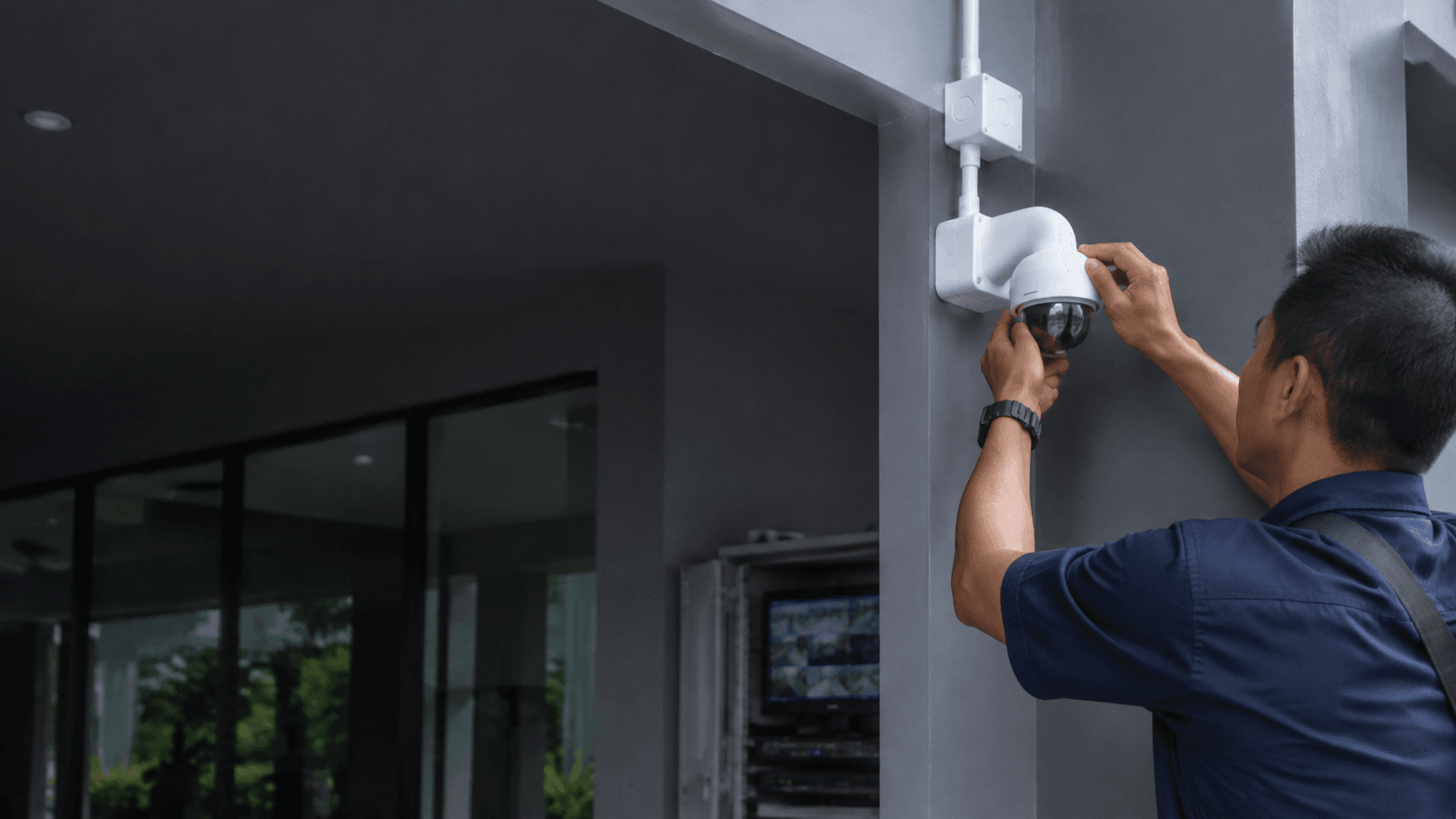
The practical difference shows up on installation day, not on a specification sheet. Analog systems push a video signal down coaxial cable to a DVR that does the digitising. A digital cctv camera does the digitising at the lens, then transmits over network cable to an NVR. That single change reshapes cabling, recorder choice, remote viewing, and how easily a system grows later.
Digital Cctv Camera vs Analog. The Core Difference
Analog cameras send a continuous electrical signal. The recorder converts it. Digital cameras convert first, then transmit. Everything downstream inherits that order.
Three consequences matter most in practice:
- Cabling. Analog runs on coaxial cable. Digital runs on network cable, which also carries power to the camera in many setups, so a single run can do both jobs.
- Recorder. Analog pairs with a DVR. Digital pairs with an NVR. The recorder is not interchangeable between the two.
- Remote viewing. A digital cctv camera produces data a network already understands, so remote viewing is a configuration task rather than an add-on module.
Analog still has a place. Where coaxial cable is already buried in walls and the recorder works, replacing the whole backbone to gain network features is a cost decision, not a technical one. A hybrid recorder can accept both signal types during a staged upgrade, which keeps an existing analog camera in service while new positions go digital.
What a Digital Cctv Camera Setup Includes
A complete setup is four working parts, not one box. The camera captures. The recorder stores. The network carries. The viewing device displays. A weak link in any of the four shows up as a system that looks fine on paper and fails at the counter.
Eyonic's CCTV installation process runs through four stages, and the order matters because each stage constrains the next.
- Site survey. Walk the property, identify entry points, blind spots, cable routes, and power availability before any equipment is chosen.
- System proposal. Match camera positions, recorder capacity, and storage to what the survey found, rather than to a standard package.
- Installation. Mount cameras, run cable, configure the recorder, and set up remote viewing.
- Handover. Confirm recording works, confirm mobile viewing works, and confirm the people who need access actually have it.
Storage is the part most often underestimated. A recorder holds a fixed amount of footage, and how many days it retains depends on how many cameras feed it and how much movement they record. A quiet warehouse and a busy shop entrance produce very different retention from identical hardware.
Where Digital Cctv Camera Systems Fit in Malaysia
Malaysian properties tend to split into four situations, and each one stresses a different part of the system.
Homes. The priority is usually the front gate, the car porch, and the main door. Coverage is small, so camera count stays low and the main question is whether night footage at the gate is usable.
Shops. The counter, the entrance, and the stock area carry the most value. Footage here is often reviewed after an incident, so retention length and the ability to find a specific moment quickly matter more than raw camera count.
Offices. Coverage follows movement: reception, corridors, server rooms, and staff entrances. Tidy cabling is usually part of the requirement, not an afterthought.
Industrial sites. Distances are longer, lighting is uneven, and cable runs are harder. These sites reward planning more than any other category, because a camera placed badly is expensive to move once the cable is in.
Eyonic's project work in Sarawak reflects that spread. The Kuching Immigration Office project focused on arrival flow, staff areas, visitor movement, and dependable daily operation. The KTA Sarawak Sdn Bhd project covered staff movement, visitor handling, tidy cabling, and clearer daily site control. Both are public-facing environments where the system has to work every day without someone babysitting it.
What to Check Before Confirming Camera Placement
Placement decides whether a system is useful. Two cameras covering the same wall badly are worth less than one camera covering the right angle well.
Lighting is the first check. Eyonic recommends checking actual lighting conditions before confirming placement for ColorVu-style cameras, because full-colour night footage depends on how much ambient light the position actually receives. A position that looks bright during a daytime survey can be near-black at 2am.
The second check is what the camera is meant to prove. A camera covering a gate needs to show a face or a plate. A camera covering a corridor needs to show movement. Those are different framing jobs, and a single wide-angle position rarely does both.
The third check is the cable route. Network cable has a practical distance limit before signal quality suffers, and every additional run adds cost and time. Mapping routes during the survey avoids discovering a problem after drilling starts.
The fourth check is who needs to see what. A shop owner, a security guard, and an office manager may all need access, but not necessarily to the same cameras. Deciding this before installation is simpler than changing it afterwards.
How Eyonic Handles a Digital Cctv Camera Project
Eyonic Sdn Bhd plans, supplies, and installs monitoring systems with camera placement, recording, and remote viewing for homes, offices, shops, and industrial sites. The work is Sarawak-based, with project evidence concentrated in Kuching.
Eric Yong founded Eyonic Security Systems and has worked in the industry for more than ten years, with experience in technical installation of digital security solutions for commercial businesses in Sarawak. That background shapes how projects are scoped: the survey comes first, and the equipment list follows the site rather than the other way round.
The Hikvision CCTV Package is priced at RM 1,599 and covers camera supply and setup, basic recording configuration, and mobile viewing handover. Larger projects sit well above that. The Kuching Immigration Office project carried an approximate budget of RM 12,000 to RM 28,000, and the KTA Sarawak Sdn Bhd project carried an approximate budget of RM 8,000 to RM 18,000. The gap between a package and a project is mostly camera count, cable distance, and how much of the site needs coverage.
For a property in Sarawak, the next practical step is to share the location, property type, and required system with Eyonic on WhatsApp at +60 11-5111 7959. That gives enough to judge whether the job is a package or a scoped project before anyone visits the site.