
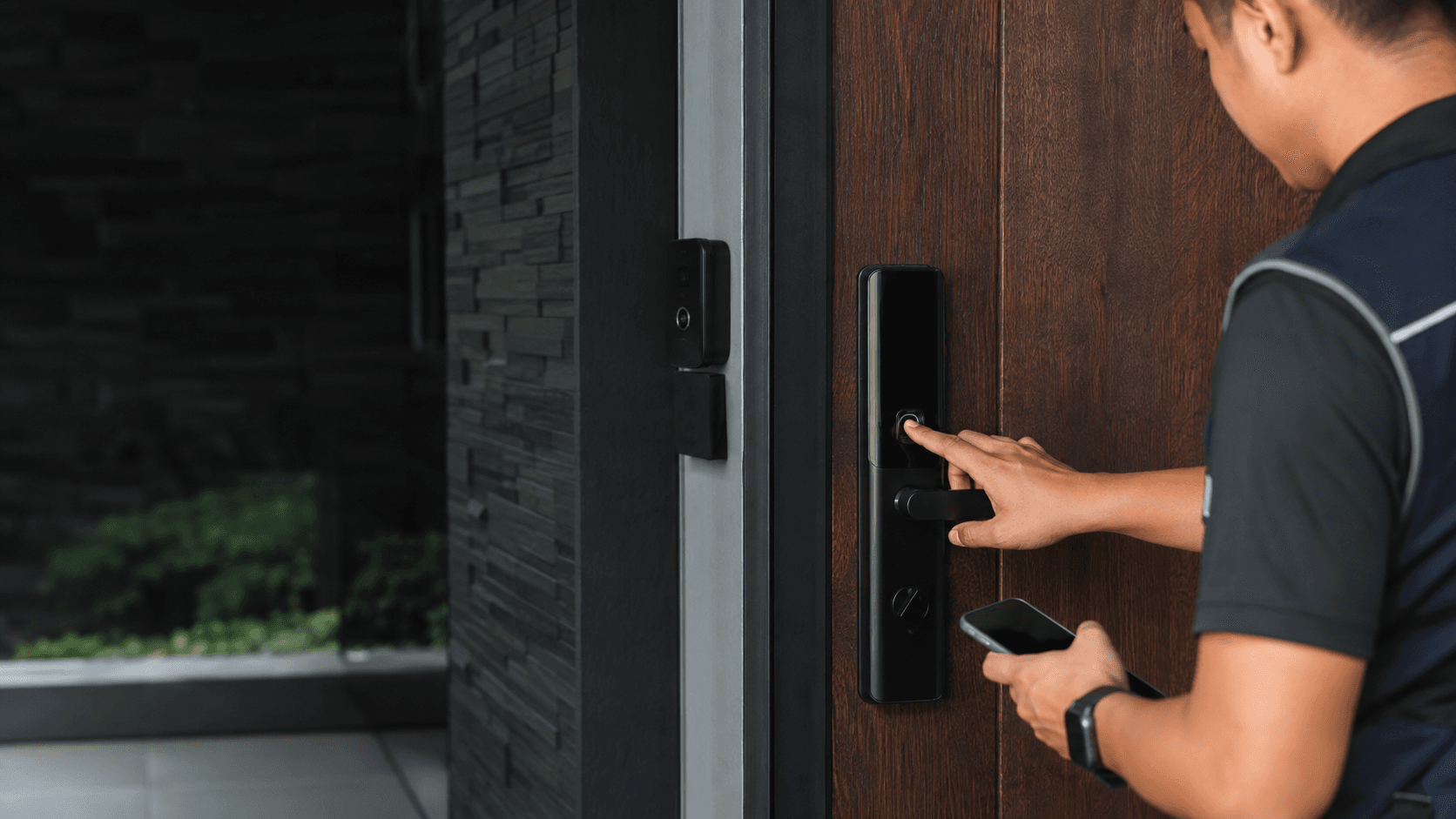
The exact-match query biometric door lock system describes hardware that reads a physical trait, matches it against enrolled templates, and releases a locking mechanism. The category spans standalone fingerprint deadbolts, keypad-plus-fingerprint models, and panel-based access control. Eyonic's own product review notes that smart locks work best when door condition, user roles, and backup method are reviewed before installation, and that for business use the choice between a standalone smart lock and an access-control panel should be checked first.
Biometric Door Lock System. What Matters Before Choosing
Three variables decide whether a biometric door lock system performs well or becomes a daily annoyance: the door itself, the people who need entry, and the fallback when the reader fails.
- Confirm the door can host the lock. Deadbolt bore, backset, door thickness, and whether the frame is metal or timber all affect fit.
- Count the users and their roles. A household of four and a shop with rotating staff need different enrolment and permission models.
- Decide the backup entry method. Keypad code, mechanical key, or a 9V jump start are the common fallbacks when a battery drains.
- Check the power source. Battery life, rechargeable cells, and whether a low-battery warning reaches the user before failure all matter.
- Confirm the environment. Humidity, direct rain, and coastal air in Sarawak stress outdoor hardware differently from an interior office door.
- Plan the handover. Enrolment, deletion of departed users, and who holds the admin credential should be settled before the installer leaves.
Eyonic's installation process follows a site survey, system proposal, installation, and handover sequence, which is the same order that suits a lock retrofit: look at the door, propose the model, fit it, then hand over credentials and backup access.
Choosing the Right Biometric Door Lock System
Fingerprint reading is the most common biometric method in residential and small commercial locks, because the sensor is small, cheap, and works without a camera. Facial recognition and palm vein reading appear in higher-priced models and in panel-based access control. Voice and iris recognition exist in the category but are far less common at a single door.
The practical split is between a standalone lock and a managed system. A standalone biometric door lock system stores templates on the device and is administered at the door. A panel-based system stores credentials centrally and is administered from a controller, which suits offices where staff join and leave regularly.
Standalone lock or access-control panel
Eyonic's smart lock review states that for business use, the company usually checks whether a standalone smart lock or an access-control panel is more appropriate. That check matters because a standalone lock has no central log of who entered and when, while a panel does. A small office with five staff may not need the log. A shop with shift changes and a need to revoke access the same day usually does.
Door condition decides more than brand
A lock that fits a timber door may not fit a metal grille or a glass door without additional hardware. The review guidance is explicit that door condition should be reviewed before installation. Measuring the existing bore and backset first avoids a return visit.
What Is a Biometric Door Lock System and How Does It Work?
A biometric door lock system captures a trait, converts it into a mathematical template, and compares that template with stored records. A match triggers the lock motor or solenoid. No image of a fingerprint is normally retained; the template is the stored artefact.
Enrolment is the step that determines reliability. A finger enrolled once, at an awkward angle, will fail more often than one enrolled several times across different placements. Users with worn, cut, or very dry skin may see higher failure rates on optical sensors than on capacitive ones.
Where the template lives
On a standalone lock, templates sit in the lock's own memory, and the number of enrolable users is capped by that memory. On a managed system, templates sit in a controller or server, and the door reader only reports a match or a failure. The second arrangement makes revocation immediate; the first requires visiting the door.
What happens when the reader fails
Every biometric door lock system needs a second way in. Common fallbacks are a numeric code, a mechanical override key, or an external power point for a drained battery. A lock with no fallback turns a flat battery into a locksmith call.
Practical Considerations for Installation in Malaysia
Malaysia's humidity and frequent rain make outdoor placement the main environmental constraint. A lock rated for interior use on a covered door may still corrode on an exposed gate. Where the door is sheltered, the constraint shifts to battery behaviour, since heat accelerates drain.
For multi-tenant buildings, the lock must coexist with the existing building access arrangement. A standalone lock on an apartment door is straightforward; a lock on a shared entrance usually needs the building's own access-control decision.
Cost expectations
Eyonic publishes package pricing at RM 1,599 for a Hikvision CCTV package, RM 1,599 for a Hikvision alarm system, and RM 1,599 for an autogate package. These are published package prices for those systems, not a quoted price for a biometric lock, and lock pricing depends on the model and door condition. Larger access projects sit in a different band: the Kuching Immigration Office project carried an approximate budget of RM 12,000 to RM 28,000, and the KTA Sarawak Sdn Bhd project an approximate budget of RM 8,000 to RM 18,000.
Where a lock fits alongside other security systems
A lock controls entry at one door. It does not record what happens after entry. Eyonic's project work at the Kuching Immigration Office focused on arrival flow, staff areas, visitor movement, and dependable daily operation, which is the wider problem a single lock only partly solves. For a shop or office, pairing door access with CCTV and an alarm gives a record of entry plus a record of activity.
Questions that come up during selection
Can a biometric lock be fooled by a photograph? Facial recognition models vary; some use depth or infrared sensing to reject a flat image, and some do not. Fingerprint sensors are generally harder to spoof than a printed photo, but sensor quality varies by model.
How many users can be enrolled? The cap is set by the lock's memory and is stated per model. A household rarely approaches it; a shop with rotating staff can.
Does a biometric lock need a subscription? Standalone locks generally do not. Models with app-based remote access may depend on the manufacturer's service, so the requirement should be confirmed per model.
What happens in cold or wet conditions? Extreme cold and wet fingers both reduce sensor accuracy. In Malaysian conditions, wet fingers after rain are the more common issue, and a keypad fallback covers it.
Making an Informed Choice About
The decision narrows quickly once the door, the user list, and the fallback are settled. A single household door with a sheltered approach suits a standalone fingerprint deadbolt. A business entrance with staff turnover suits a managed system with central revocation. A gate or exposed door needs hardware rated for the environment, not just for the feature list.
Eyonic Sdn Bhd plans, supplies, and installs security systems in Sarawak, including smart lock door access, CCTV, alarm systems, autogate, keyphone intercom, and Starlink internet. The company's founder, Eric Yong, has worked in technical installation of digital security solutions for commercial businesses in Sarawak for more than 10 years.
Share your location, property type and required system with Eyonic on WhatsApp at +60 11-5111 7959 for the next practical step.