
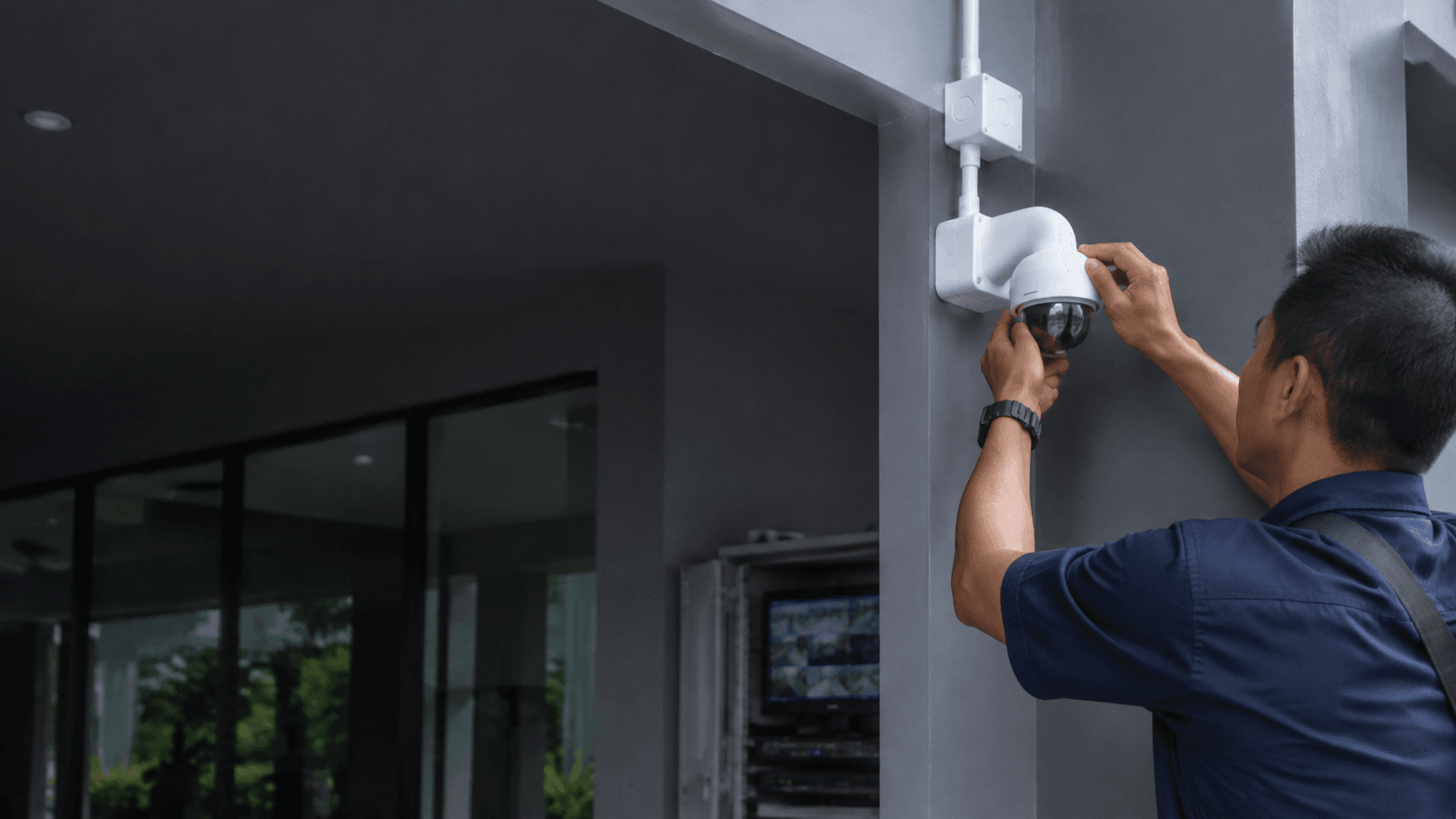
The exact-match query "wireless indoor camera with audio" describes a decision, not a single product. Buyers comparing these cameras in Malaysia weigh where the camera sits, what the room's light actually does after dark, how strong the Wi-Fi signal is at that spot, and whether footage is kept locally or in the cloud. Those four checks decide more outcomes than any single feature list.
Wireless Indoor Camera With Audio: What Buyers Compare
Across the retail and review pages that rank for this topic, coverage clusters on night vision, two-way audio, Wi-Fi connectivity, motion detection, storage choice and smart-home integration. Almost none of those pages use the full phrase in their main heading, and only one uses it in body text at all. That leaves room for a page that treats the purchase as a placement and installation decision rather than a specification sheet.
The practical sequence for a professionally installed system runs in four stages.
- Site survey — the room, lighting, mounting points and network coverage are checked on site.
- System proposal — camera placement, recording and remote viewing are set out before any work starts.
- Installation — cameras, cabling and the recorder are fitted and configured.
- Handover — mobile viewing, recording behaviour and user testing are walked through with the owner.
Eyonic follows that survey, proposal, installation and handover sequence on its CCTV installation work in Sarawak. The same order applies to an indoor camera with audio, because the audio and video both depend on where the unit ends up.
Rooms, lighting, and placement before purchase
Lighting is the first thing to verify, not the last. Eyonic's own guidance on ColorVu-style cameras is to check actual lighting conditions before confirming placement, because a room that looks bright in the afternoon can behave very differently at night. A camera rated for low-light colour work still needs a realistic read of the room after dark.
Placement height and angle matter just as much. A camera aimed across a doorway captures faces; one aimed down from a high corner captures the tops of heads. For a room where audio matters, the microphone needs to be close enough to the conversation area to be useful, which usually pulls the camera lower and more central than a pure security placement would.
| What to check in the room | Why it changes the decision |
|---|---|
| Lighting after dark, not at viewing time | Determines whether night vision or low-light colour is the realistic mode |
| Placement height and aim | Decides whether faces or the tops of heads are recorded |
| Wi-Fi signal strength at the mounting point | A weak signal at the corner of a room affects live viewing and alerts |
| Distance from the audio source | Two-way audio only helps if the microphone can hear the room |
| Local recording versus cloud storage | Changes ongoing cost, retention and who holds the footage |
Audio, connectivity, and storage expectations
Audio on an indoor camera usually means two things: the camera records sound, and it carries a speaker so someone can talk back through the app. Both depend on the same network path as the video. If live view stutters at the mounting point, the audio will too.
Storage splits into two broad routes. Local recording keeps footage on a recorder or memory card on the premises, which suits owners who want the recording to stay in the building. Cloud storage moves footage off site and typically carries a subscription, which suits owners who want access if the device itself is removed. Neither route is universally better; the choice follows who needs to see the footage and for how long.
Remote viewing is the feature most owners actually use day to day. It is also the one most likely to disappoint if the network was never checked at the camera's position, which is why the survey stage exists.
Wireless Indoor Camera With Audio in Malaysian properties
Malaysian homes and shop offices often mix concrete walls, tiled floors and multiple floors, and Wi-Fi coverage rarely behaves the same way in every room. A camera that works well in an open living area can struggle behind a thick wall or on an upper floor far from the router. Checking signal at the exact mounting point is more reliable than checking it in the room generally.
For business premises, the placement question shifts. Eyonic's work for the Kuching Immigration Office focused on arrival flow, staff areas, visitor movement and dependable daily operation — a public-office pattern where cameras follow how people move through the space rather than covering a single room. An indoor camera with audio in a shop or office usually sits where staff interact with visitors, and the audio requirement follows that same logic.
Eyonic's project work in Kuching has also covered an engineering consultancy office, where the brief centred on staff movement, visitor handling, tidy cabling and clearer daily site control. Cabling tidiness matters more than it first appears: an indoor camera placed for audio often sits lower and more visibly than a ceiling-mounted unit, so the cable route becomes part of the room.
Installation path. survey, proposal, installation, handover
A professional path starts with a survey rather than a product choice. The survey confirms the room, the lighting, the mounting points and the network, and it is the stage where an unsuitable placement is caught before anything is drilled.
The proposal then sets out camera placement, recording and remote viewing for the specific property. Installation fits and configures the equipment, and handover covers mobile viewing and user testing so the owner can actually operate the system afterwards. Eyonic's published CCTV installation process follows exactly that order.
For owners weighing a package, Eyonic lists a Hikvision CCTV package at RM 1,599 covering camera supply and setup, basic recording configuration and mobile viewing handover. That package is a CCTV scope, not a quotation for a specific indoor audio camera, and it should be read as a starting reference rather than a like-for-like price for any individual room.
Evidence gaps and what to confirm before deciding
Several details cannot be settled from published material and need to be confirmed directly for the specific property. Resolution, field of view, audio pickup range, storage limits and power arrangements vary by model and are not fixed by the category. Battery life, standby time and wireless range figures are likewise model-specific.
Warranty and compliance terms also need confirming against the actual unit supplied. Audio recording indoors raises privacy questions that differ by setting, and no Malaysia-specific regulatory position is established here, so that point should be checked for the specific premises before installation rather than assumed.
What can be settled in advance is the room itself: where the camera goes, what the lighting does after dark, whether the Wi-Fi reaches that spot, and whether footage is kept locally or in the cloud. Those four answers narrow the shortlist far more than any feature comparison.
Share the location, property type and required system with Eyonic on WhatsApp at +60 11-5111 7959 for the next practical step.