
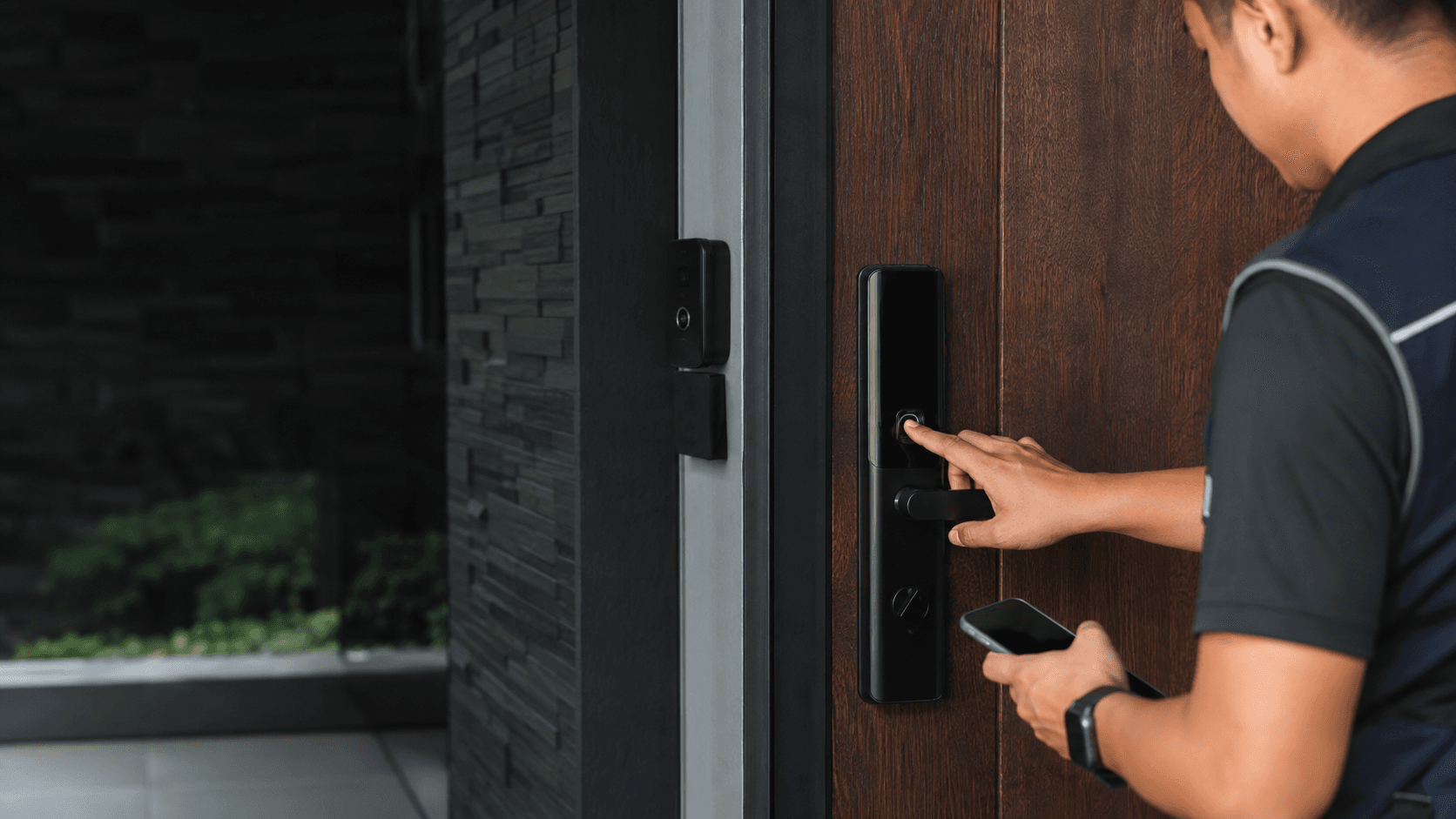
The phrase covers two different things in practice. Some buyers want a knob or lever handle with electronics inside. Others want a deadbolt or lever set that Alexa can lock, unlock or report status on. Both sit under the same search, and both raise the same planning questions before any hardware is ordered.
Eyonic Sdn Bhd is a security system supplier in Sarawak working on CCTV and ELV systems for homes, offices, shops and industrial sites. Smart lock door access is part of that range, and the company's own review guidance is that smart locks work best when door condition, user roles and backup method are reviewed before installation.
What Alexa Door Knob control actually does
Voice control over a door is a convenience layer, not the lock itself. Alexa sends a command; the lock or its bridge carries that command out. The physical keyway, the latch and the door frame still decide whether the door is secure.
In a home, the usual value is hands-free entry when carrying groceries, a child or a parcel, plus the ability to check whether a door is locked without walking back. In a shop or office, the value shifts toward controlled convenience: who can enter, at what hours, and whether there is a record.
Alexa voice control also has a practical limit that buyers in Malaysia should understand early. Voice is one access method among several. Keypad codes, fingerprint readers, phone apps and physical keys usually remain in the mix, and the mix matters more than the voice feature on its own.
Eyonic's own product review notes that for business use, the choice between a standalone smart lock and an access-control panel is a real decision rather than a default. A single door with a handful of users points one way. Multiple doors, staff turnover and visitor handling point another.
Alexa Door Knob compatibility and bridge requirements
Compatibility is decided by the specific model, not by the category. A lock that works with Alexa does so through a defined route, and that route determines what else must be bought and powered.
Three patterns appear across the market. Some locks connect directly to Wi-Fi. Some use Bluetooth and need a separate bridge to reach the network. Some use a hub or controller protocol and join Alexa through that hub. The label on the box is the only reliable answer for a given model.
Because of that, the honest position is that no single bridge rule applies to every Alexa Door Knob. A buyer comparing two locks may find one needs nothing extra and the other needs a bridge plugged in within range. That difference changes the total cost and the number of devices drawing power.
Two failure cases deserve attention before purchase. The first is network loss. if the internet drops, app control and voice control may stop working even though the door itself still opens by keypad, key or fingerprint. The second is power loss at the lock: battery-powered locks keep working until the battery is flat, and a flat battery is the most common reason a smart lock stops responding.
Backup entry is therefore not an optional extra. It is the plan for the day the network, the bridge or the battery fails. Eyonic's review guidance places backup method alongside door condition and user roles for exactly this reason.
Door condition, user roles and backup entry
Malaysian doors vary more than buyers expect. Metal grille doors, solid timber doors, hollow-core interior doors and glass doors each present different fixing points. A lock that suits one may not suit another without modification.
Door condition is the first check. Existing bore holes, backset distance, door thickness and frame alignment all affect whether a replacement lock fits cleanly. A door that has swollen, dropped or been repaired may need adjustment before any smart hardware goes on.
User roles are the second check. A family home needs a small number of permanent users and a way to issue temporary access to a cleaner, a relative or a delivery. A business needs staff access that can be removed the day someone leaves, plus a record of who entered and when.
Backup entry is the third check, and it should be decided before installation rather than after. The practical options are a mechanical key, a keypad code that works offline, or a second entrance that is not dependent on the smart lock.
Eyonic's smart lock door access review frames the business question directly: whether a standalone smart lock or an access-control panel is more appropriate. A standalone lock suits a single controlled door. An access-control panel suits multiple doors, shared entrances and sites where staff movement and visitor handling need clearer daily control.
Planning and installation in Sarawak
Local installation follows a sequence that keeps the hardware decision tied to the actual door. Eyonic's installation process runs through site survey, system proposal, installation and handover.
- Site survey. the door, frame, existing hardware, power points and network coverage are checked on site.
- System proposal. the lock type, bridge or hub requirement, user roles and backup entry are set out before supply.
- Installation. the lock is fitted, wired or paired as required, and tested against the agreed access methods.
- Handover. users, codes, app access and the backup procedure are explained and tested with the people who will use them.
That sequence matters in Sarawak because travel and site conditions make rework expensive. A survey that confirms door thickness, backset and network reach prevents a second visit to swap hardware that does not fit or does not connect.
Eyonic has completed work for the Kuching Immigration Office, focused on arrival flow, staff areas, visitor movement and dependable daily operation, and for KTA Sarawak Sdn Bhd, an office setup in Kuching supporting staff movement, visitor handling, tidy cabling and clearer daily site control. Both projects show the same pattern: access decisions are made around how people actually move through a building, not around a single device feature.
For a home, the scope is usually one or two doors and a short handover. For a shop or office, the scope grows to include staff roles, visitor handling and how the lock relates to existing CCTV, alarm or intercom systems. Eyonic's published packages for Hikvision CCTV, Hikvision alarm systems and autogate work are each listed at RM 1,599, which gives a sense of how the company prices entry-level security work in the region.
Alexa Door Knob questions before choosing
Does the lock need a bridge? It depends on the model. Direct Wi-Fi locks generally do not; Bluetooth and hub-based locks generally do. The manufacturer's documentation for that exact model is the only reliable source.
What happens when the internet is down? Voice and app control may stop. Keypad, fingerprint and mechanical key entry usually continue, which is why backup entry is planned in advance.
Can it go on an existing door? Often yes, but bore diameter, backset, door thickness and material decide whether it is a direct fit or needs modification. This is the single most common reason a survey is done before supply.
Is a smart lock enough for a business? For one controlled door with a small user list, a standalone lock can be appropriate. For multiple doors, staff turnover and visitor movement, an access-control panel is usually the better fit.
Who installs and supports it locally? Eyonic handles planning, supply and installation for security and ELV systems in Sarawak, with the site survey and handover steps built into the process.
Share your location, property type and required system with Eyonic on WhatsApp at +60 11-5111 7959 for the next practical step.