
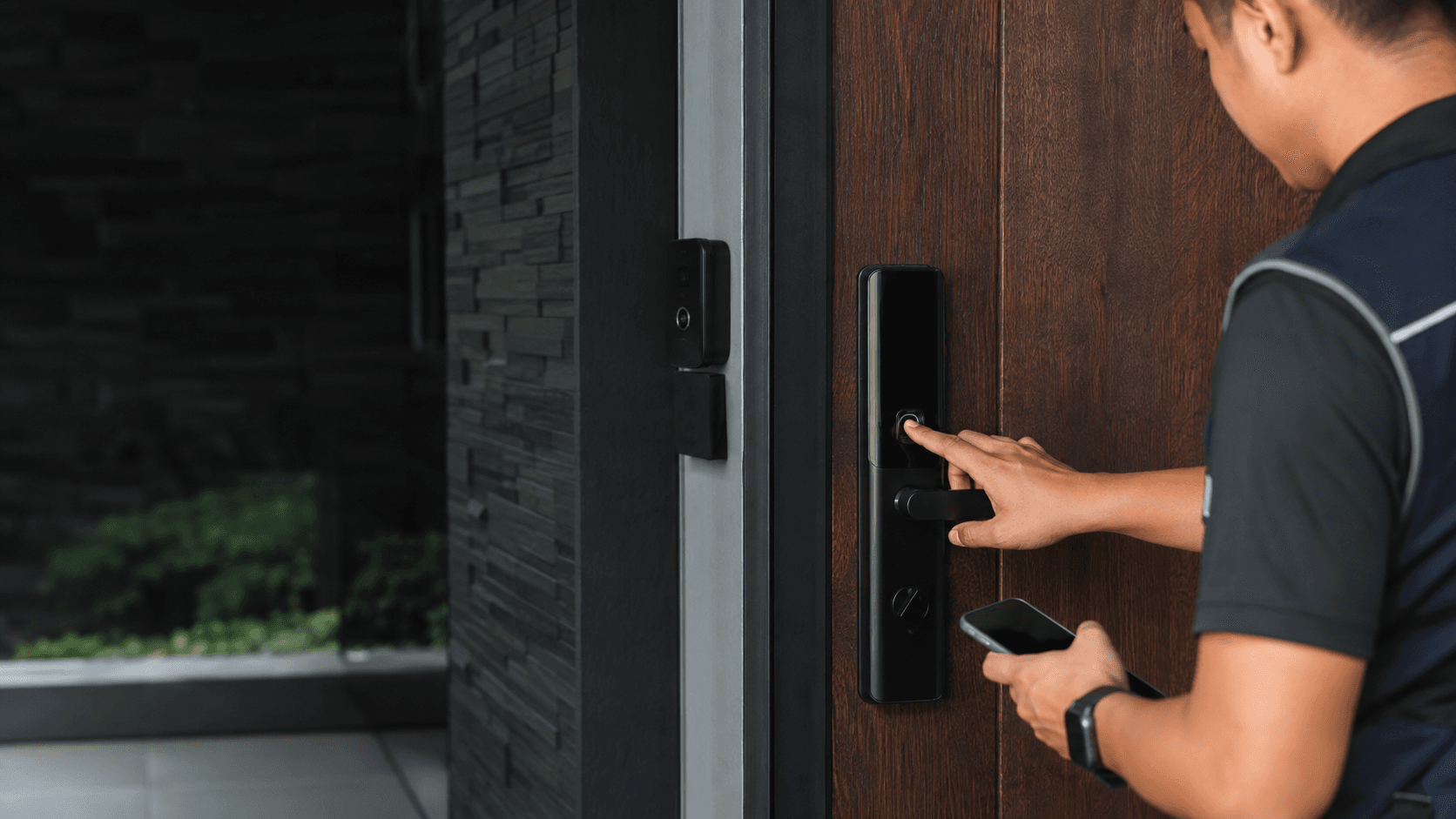
The hardware is a two-sided version of keyless entry: instead of a keypad outside and a plain handle inside, both sides carry a code pad. That changes who can move through the door, from which direction, and what happens when the code is forgotten or the power fails. The sections below cover what the product does, where it fits in Malaysian properties, and the checks that decide whether it is the right choice.
Double Keypad Door Lock. What Two-Sided Entry Control Means
A standard electronic lock assumes one trusted side and one controlled side. A double keypad door lock removes that assumption. Both faces accept a code, so a person standing on either side of the door can unlock it without carrying a key or being let in by someone else.
That symmetry is the whole point. It suits doors that sit between two areas of equal or near-equal trust: a gate between a car porch and a rear lane, a door between a shop floor and a storeroom, a partition between two office zones, or a yard gate that staff pass through in both directions.
Two-sided keypad entry is not the same as a lock with a keypad outside and a thumb-turn inside. The thumb-turn version still lets anyone inside open the door freely. The double-sided version keeps both directions under code control, which is why it appears in commercial door hardware catalogues alongside access control rather than in the consumer smart lock aisle.
Mechanical and electronic versions
Double-sided keypad hardware comes in two broad families. Mechanical push-button locks use a set of numbered or lettered buttons and no batteries; the code is changed by rearranging the internal mechanism. Electronic keypad locks use a powered pad, and typically support more codes, easier code changes, and sometimes an audit trail of which code was used and when.
The trade-off is straightforward. Mechanical units keep working when power or batteries fail, but they hold fewer codes and offer no record of use. Electronic units give more control and more reporting, but they depend on a power source and on someone remembering to maintain it.
Where a Double Keypad Door Lock Fits in Malaysian Properties
In Sarawak and across Malaysia, the strongest fit is usually a door that already has controlled movement in both directions and where key handling has become a nuisance. Common examples include.
- Shop lots where staff move between the front counter area and a rear store or service lane.
- Offices that split a floor into a public-facing zone and an internal working zone.
- Gated residential compounds where a side or rear gate is used by household members and regular visitors.
- Small industrial or workshop units where a partition door separates tools or stock from the main floor.
The fit weakens when the door is a main entrance that the public must use, when the door is the only escape route from an occupied space, or when the people passing through change constantly and cannot be issued codes reliably.
Doors that should not carry two-sided keypad locking
Any door that serves as a required means of escape needs careful thought before a code is placed on the inside face. A person leaving a building in an emergency should not have to remember a code to get out. Where a two-sided lock is proposed on such a door, the exit path and the unlocking method on the inside need to be confirmed against the building's own requirements before anything is ordered. This article does not state a Malaysian regulatory position on that point, because no verified requirement was available; the check belongs with the person responsible for the premises.
Door Condition and User Roles Before Choosing a Double Keypad Door Lock
Eyonic's own guidance on smart lock door access is that these locks work best when the door condition, user roles and backup method are reviewed before installation. That order matters, because each check can rule the product out before any money is spent.
- Check the door itself. its material, thickness, existing cut-outs, how it closes, and whether the frame can carry the lock body and both keypads.
- Check the user roles. who needs to enter from each side, how often, whether they are permanent staff, rotating staff, contractors or visitors, and whether codes can be issued and withdrawn cleanly.
- Check the backup method. what happens when a code is forgotten, a battery runs flat, or a user leaves without returning a credential.
- Decide between a standalone smart lock and an access-control panel, based on how many doors, how many users, and how much record-keeping the site actually needs.
Door condition is the check most often skipped. A hollow or lightweight door may not accept the hardware cleanly. A door that already has a mortise cut for a different lock may need modification. A door that does not sit squarely in its frame will put strain on any electronic mechanism, and a misaligned door is a poor candidate for a lock that depends on a motor or solenoid to throw the bolt.
User roles decide the code structure
If the same code is shared by everyone, the lock is only a barrier, not a record. If each person or team gets a separate code, the lock becomes a way to see who entered and to remove one person's access without reissuing codes to everyone else. The second approach needs a lock that supports multiple codes and, ideally, an audit trail. Whether a specific model supports that is a specification question that has to be confirmed against the manufacturer's datasheet for the model being considered.
Access Control Panel or Standalone
For a single door with a small, stable group of users, a standalone double keypad door lock is usually the simpler answer. It needs no central controller, no network, and no software. Codes are managed at the door.
For a site with several doors, changing staff, or a need to review entry records centrally, an access-control panel is usually the better structure. The panel manages credentials across doors, and the door hardware becomes a reader and a lock rather than the decision-maker. Eyonic's product review notes that for business use, the usual question is whether a standalone smart lock or an access-control panel is more appropriate, which is the same fork in the road here.
The practical difference shows up later, not at installation. A standalone lock is cheap to add and easy to live with until the site grows. An access-control panel costs more up front and needs more planning, but it does not have to be replaced when the second or third door is added.
Backup Entry and Daily Operation Planning
Every code-based lock needs a plan for the day the code does not work. That plan should be decided before installation, not after the first lockout.
For a mechanical double-sided lock, the backup is usually a key override or a second code held by a responsible person. For an electronic lock, the backup may be a mechanical key, an external power point, or a documented procedure for a manager to open the door. Whichever route is chosen, the people who need it must know it exists and where the key or procedure is kept.
Daily operation also covers the small things: who changes the code when a staff member leaves, how often batteries are checked, and what happens during a power interruption. These are not technical questions, but they decide whether the lock is still doing its job a year after installation.
What cannot be confirmed from available evidence
Specific model specifications, code capacities, audit trail sizes, weather ratings, finish options, pricing for supply or installation in Malaysia, and warranty terms are not available in the evidence used for this article. Those details should come from the manufacturer's datasheet and the supplier handling the installation, not from a general explanation of how the product works.
Practical Next Step With Eyonic
Eyonic Sdn Bhd plans, supplies and installs security and ELV systems in Sarawak, and its installation process runs through site survey, system proposal, installation and handover. The same sequence applies to door access hardware: the door, the users and the backup method are checked before a model is proposed.
The Kuching Immigration Office project is an example of the kind of site where arrival flow, staff areas, visitor movement and dependable daily operation all had to be considered together, rather than as separate purchases. A door that needs two-sided keypad entry usually sits inside that same set of questions.
Share the location, property type and required system with Eyonic on WhatsApp at +60 11-5111 7959 for the next practical step.