
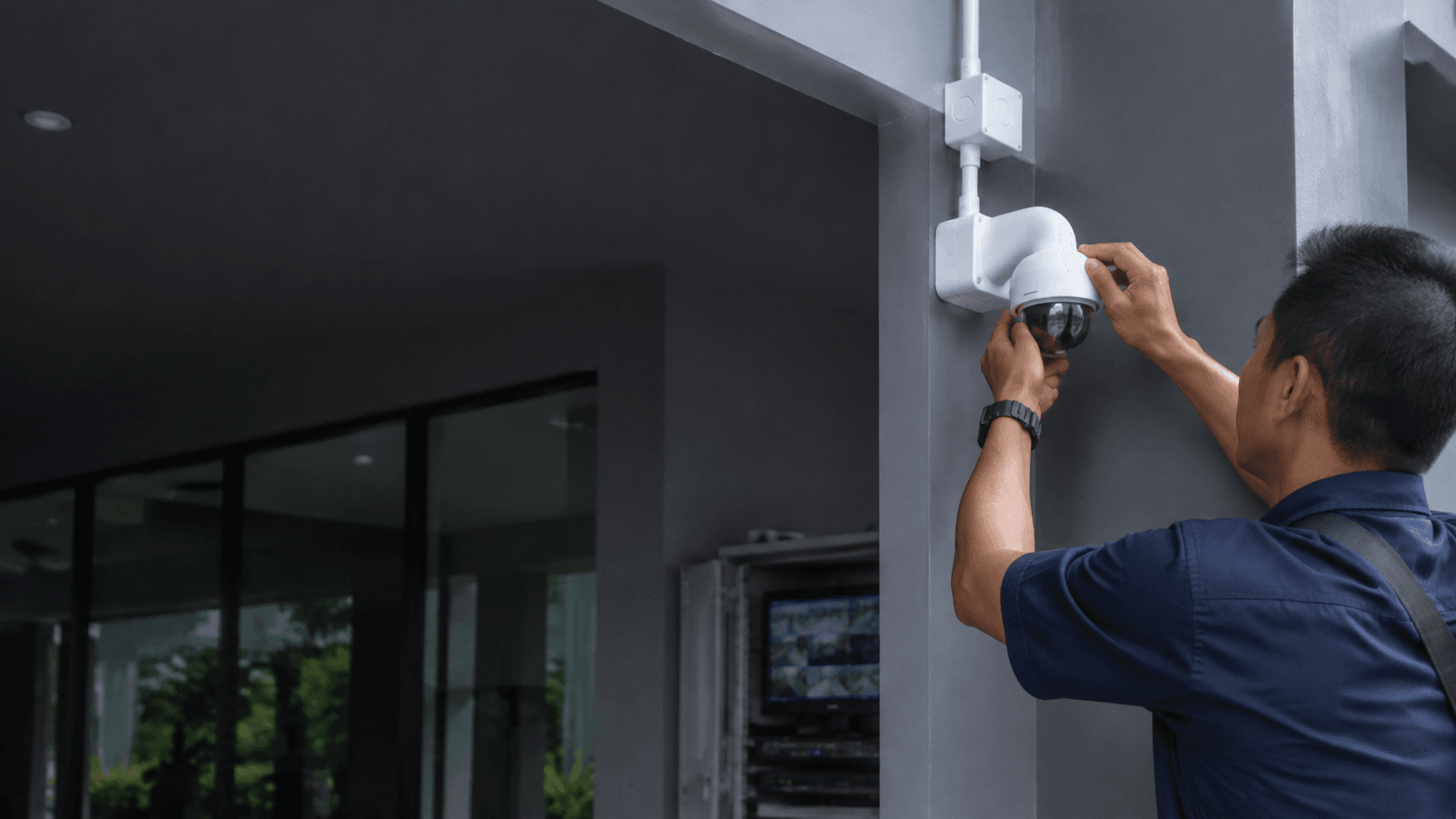
The term covers two different things depending on where the reader sits. In markets such as Australia and Ireland, ADT sells and monitors CCTV as part of a broader home security service. In Malaysia, the practical question is usually narrower: whether an ADT-branded camera path exists locally, and what a comparable installed camera system actually involves.
No supplied evidence confirms that ADT-branded CCTV cameras, ADT monitoring plans, or the ADT Blu and ADT Pro Install platforms are offered in Malaysia. That gap matters, because a buyer searching adt cctv in Malaysia is often really asking what a working camera system costs and requires, not which logo sits on the housing.
Adt Cctv. what the term covers
ADT is a security company with operations across several countries, and its camera offerings differ by region. Competitor coverage of ADT cameras clusters around two platform names, ADT Pro Install and ADT Blu, plus Google Nest cameras supplied through ADT in the United States. Those platform details come from third-party review sites and describe the United States market, not Malaysia.
For a Malaysian property, the useful reading of adt cctv is as a category question: what does a professionally installed camera system include, and who supports it after handover. A locally supplied system answers that with named hardware, a documented installation sequence, and a support contact.
Adt Cctv camera types and where each fits
Camera choice follows the scene, not the brand. A dome or turret camera suits a covered entrance or an indoor corridor where the housing needs to sit close to the ceiling. A bullet camera suits an exposed perimeter wall where the body can be angled along a fence line or driveway. A doorbell-style camera suits a single main entry where two-way audio matters more than long-range detail.
Low-light performance is the specification most often misread. Eyonic advises checking actual lighting conditions before confirming placement for ColorVu-style cameras, because a camera rated for colour images in near darkness still depends on how much ambient light reaches that exact spot at night. A position that looks bright during a daytime survey can behave differently after dark.
Placement decisions that matter more than model numbers include the height of the mounting point, whether a face or only a head and shoulders will be captured, whether a gate or tree will block the view at certain hours, and whether the cable route stays tidy and protected. Eyonic lists camera placement and NVR setup as distinct parts of its CCTV work, which reflects how much of the outcome is decided before any bracket is fixed.
Adt Cctv installation from survey to handover
Eyonic's CCTV installation process runs through four stages, and the sequence is worth understanding because each stage constrains the next.
- Site survey, where the property layout, entry points, lighting and existing cabling are reviewed on site.
- System proposal, where camera positions, recorder location and scope are set out before work begins.
- Installation, where cameras, cabling and the recorder are fitted and configured.
- Handover, where recording and mobile viewing are demonstrated and the system is left in a working state.
The survey stage is where most avoidable problems are caught. A recorder needs a ventilated, accessible position with power and a network path. Cable runs need a route that does not cross a walkway at ankle height or sit exposed on a rendered wall. Camera angles need checking against the actual field of view rather than a floor plan.
Scale changes the shape of the work. Eyonic's project for the Kuching Immigration Office focused on arrival flow, staff areas, visitor movement and dependable daily operation, which is a different brief from a single shop lot. A public office with continuous foot traffic needs coverage that supports daily operation rather than isolated camera positions. Eyonic's work for KTA Sarawak Sdn Bhd covered staff movement, visitor handling, tidy cabling and clearer daily site control, which shows how much of an office installation is about cable discipline and sightlines rather than camera count.
Adt Cctv recording, storage and remote viewing
Recording is the part of the system that determines whether footage is actually useful later. A recorder with a hard drive keeps footage locally, which means playback does not depend on internet speed. Retention depends on camera count, resolution and how much motion the scene generates, so a busy entrance fills storage faster than a quiet rear lane.
Remote viewing lets a phone check a live or recorded view from outside the property. It depends on the recorder being reachable over the network and on the mobile app being configured during handover. Eyonic lists remote viewing and NVR setup as separate services, and the handover stage of its process includes mobile viewing, which is the point where a buyer can confirm the app works before the installer leaves.
Two constraints are worth planning around. Upload speed at the property limits how smoothly a remote live view plays, and a recorder placed in a locked room with no network path will need additional work later. Both are survey-stage questions rather than installation-stage surprises.
Adt Cctv costs and package expectations in Malaysia
Eyonic publishes package pricing at RM 1,599 for a Hikvision CCTV package covering camera supply and setup, basic recording configuration and mobile viewing handover. The same RM 1,599 figure applies to a Hikvision alarm system and to an autogate package, each with its own scope of supply, setup and handover.
Larger or more complex sites sit well above a single package. Eyonic's Kuching Immigration Office project carried an approximate budget of RM 12,000 to RM 28,000, and the KTA Sarawak Sdn Bhd office project carried an approximate budget of RM 8,000 to RM 18,000. Those ranges reflect multi-camera office installations with cabling, recorder placement and handover rather than a single-camera setup.
No supplied evidence confirms pricing for ADT-branded equipment in Malaysia, so any ADT-specific figure encountered online should be treated as belonging to another market. The comparison that holds locally is between a published package price and a project budget, and the difference between them is usually camera count, cable distance and site complexity.
Adt Cctv planning checks before confirming a system
Before confirming any camera system, the practical checks are the ones that change the quote. Confirm the actual lighting at each proposed position after dark, not just at the time of the survey. Confirm where the recorder will live and whether that spot has power, ventilation and a network connection. Confirm which doors, gates and walkways need coverage and which can be left out. Confirm who will hold the mobile viewing credentials and how they will be reset if a phone is replaced.
For a business site, add two more. Check whether the camera positions support how staff and visitors actually move through the building, since a system that covers the perimeter but not the counter area will not answer the questions that come up later. Check that cabling can be run tidily, because exposed or improvised cable runs are the most common reason a completed installation looks unfinished.
Where a property needs cameras, an alarm and gate control together, the three Eyonic packages share the same RM 1,599 starting figure, which makes it possible to scope them as one project rather than three separate visits. Eric Yong, founder of Eyonic Security Systems, has worked in technical installation of digital security solutions for commercial businesses in Sarawak for more than 10 years, which is the background behind the survey-first approach.
Share the property location, property type and required system with Eyonic on WhatsApp at +60 11-5111 7959 for the next practical step.