
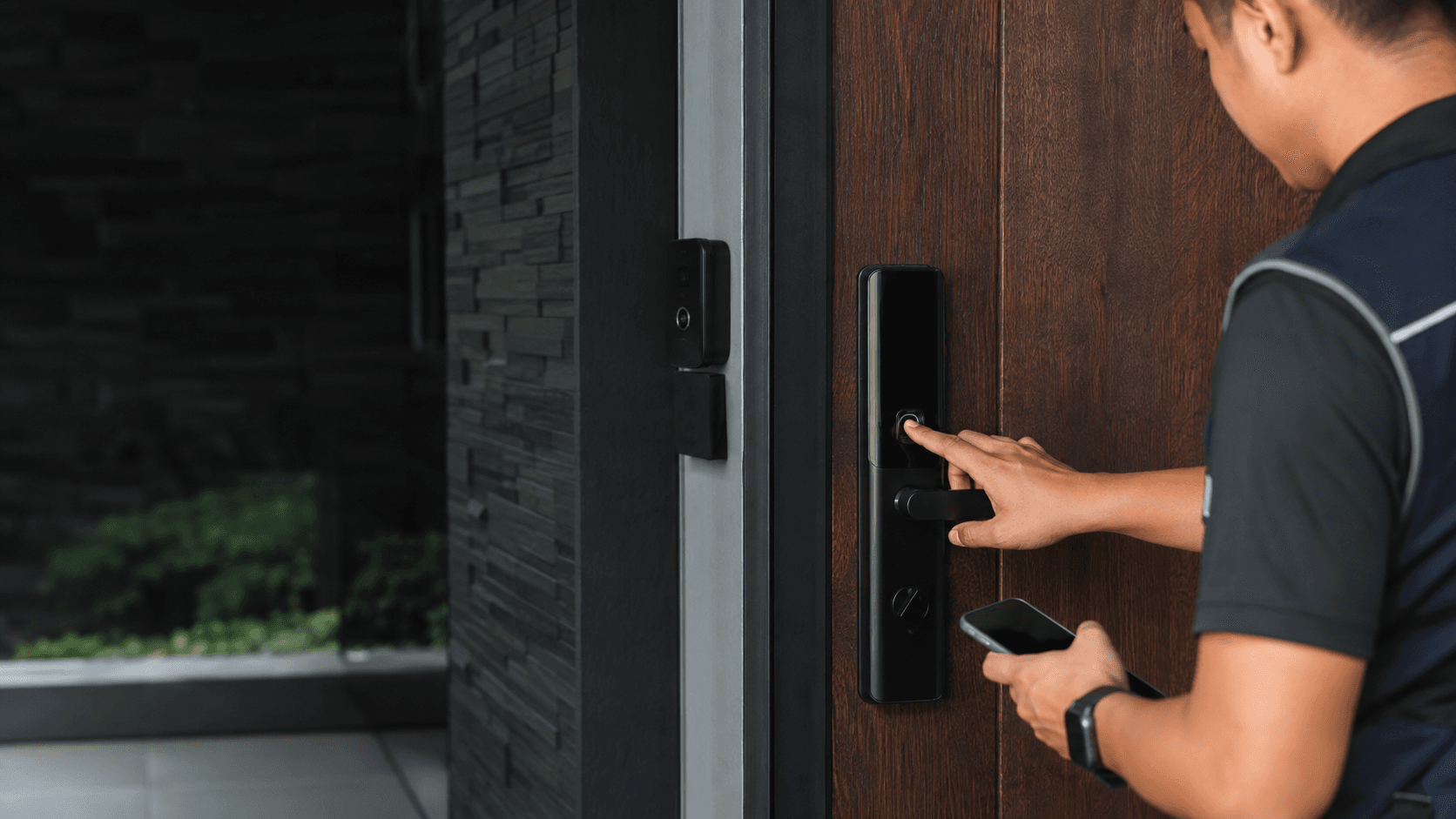
The exact-match query best coded door locks is a shopping phrase, but the decision behind it is rarely about the lock alone. A coded lock is a deadbolt, lever, or handle that opens when a correct code is entered on a keypad or touchscreen, sometimes alongside a fingerprint, card, or app. Eyonic Sdn Bhd, a security system supplier in Sarawak, reviews smart lock door access on the basis that door condition, user roles, and backup method should be checked before installation, and that business premises may need an access-control panel rather than a standalone lock.
- Confirm the door type, thickness, and existing bore holes, because a coded lock that does not match the door cannot be fitted without extra carpentry.
- Count the people who need daily entry and decide whether each one gets a separate code or a shared one.
- Choose the unlock methods. keypad only, keypad plus key, keypad plus fingerprint, or keypad plus app.
- Decide how the lock behaves when the battery runs flat, and keep a mechanical key or external power option available.
- Match the lock to the setting, since a home entry door and an office with staff and visitors place different demands on the same hardware.
- Arrange installation and handover so codes, user permissions, and backup entry are tested before the lock goes into daily use.
Best Coded Door Locks. What Matters Before You Choose
Most buying guides rank locks by brand and price. The factors that decide whether a coded lock works well in practice are narrower: whether the door accepts it, whether the code system fits the number of users, and whether there is a way in when the electronics fail.
Eyonic's smart lock review notes that smart locks work best when door condition, user roles, and backup method are reviewed before installation. That sequence matters more than the model number, because a lock that suits a single-family home may be the wrong choice for a shop with rotating staff.
Choosing the Right Coded Door Locks
A coded lock is only as good as its fit with the door and the people using it. The table below sets out the main decision points and what each one changes.
| Decision point | What it affects | Practical constraint |
|---|---|---|
| Door type and existing bore | Whether the lock fits without modification | Metal doors and non-standard backsets may need extra work |
| Number of users | Whether separate codes are practical | Shared codes cannot be traced to one person |
| Unlock methods | Convenience and fallback options | More methods usually mean more to configure and maintain |
| Power source | Reliability between battery changes | Battery life varies with usage and features |
| Backup entry | Access during a flat battery or fault | A mechanical key or external power point must be planned |
| Setting | Home versus office or commercial use | Business use may suit an access-control panel instead |
For a single home entry door, a keypad deadbolt with a mechanical key override covers most needs. For an office with staff and visitors, the question shifts to whether a standalone smart lock is enough or whether an access-control panel gives better control over who enters and when. Eyonic checks that distinction during review rather than assuming one answer fits every site.
What is coded door locks?
Coded door locks are door locks that open when a correct numeric code is entered, rather than only with a physical key. Many models also accept a fingerprint, a card, or a phone app, and most keep a mechanical key or external power terminal as a fallback. The category covers keypad deadbolts, keypad lever sets, and smart locks with a keypad built in.
The Best Smart Locks Of 2026
Published roundups for 2026 concentrate on a small group of brands, and the pattern is consistent across the major review sites. SafeHome.org, CNET, and Consumer Reports all build their 2026 picks around August, Yale, Schlage, Kwikset, Ultraloq, and Level, with categories such as best overall, best budget, best retrofit, best fingerprint, and best for Apple Home Key.
Those rankings are useful for shortlisting, but they are written for a general audience and rarely account for Malaysian door stock, local installation practice, or the split between home and commercial use. A lock that wins a lab test for battery life or app polish may still be the wrong fit for a shop shutter or an office with a staff turnover problem.
Two structural points from the 2026 roundups are worth carrying into any shortlist. First, retrofit models reuse the existing deadbolt hardware, while full replacements swap the whole lock body, and that choice affects both cost and how much of the door is disturbed. Second, durability ratings and platform compatibility are separate questions: a lock can be well built and still fail to connect to the app or hub already in use.
Practical Considerations for Coded Door Locks
Several constraints decide whether a coded lock stays convenient after the first month.
Battery and power. Every electronic lock depends on a power source. Battery life varies with how often the lock is used and how many features run continuously, so the practical question is what happens on the day the battery runs flat. A mechanical key override or an external power terminal turns that from a lockout into a short delay.
User management. A household with three or four people can share a code without much risk. A workplace cannot, because a shared code leaves no way to know who entered or to remove one person's access. Where staff or tenants change regularly, separate codes or an access-control panel become the more workable option.
Door condition. Existing bore holes, door thickness, and the material of the door all affect what can be fitted. A lock specified for a timber door may not suit a metal door without additional preparation, and that is a site question rather than a catalogue question.
Setting. A home entry door and a commercial entrance place different demands on the same category. Eyonic's review of smart lock door access describes the product as good for controlled convenience when user permissions and backup entry are planned properly, which is a fair summary of where these locks succeed and where they do not.
Eyonic's own project work shows how much the setting shapes the specification. A completed project for the Kuching Immigration Office focused on arrival flow, staff areas, visitor movement, and dependable daily operation, while a project for KTA Sarawak Sdn Bhd covered staff movement, visitor handling, tidy cabling, and clearer daily site control. Both are public-facing or staffed environments where entry points have to keep working through a full working day, which is a different brief from a single home door.
Making an Informed Choice About Coded Door Locks
The shortlist stage is where most buyers stop, but the decision is usually settled by three questions: does the lock fit the door, does the code system fit the people using it, and is there a reliable way in when the electronics fail. If all three answers are clear, the brand choice becomes a matter of budget and preferred unlock methods rather than guesswork.
Where the answers are unclear, a site survey resolves them. Eyonic's installation process runs through site survey, system proposal, installation, and handover, and that order exists because door condition and user roles are easier to confirm on site than from a product listing. The same logic applies to a single home door as to an office entrance, even though the scale differs.
For readers comparing coded locks against a wider security setup, it helps to treat the lock as one layer rather than the whole system. A coded lock controls who passes through a specific door; it does not record what happens elsewhere on the property. Where entry control and monitoring both matter, the lock decision and the camera or alarm decision are usually made together so that cabling, power, and handover are handled in one visit rather than two.
Share the location, property type, and required system with Eyonic on WhatsApp at +60 11-5111 7959 for the next practical step.