
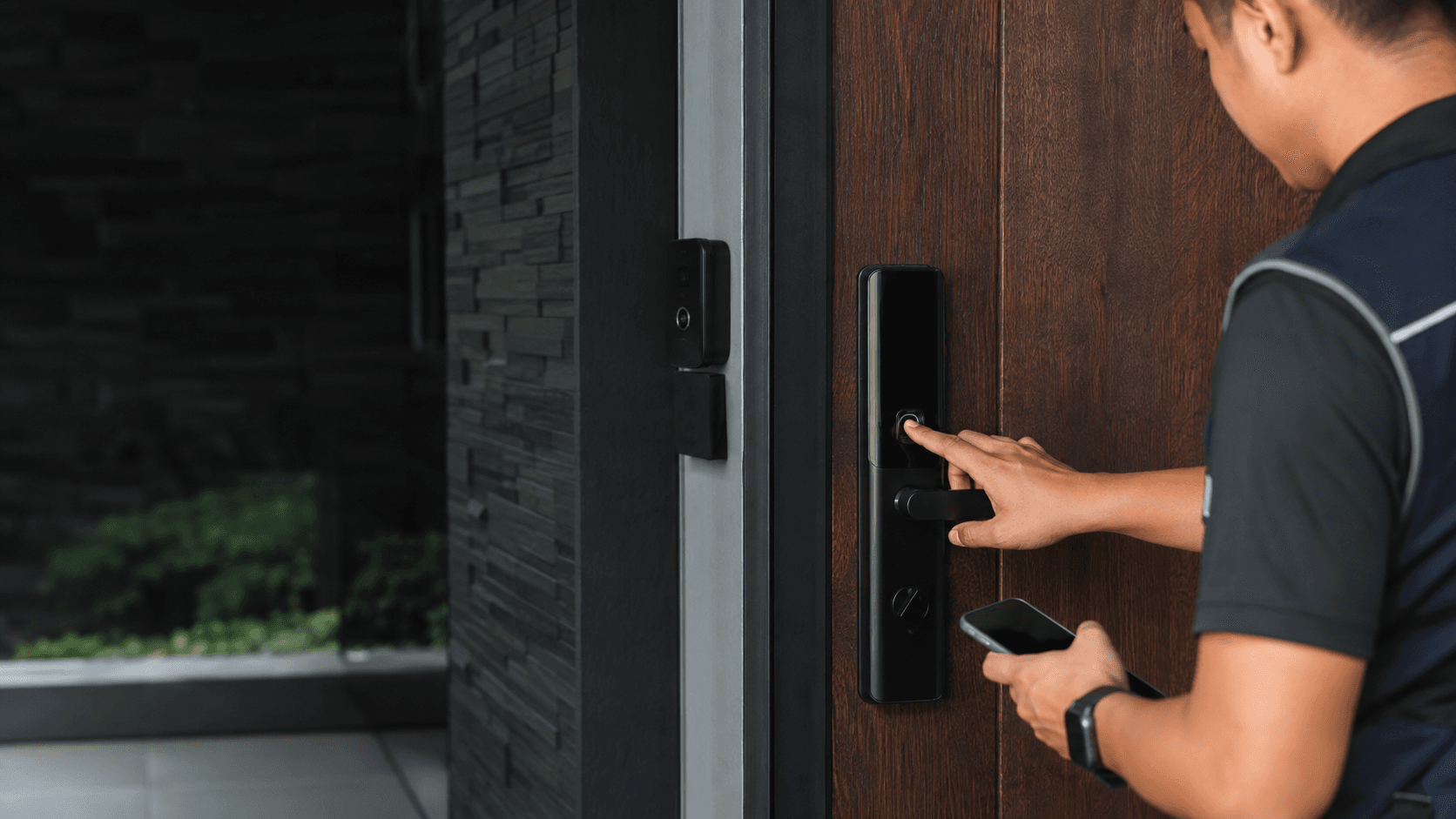
The exact-match query "door knob electronic lock" describes a specific hardware category: a knob-shaped handle that unlocks electronically rather than with a cut key. Retail listings in this category span keypad knobs, fingerprint knobs, and app-controlled handles, and the same product family appears under the labels digital lock, keyless entry knob, and smart knob lock. Buyers comparing options in Malaysia usually weigh three things at once: how the door is used, who needs entry, and what happens when the battery dies or the code is forgotten.
Door Knob Electronic Lock. What Matters Before Choosing
Most disappointment with a door knob electronic lock traces back to a mismatch between the lock and the door it is fitted to, not to the lock's electronics. A knob lock is a different product from a deadbolt, and the two are not interchangeable on the same mounting hole.
A keypad knob typically fits a standard knob bore and latch, which makes it a direct swap for an existing knob on an interior door. A deadbolt occupies a separate bore above the knob and provides a longer bolt throw into the frame. Homes that want keyless entry at the main entrance often end up with a keypad deadbolt rather than a knob, because the deadbolt carries the security function and the knob stays mechanical. Retail category pages reflect this split: knob-format electronic locks cluster around bedrooms, storage rooms, offices, and apartments, while deadbolt-format locks dominate front-door listings.
Eyonic's own product review guidance makes the same distinction from an installation standpoint. Smart locks work best when the door condition, user roles, and backup method are reviewed before installation, and for business use the choice between a standalone smart lock and an access-control panel is a real fork in the road rather than a cosmetic preference.
Choosing the Right Door Knob Electronic Lock
The decision sequence below follows the order that matters on site. Working through it in sequence avoids buying a lock that fits the budget but not the door.
- Confirm the door format. Check whether the existing hardware is a knob-only bore or a knob plus deadbolt, and measure the backset and door thickness before ordering.
- Decide the entry method. Keypad code, fingerprint, app control, keycard, or a combination — each adds convenience and each adds a failure mode.
- Count the users. A household of four needs far fewer codes than a shop with rotating staff, and user capacity changes which models qualify.
- Plan the backup. A physical key override, a mechanical key cylinder, or an external power option determines what happens during a flat battery.
- Check the environment. Interior doors, covered entrances, and exposed exterior doors place different demands on the hardware.
- Confirm the handover. Whoever installs the lock should test every code, every user role, and the backup path before the job is treated as finished.
Steps two and three interact more than buyers expect. A fingerprint knob removes the need to remember a code, but it also removes the ability to issue a temporary code to a cleaner or a contractor. A keypad knob with a large user capacity handles staff turnover better but requires someone to actually delete old codes. Neither is universally better; the right answer depends on whether the door serves a fixed household or a changing group.
What is a door knob electronic lock?
A door knob electronic lock is a knob-format door handle that grants entry through an electronic credential — a keypad code, a fingerprint, a keycard, or an app command — instead of, or alongside, a physical key. The electronic component sits in the knob or the rose behind it, and the latch mechanism remains largely conventional.
This matters because it separates the product from two neighbours it is often confused with. A smart deadbolt is electronic but mounts in the deadbolt bore, not the knob bore. A mechanical keypad knob with no electronics is a different product again, though retail listings sometimes blur the labels. The practical test is whether the lock needs power: if it does, it belongs in this category.
Electronic Door Locks for Convenient Security
Convenience is the honest headline benefit, and it is worth being precise about what that convenience costs. Removing the key removes the lost-key problem, the copied-key problem, and the fumbling-at-the-door problem. It introduces a battery, a code that can be shared too widely, and a dependency on the lock's own electronics continuing to work.
For a household, the trade is usually favourable. For a business, the trade depends on scale. Eyonic's review guidance notes that for business use, the choice between a standalone smart lock and an access-control panel deserves a deliberate look — a single knob lock on an office door is simple, but a building with multiple controlled doors and staff who move between them is a different problem that a panel-based system handles more cleanly.
Eyonic's completed work in Sarawak illustrates how access questions scale. The Kuching Immigration Office project focused on arrival flow, staff areas, visitor movement, and dependable daily operation — a public building where the movement pattern, not the hardware brand, drove the design. The KTA Sarawak Sdn Bhd project addressed staff movement, visitor handling, tidy cabling, and clearer daily site control for an engineering consultancy office in Kuching. Both are access-and-movement problems first and product problems second, which is the same order of thinking that applies to a single door knob electronic lock.
Where a knob lock fits and where it does not
A knob-format electronic lock suits interior doors where the goal is controlled convenience: a home office, a bedroom, a storage room, a small shop's back door, or an apartment entry where the building already provides the primary security. It is a poor fit for an exposed main entrance with no secondary locking, for a door that must resist forced entry, and for any door where the frame or bore is already damaged.
Door condition is the constraint that gets overlooked most often. A door that has swollen, a frame that has shifted, or a latch that already needs a shoulder to close will not improve with an electronic knob. Eyonic's installation process begins with a site survey and a system proposal before any installation work, which is the point at which a door that cannot take the hardware gets identified rather than discovered afterwards.
Practical Considerations for a Door Knob Electronic Lock
Several practical details decide whether the lock is pleasant or irritating in daily use.
Battery life and battery type vary by model and by how often the lock is used, so the honest approach is to check the specific product's stated runtime rather than assume a category figure. What matters more is the low-battery warning and whether the lock still opens after the warning. A lock that warns early and still works for weeks is manageable; one that fails silently is not.
Code management is the second detail. A lock with a generous user capacity is only useful if someone removes departed users. For a business, that maintenance task belongs to a named person, not to whoever remembers.
Environment is the third. Interior doors and covered entrances are forgiving. Exposed doors face rain, heat, and humidity, and the product's stated environmental rating is the only reliable guide — a claim that a lock is "waterproof" without a stated rating is not evidence.
Handing and fit are the fourth. Many knob locks accommodate both left- and right-handed doors, but not all do, and the backset must match the door. These are checkable before purchase and expensive to discover afterwards.
Cost and scope in Malaysia
Hardware prices for this category vary widely by brand, entry method, and finish, and no single figure represents the market. Installation scope is the larger variable: a straight swap onto an existing bore is a short job, while a door that needs adjustment, a new bore, or additional access control is a project.
Eyonic publishes package pricing for its other security work — RM 1,599 for a Hikvision CCTV package, RM 1,599 for a Hikvision alarm system, and RM 1,599 for an autogate package — which gives a sense of how the company structures supply-and-install work, though these packages cover different systems than door hardware. Larger access and monitoring projects sit in a different range: the Kuching Immigration Office work carried an approximate budget of RM 12,000 to RM 28,000, and the KTA Sarawak Sdn Bhd office project an approximate budget of RM 8,000 to RM 18,000. Those figures describe multi-part installations, not a single knob lock, and should not be read as a price for one.
Making an Informed Choice About a
The decision comes down to four questions answered honestly. Is the door interior or exposed? Is the user group fixed or changing? Is there a backup entry path that does not depend on the lock's electronics? And is the door itself in a condition to accept new hardware?
If all four answers point the same way, a knob-format electronic lock is a reasonable, low-drama upgrade. If any answer is unclear — particularly on an exposed main entrance or a door serving a rotating group of people — the sensible move is to have the door and the access requirement looked at before choosing hardware. That is the same sequence Eyonic applies to its other security work: site survey, system proposal, installation, and handover, with the survey doing the work that prevents a wrong purchase.
Eric Yong, founder of Eyonic Security Systems, has worked in the industry for more than ten years and is experienced in technical installation of digital security solutions for commercial businesses in Sarawak. For a single door, that experience mostly shows up in the questions asked before the hardware is chosen.
Share the location, property type, and required system with Eyonic on WhatsApp at +60 11-5111 7959 for the next practical step.