
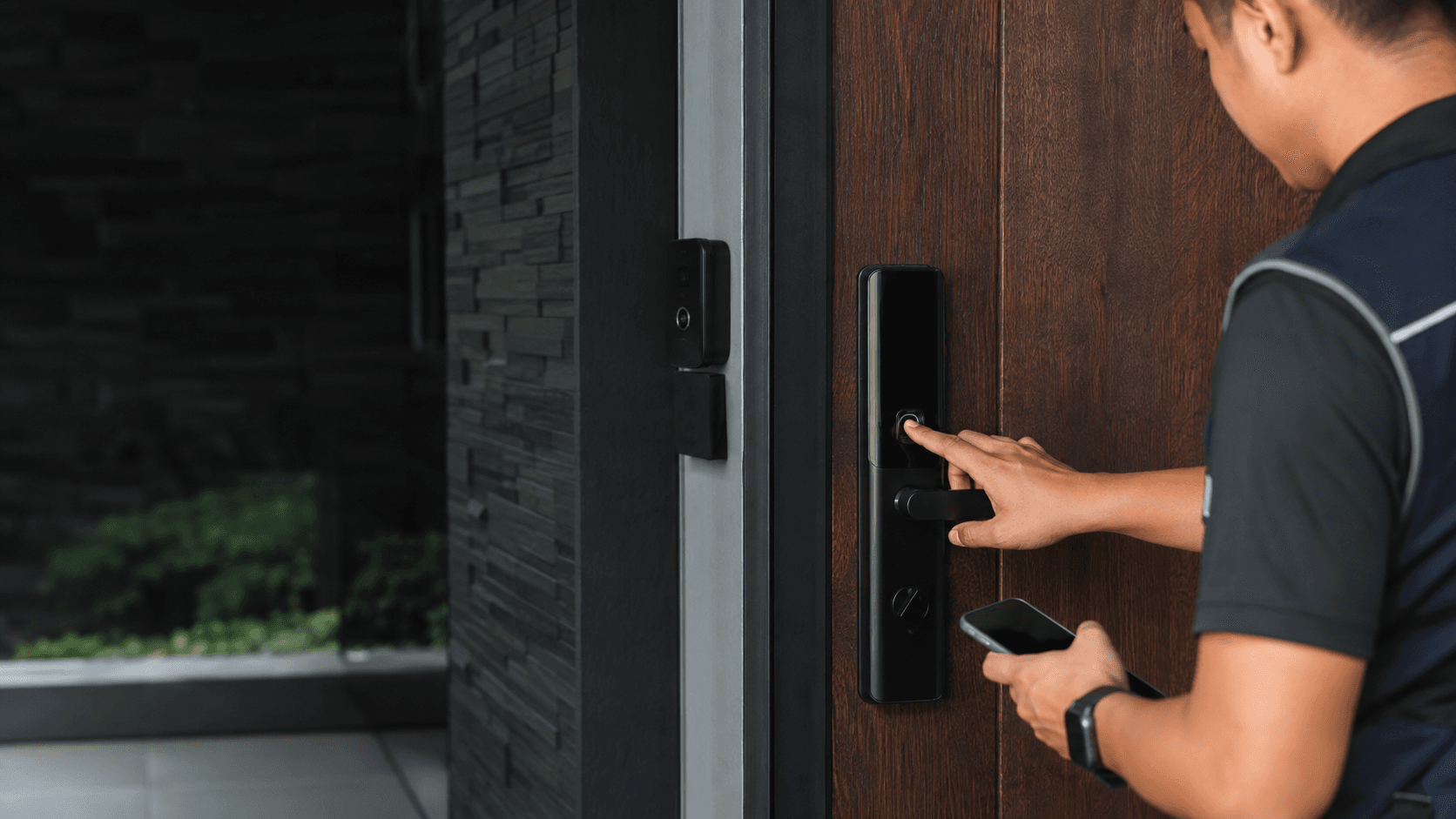
The exact-match query keypad entry front door describes a specific upgrade rather than a single product. It covers the lock body, the code pad, the door preparation behind both, and the decision about who is allowed through. In Malaysia, that decision usually involves a household, a shop lot, or an office with staff and visitors moving through the same entrance at different hours.
Eyonic Sdn Bhd is a security system supplier in Sarawak working on CCTV and ELV systems, with planning, supply and installation for homes, offices, shops and industrial sites. Smart lock door access sits inside that range, and the company's own review guidance notes that smart locks work best when door condition, user roles and backup method are reviewed before installation.
Keypad Entry Front Door. What Matters Before You Choose
Three things decide whether a keypad lock performs well over years rather than weeks: the door itself, the people who need entry, and what happens when the electronics stop cooperating.
Door condition comes first because a keypad deadbolt is a mechanical product with an electronic overlay. If the door frame has shifted, the strike plate sits proud, or the existing bore holes are undersized, the bolt will drag. A dragging bolt drains batteries faster and produces the false failures that make people distrust keyless entry. Eyonic's smart lock review guidance puts door condition at the front of the assessment for exactly this reason.
User roles come second. A family home needs a handful of codes and a way to issue a temporary one for a cleaner or a relative. A shop needs a code that can be changed when staff turnover happens. An office needs to know whether a standalone smart lock is sufficient or whether an access-control panel with logging is the better fit. Eyonic's review guidance draws that line explicitly for business use.
Backup entry comes third. Every electronic lock on a front door needs a mechanical or secondary path in, whether that is a physical key override, a 9-volt jump terminal, or a second entrance that is not electronically controlled. This is not a hypothetical concern in Sarawak, where a flat battery during a heavy evening downpour is a real inconvenience rather than a thought experiment.
Choosing the Right Keypad Entry Front Door
A practical sequence reduces the chance of buying a lock that fits the box but not the door.
- Confirm the door type and thickness, and check whether the existing bore holes match a standard deadbolt footprint or need fresh preparation.
- Decide the entry method. keypad only, keypad with fingerprint, keypad with app control, or keypad with a physical key override.
- Count the users and decide how many separate codes are needed, and whether any code must expire automatically.
- Check the power source and estimate battery life against how often the door is used each day.
- Confirm the backup method before installation, not after the first lockout.
- Decide whether the lock stands alone or connects to a wider system such as CCTV, an alarm panel, or an intercom.
- Arrange installation and a handover that includes testing every code and the mechanical override.
Step six is where many buyers underestimate the value of planning ahead. A keypad lock that operates independently is simple and reliable. A keypad lock that ties into a broader setup can support visitor handling and staff movement, which is the kind of requirement Eyonic addressed at the Kuching Immigration Office project, where arrival flow, staff areas and visitor movement were the stated focus.
What is keypad entry front door hardware actually made of
A keypad entry front door lock is a deadbolt or lever set with an electronic keypad replacing the key cylinder. The exterior assembly holds the keypad, the interior assembly holds the motor and battery compartment, and the bolt mechanism sits inside the door. Communication between the two halves runs through the door, which is why door thickness and bore alignment matter more than most buyers expect.
Keypad types divide into physical buttons and capacitive touchscreens. Physical buttons give tactile feedback and tend to remain legible in low light. Touchscreens offer a cleaner surface and are easier to wipe down, but they can be less responsive in heavy rain or with wet hands. Neither is universally better; the choice depends on climate exposure and how the door is used.
Electronic Door Locks - The Home Depot and similar retail ranges
Large retail listings group keypad entry front door products by price band and feature set, which makes them useful for comparing specifications but less useful for judging fit. A lock listed at a low price may use a lower security grade, a shorter battery life, or a smaller code capacity than a mid-range model. The specification sheet rarely states how the lock behaves when the door frame is slightly out of alignment.
Retail ranges also tend to present keyless entry as a single category, blending standalone keypad deadbolts with app-connected smart locks and retrofit units that sit over an existing deadbolt. Those are three different products with three different installation requirements. A retrofit unit avoids replacing the deadbolt but adds a bulkier interior profile. A full replacement deadbolt gives a cleaner result but requires the door to accept a standard footprint.
Practical Considerations for Keypad Entry Front Door Installation
Installation quality determines whether the lock feels solid or fiddly. The mechanical work is small but unforgiving: the bolt must extend and retract without resistance, the strike plate must align, and the door must close without needing to be pushed or lifted.
Eyonic's CCTV installation process runs through site survey, system proposal, installation and handover, and the same discipline applies to door hardware. A survey confirms the door condition and the wiring or power situation. A proposal sets out what will be installed and how it will be tested. Handover covers code setup and a demonstration of the backup method.
For commercial premises, the survey also establishes whether a standalone lock is enough. Eyonic's smart lock guidance notes that for business use the company usually checks whether a standalone smart lock or an access-control panel is more appropriate. That check matters when a site needs a record of who entered and when, or when multiple doors must be managed together.
Where keypad entry front door hardware fits in a wider security setup
A front door lock controls one point of entry. It does not show what happened outside that door before someone arrived. Pairing a keypad lock with camera coverage at the entrance gives a record that a code alone cannot provide, and it is the combination most commonly requested for shop lots and offices.
Eyonic's project work in Sarawak has covered public offices and engineering consultancy sites, including a Kuching office setup supporting staff movement, visitor handling, tidy cabling and clearer daily site control. Door access, camera placement and intercom are usually planned together in that kind of environment rather than purchased separately.
Eyonic's published package pricing starts at RM 1,599 for a Hikvision CCTV package, RM 1,599 for a Hikvision alarm system, and RM 1,599 for an autogate package. Those figures cover the listed supply, setup and handover items in each package and do not represent door lock pricing, which depends on the lock model and door condition.
Limits and edge cases worth knowing
Keypad locks are not suitable for every door. A gate, a sliding door, or a door with an unusual thickness may need a different product category entirely. Metal doors and doors exposed to direct rain require specific weatherproofing considerations that a standard interior-rated lock will not meet.
Battery life varies with usage frequency, temperature and bolt friction. A lock on a door used twenty times a day will consume batteries faster than one used twice a day, and a stiff bolt accelerates that drain. Access logs, where available, are only as useful as the timekeeping on the device.
Code sharing is the most common operational weakness. A code given to a contractor and never deleted is a permanent entry method. Any keypad entry front door setup benefits from a simple rule about who holds a code and when it is removed.
Making an Informed Choice About
The decision narrows once door condition, user roles and backup method are settled. A household with a standard wooden front door and a handful of users is well served by a standalone keypad deadbolt with a physical key override. A shop with staff turnover benefits from multiple codes and a straightforward way to delete them. An office with visitor traffic and a need for records is usually better served by planning door access alongside cameras and intercom rather than treating the lock as an isolated purchase.
Eric Yong, founder of Eyonic Security Systems, has worked in the industry for more than ten years with a focus on technical installation of digital security solutions for commercial businesses in Sarawak. That background is relevant to door access because the installation details, not the product box, determine whether the lock works reliably.
Share your location, property type and required system with Eyonic on WhatsApp at +60 11-5111 7959 for the next practical step.