
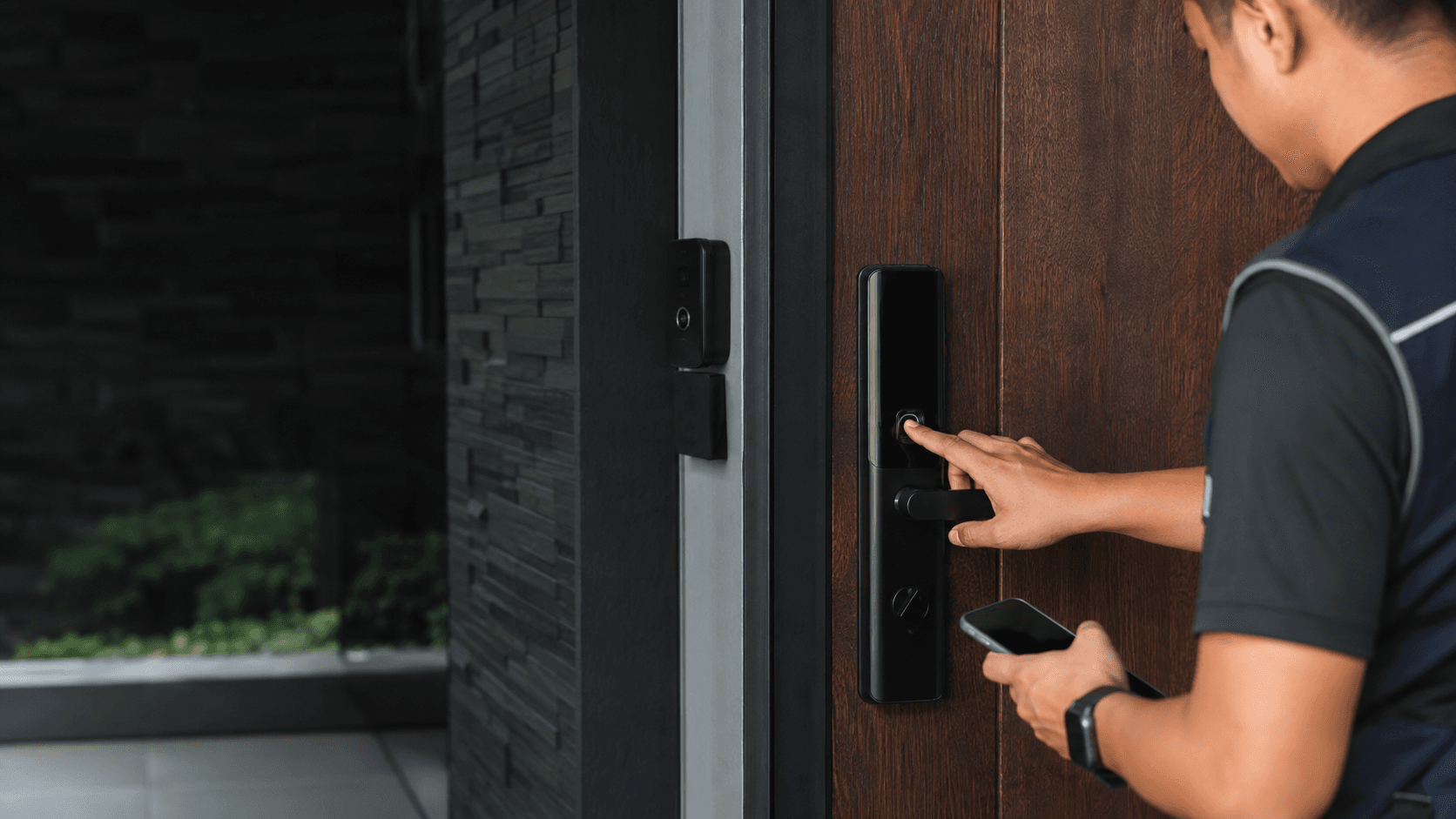
That single fitting is the whole point of the category. On a standard Malaysian door, the handle is the part a hand grips every time the door opens, and the lock is the part that decides who gets through. A keyless door lock with handle merges both jobs, which changes what gets replaced, what gets drilled, and how many people can be given their own way in.
The competitor set for this topic is dominated by US retail and review pages. Door Locks Direct sells keyless electronic handlesets as a lockset category. CNET, Wirecutter, Consumer Reports, SafeHome, PCMag and ZDNET publish smart lock roundups built around brand comparisons and lab testing. None of those pages address Malaysian door conditions, user roles, or installer scoping, and none of the eight analysed pages carried the exact query or the main entity in the H1. The gap is a local, installation-led treatment of the handle-integrated form.
What a handle-integrated keyless lock changes at the door
A handle-integrated lock replaces the existing lockset rather than sitting on top of it. The lever or knob, the latch mechanism, and the electronic credential reader arrive as one assembly, and the door keeps a single visible piece of hardware instead of a separate deadbolt above a separate handle.
That matters for three practical reasons.
The first is the door preparation. A handle-integrated unit has to match the existing bore and latch cutout, or the door has to be reworked. A retrofit deadbolt that sits above an untouched handle avoids that problem entirely, which is why retrofit designs appear so often in the review-oriented competitor pages. The trade-off is visual. two fittings instead of one.
The second is the pull. On a door with a separate deadbolt, the handle is a dumb lever that never needs power or a credential. On a handle-integrated unit, the same lever that releases the latch is also the part that reads the credential, so the fitting carries both the mechanical and the electronic load.
The third is the failure mode. When a handle-integrated lock loses power or a credential reader fails, the door still has to open. That is why backup entry is a design question rather than an afterthought, and why the review pages in the competitor set spend so much space on battery life and mechanical override.
Access methods and who needs entry
Access method is the second decision after form. The common options in this category are a numeric code entered on a keypad, a fingerprint read at the handle, a card or fob presented to a reader, and a phone app or digital pass. Some units combine several.
The choice follows the user list, not the feature list. A household with two or three regular adults and occasional visitors has a different requirement from a shop with staff arriving across shifts, or an office where visitors need to reach a reception area but not the back rooms.
Eyonic's own product review guidance on smart lock door access states that smart locks work best when the door condition, user roles and backup method are reviewed before installation, and that for business use the company usually checks whether a standalone smart lock or an access-control panel is more appropriate. That is the same question a handle-integrated lock raises, because the handle form is convenient for a home or a small office and less obviously right for a site with many doors and many staff.
Two edge cases are worth naming. A property with short-stay guests needs a way to issue and revoke a credential without handing over a physical key, which pushes toward code or app access. A property with elderly residents or young children needs an entry method that does not depend on a phone, which pushes toward a keypad or a mechanical key as the everyday route.
Door condition, user roles and backup entry
Door condition decides whether a handle-integrated lock is even a candidate. The relevant checks are the door material and thickness, the existing bore and latch cutout, whether the frame closes cleanly, and whether the door is exposed to weather. A door that already sticks or swings loose will not be fixed by a new lockset, and an electronic fitting on a misaligned door wears faster than one on a door that closes true.
User roles decide the credential plan. The useful questions are how many people need regular entry, how many need occasional entry, who can add or remove a credential, and what happens when someone leaves. A handle-integrated lock with a small credential capacity suits a home. A site with rotating staff or contractors needs either a larger capacity or a separate access-control panel, which is the fork Eyonic's smart lock review guidance describes.
Backup entry decides the risk. Every electronic lock needs a route in when the battery is flat, the reader fails, or the credential is lost. The usual routes are a mechanical key override, an external power point, or a second door that stays mechanical. The point is to decide which one applies before installation, not after the first lockout.
One constraint applies to rented and strata property. Replacing a lockset changes the door hardware, and the approval position depends on the tenancy agreement or the building's management rules. That is a question for the landlord or the management office, and it is worth settling before any cutting happens.
How Eyonic scopes a keyless door lock with handle
Eyonic Sdn Bhd is a security system supplier in Sarawak, Malaysia, working on CCTV and ELV systems for homes, offices, shops and industrial sites. The company's published installation process runs in four stages, and the same sequence applies to door hardware scoping.
- Site survey, covering the door, the frame, the closing action and the surrounding access route.
- System proposal, setting out the recommended unit and the credential plan for the people who need entry.
- Installation, including the lockset fitting and the credential setup.
- Handover, covering user testing and the backup entry method.
The survey stage is where most of the risk sits. Eyonic's published guidance on ColorVu-style cameras recommends checking actual conditions on site before confirming placement, and the same principle applies to a door: the survey is what confirms whether the existing preparation suits a handle-integrated unit or whether the door needs reworking.
Eyonic's project record shows the same survey-led approach on access and movement work. The Kuching Immigration Office project focused on arrival flow, staff areas, visitor movement and dependable daily operation, with an approximate budget for that type of work of RM 12,000 to RM 28,000. The KTA Sarawak Sdn Bhd project supported staff movement, visitor handling, tidy cabling and clearer daily site control, with an approximate budget of RM 8,000 to RM 18,000. Both are access-and-movement problems rather than lock problems, but they show the pattern: the door or entrance is scoped as part of how people actually move through the building.
Eric Yong founded Eyonic Security Systems and has worked in the industry for more than ten years, with experience in technical installation of digital security solutions for commercial businesses in Sarawak.
Two limits are worth stating plainly. Eyonic's published package pricing covers a Hikvision CCTV package, a Hikvision alarm system and an autogate package, each at RM 1,599. Those figures do not cover lock supply or installation, so a keyless door lock with handle is quoted separately. And the published material does not name specific lock brands or models, so brand selection is a survey-stage conversation rather than a published list.
Practical next step for a keyless door lock with handle
The decision narrows quickly once three things are known: the door and frame condition, the list of people who need entry and how often, and the backup route when the electronics are unavailable. Those three answers determine whether a handle-integrated unit fits, whether a separate deadbolt plus handle is the better form, and whether the site needs an access-control panel instead.
For a single home door in Sarawak, a handle-integrated keyless lock is usually a straightforward replacement if the existing preparation matches. For a shop or office with several doors and rotating staff, the survey is likely to point toward a panel-based system, with the handle-integrated lock reserved for the main entrance.
Share the location, property type and required system with Eyonic on WhatsApp at +60 11-5111 7959 for the next practical step.