
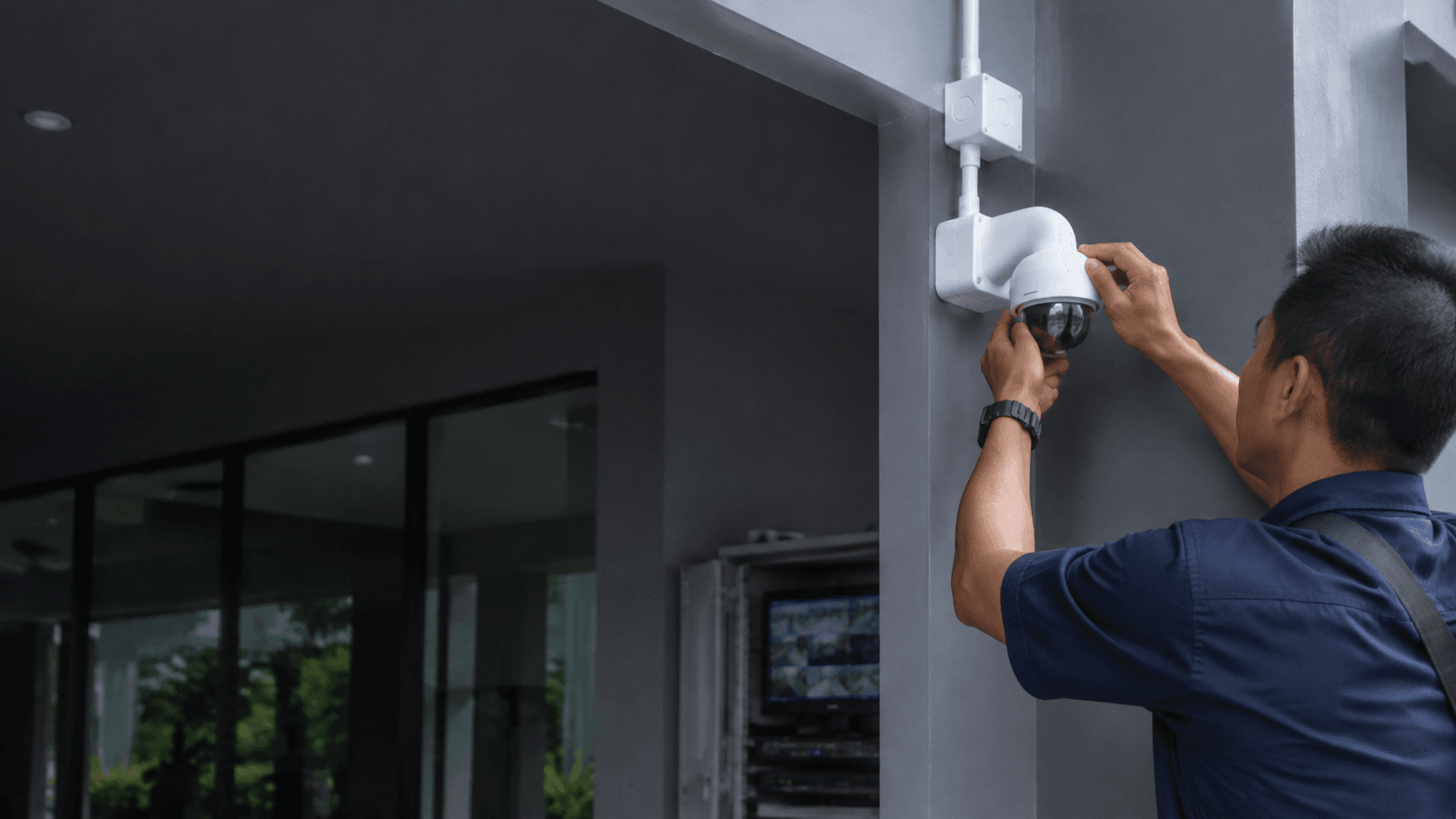
The exact phrase camera video exterior describes the whole outdoor chain rather than one box on a wall. A camera has to see the right area, the recorder has to keep the footage, and the phone has to show it later. Eyonic Sdn Bhd plans, supplies and installs monitoring systems with camera placement, recording and remote viewing for homes, offices, shops and industrial sites in Sarawak.
Most outdoor jobs fail on the boring parts. A camera aimed at a blank wall records nothing useful. A recorder tucked in a hot cupboard stops when the power blinks. A phone app handed over without a test leaves the owner guessing. The sections below follow the order that matters: what the system includes, how light and placement change the result, how Eyonic runs an installation, what changes by property type, and what to prepare before anyone visits.
What Camera Video Exterior Covers in a Working System
An outdoor setup has four working parts, and each one can break the chain on its own.
- Cameras mounted where they can see the approach, the gate, the loading area or the walkway.
- Cabling and power routed so the run survives weather and does not hang loose across a wall.
- Recording held on a recorder or storage device that keeps footage long enough to be reviewed.
- Remote viewing set up on the owner's phone so the footage can be checked away from the site.
Eyonic lists camera placement, NVR setup and remote viewing as separate parts of its CCTV work, which matches how the chain actually behaves. A weak link anywhere shows up as missing footage, not as a broken camera.
Two practical questions decide most of the design. How far is the camera from the thing it must identify, and how much of the day is that area lit? Distance sets the lens choice. Light sets whether colour detail survives after dark. Neither can be judged from a floor plan alone.
Why recording and viewing are separate decisions
Recording answers what happened last week. Remote viewing answers what is happening now. A site can have one without the other, and some owners only discover the gap when they need the footage. Eyonic's handover step exists to close that gap before the job is called finished.
Lighting and Placement Decide Whether Exterior Footage Is Usable
Placement and lighting are the two variables that most often separate footage that identifies a person from footage that only shows a shape.
Eyonic recommends checking actual lighting conditions before confirming placement for ColorVu-style cameras. That advice matters because a camera that performs well in a lit showroom can behave differently on a dim back lane. The check is done on site, at the hours that matter, not from a catalogue page.
Placement has its own constraints. A camera under a wide eave may stay dry but lose the view of the gate. A camera on a high pole may cover more ground but record faces from an angle that hides features. A camera facing a bright street at night may expose for the street and leave the doorway dark. Each of these is a trade-off, and the right answer depends on what the owner actually needs to see.
Common placement trade-offs
- Height. higher cameras cover more area but record faces from above.
- Angle. a straight-on view of an approach usually reads better than a side view.
- Light. a camera pointed into a bright source loses detail in the shadowed area.
- Obstruction. trees, signage and parked vehicles change the view through the day.
None of these can be settled by a specification sheet. They are settled by standing at the site and looking at what the camera will actually see.
How Eyonic Plans an Outdoor Camera Video Exterior Installation
Eyonic's CCTV installation process runs through four stages: site survey, system proposal, installation, and handover.
- Site survey. The team looks at the property, the areas to be covered, the lighting at different hours, and the routes available for cabling and power.
- System proposal. The survey findings become a proposed camera layout, recording arrangement and viewing setup, matched to the property and the budget.
- Installation. Cameras are mounted, cabling is run, the recorder is configured, and the system is brought online.
- Handover. The owner is shown how to view footage, and the setup is tested before the job closes.
The order matters. A proposal written before a survey is a guess about lighting, cable routes and coverage. The survey is what turns a package into a plan for a specific building.
Eyonic's founder, Eric Yong, has worked in the industry for more than ten years and is experienced in technical installation of digital security solutions for commercial businesses in Sarawak. That background shows up most clearly in the survey stage, where cable routes and lighting are judged on site rather than assumed.
What handover should include
Handover is where the system becomes usable. It should cover how to open the live view, how to find recorded footage from a given day, and who to contact when something stops working. A system that records correctly but cannot be reviewed by its owner is only half finished.
Choices for Homes Offices Shops and Industrial Sites
The same four-stage process applies everywhere, but the priorities shift with the property.
Homes usually need the gate, the car porch and the front door covered, with remote viewing for family members who are out during the day. Coverage is narrow and the main risk is a camera that misses the gate because it was aimed at the whole street.
Offices need entrances, reception and staff areas, with recording that supports daily operations rather than only incidents. Eyonic completed a project for the Kuching Immigration Office focused on arrival flow, staff areas, visitor movement and dependable daily operation, and a similar pattern applies to engineering consultancy sites such as the KTA Sarawak Sdn Bhd project in Kuching, which needed support for staff movement, visitor handling, tidy cabling and clearer daily site control.
Shops need the counter, the entrance and any stock or cash area, with footage that can be reviewed quickly after an incident. Camera placement near a bright shopfront window is a common problem because the light outside overwhelms the interior view.
Industrial sites need wider coverage across yards, loading areas and perimeter routes, where cable runs are longer and lighting is often uneven. These jobs tend to be planned around coverage zones rather than single camera positions.
Budget follows the same pattern. Eyonic's Hikvision CCTV Package is RM 1,599 and covers camera supply and setup, basic recording configuration and mobile viewing handover. Larger project work sits in different ranges: the Kuching Immigration Office project had an approximate budget of RM 12,000 to RM 28,000, and the KTA Sarawak Sdn Bhd project had an approximate budget of RM 8,000 to RM 18,000. The gap between a package and a project is mostly about camera count, cable distance and how much of the site needs coverage.
What to Prepare Before an Outdoor Site Survey
A survey goes faster and produces a better proposal when the owner arrives with a few things already decided.
- Areas that must be covered — gate, porch, entrance, counter, yard, loading bay.
- Hours that matter most — daytime foot traffic, after-dark activity, or both.
- Existing infrastructure — where power and network points already exist, and whether old cabling can be reused.
- Who needs to view footage — one person, a family, or several staff with different access needs.
- How long footage should be kept — this drives the recording and storage decision.
Photographs of the property taken at different times of day help before the visit, because they show how light falls across the areas of interest. They do not replace the on-site lighting check, but they shorten the conversation.
One constraint worth stating plainly: no camera placement can guarantee a particular outcome, and no footage is useful if the area it covers was never the area that mattered. The survey exists to reduce that risk before money is spent on hardware.
When the property type, location and required coverage are known, the next practical step is to share those details with Eyonic on WhatsApp at +60 11-5111 7959 so the survey and proposal can be matched to the site.