
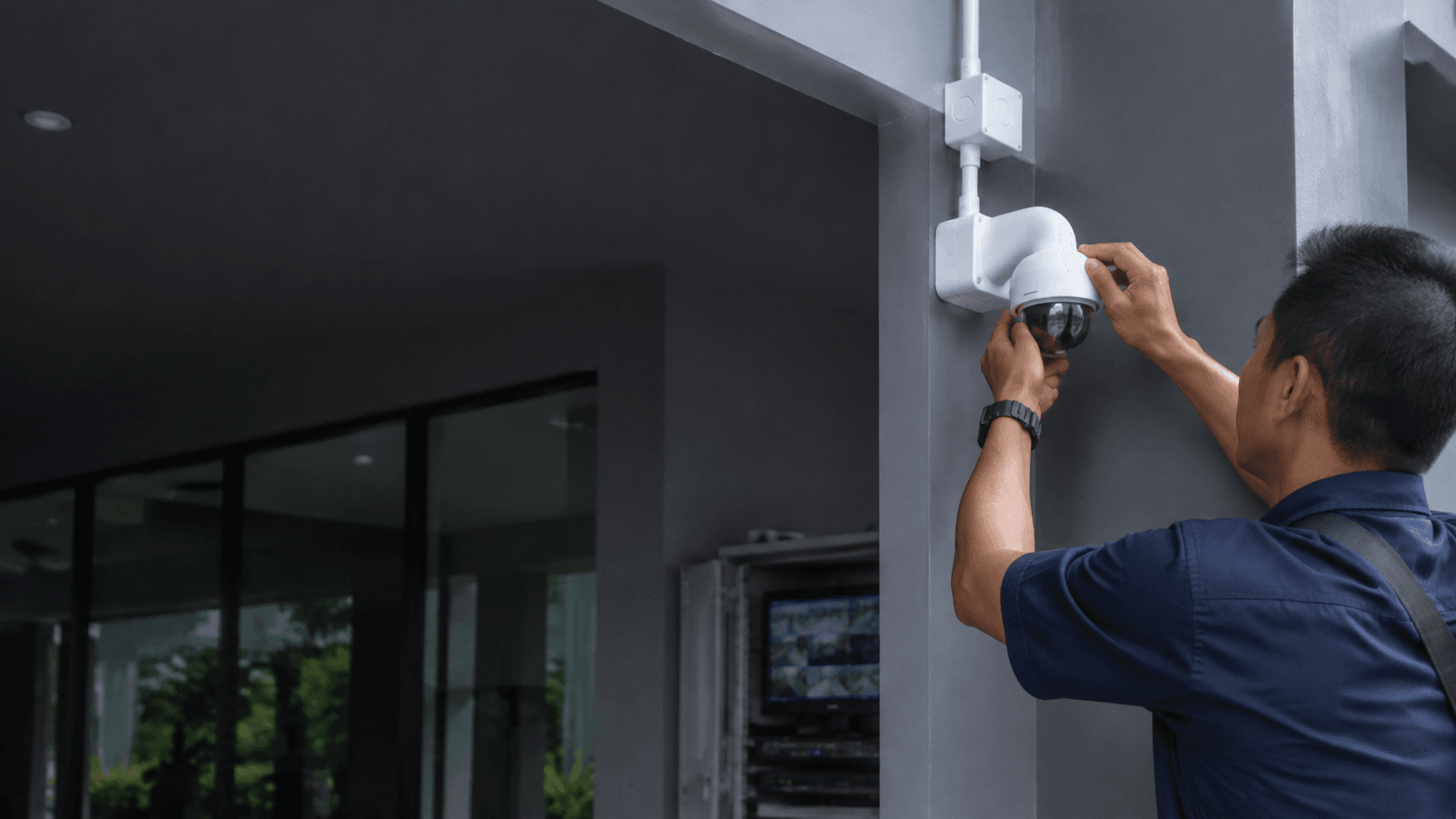
Indoor coverage decisions in Malaysia usually come down to three things: what the premises needs watched, where cameras can actually see it, and how footage gets recorded and reviewed afterwards. Eyonic Sdn Bhd, a security system supplier in Sarawak, handles that sequence through a site survey, a system proposal, installation and handover.
What an indoor camera system covers in a Malaysian premises
Indoor coverage is not one camera pointed at a room. It is a set of positions chosen so that each entry point, transaction point and movement path stays inside at least one camera's view for the moments that matter.
For a home, that usually means the front door interior, a hallway, and any room holding valuables. For a shop, it means the entrance, the counter, and the stockroom door. For an office, it means reception, the corridor serving staff areas, and any room where cash or records are kept. Public-facing premises add a further layer: arrival flow and visitor movement, which is the pattern Eyonic worked to when it completed a project for the Kuching Immigration Office, focused on arrival flow, staff areas, visitor movement and dependable daily operation.
Two constraints shape indoor work more than outdoor work. Ceilings and walls limit where cable can run and where a camera can be fixed, and indoor lighting changes through the day as blinds open, lights switch on, and screens glow. Both are settled on site, not from a floor plan alone.
Indoor camera system planning starts with a site survey
Eyonic's CCTV installation process runs through four stages: site survey, system proposal, installation, and handover. The survey is where the useful decisions get made, because it is the only stage where the actual building, its lighting and its movement patterns are visible at the same time.
- Site survey — the premises is walked through to identify entry points, movement paths, lighting conditions and where cable and equipment can be fixed.
- System proposal — the surveyed findings are turned into a proposed system covering camera positions, recording and viewing.
- Installation — cameras, recording equipment and cabling are installed according to the agreed proposal.
- Handover — the completed system is handed over, including mobile viewing setup.
A survey that skips the walk-through tends to produce cameras aimed at walls, positions that miss the counter, or cable routes that cannot be concealed. The survey also settles the question of whether a space needs one wide view or several narrower ones, which is a coverage decision rather than a product decision.
What the survey should record
Entry and exit points, including secondary doors and staff entrances. Counter and cash positions. Corridors and the routes people actually walk rather than the routes the plan suggests. Rooms holding stock, records or equipment. Existing lighting, including which areas are lit at night and which are not. Available mounting surfaces and cable paths. Where the recording equipment can sit, and whether it needs ventilation or a locked enclosure.
Camera placement follows lighting and movement, not guesswork
Placement is the part of an indoor camera system that most often decides whether the footage is useful. A camera that covers a doorway but faces a bright window will lose the person walking through it. A camera mounted too high will capture heads and ceilings rather than faces.
Eyonic recommends checking actual lighting conditions before confirming placement for ColorVu-style cameras. That guidance matters indoors because interior light is rarely constant: daylight through glass, fluorescent or LED ceiling light, and screen glow all fall on the same scene at different times. A position that reads well at midday can behave differently at night, and the survey is the point at which that is checked rather than assumed.
Movement matters for the same reason. A camera placed on the path people actually use will capture them; a camera placed where the plan says people should walk may capture an empty corridor. In the Kuching Immigration Office project, the focus was on arrival flow, staff areas and visitor movement, which are movement patterns rather than fixed objects.
Placement trade-offs worth naming
Wider coverage per camera reduces the number of units but spreads detail across a larger frame, so faces and number plates become smaller. Narrower coverage improves detail but needs more cameras to cover the same space. Height improves the view over obstacles but flattens the angle onto faces. Concealment reduces the chance of tampering but can put the lens behind a shelf or pillar. Each of these is a real trade-off, and the survey is where they get weighed against the actual room.
Recording, viewing, and handover after installation
Recording and viewing are configured during installation and confirmed at handover. Eyonic's service scope covers camera placement, recording and remote viewing, and its Hikvision CCTV Package at RM 1,599 includes camera supply and setup, basic recording configuration, and mobile viewing handover.
Remote viewing is what turns recorded footage into something usable day to day. It is also the part most likely to be affected by the premises' own network, so the handover step exists to confirm that the viewing setup works before the installer leaves rather than after.
Handover is also where the practical questions get answered: how to review footage from a chosen time, what happens when the recording equipment loses power, and who to contact if a camera stops responding. For premises with staff turnover, the handover is worth repeating for whoever will actually use the system.
What handover should leave behind
A working mobile viewing setup on the devices that will be used. A clear explanation of how to find footage from a specific date and time. Confirmation that recording is running and where it is stored. Contact details for support. For multi-user premises, a decision on who holds viewing access and whether that access is shared or restricted.
questions to settle before confirming
Most of the friction in an indoor camera system project comes from questions that were never asked during the survey. Settling them early is cheaper than adjusting after installation.
How many cameras does the space actually need? That follows from the coverage map built during the survey, not from a package size. A single-room shop and a two-floor office rarely need the same count.
Where will recording equipment live? It needs a position that is secure, ventilated and reachable for maintenance. This is a survey decision because it affects cabling.
Who will review footage, and how often? A system reviewed only after an incident needs different priorities from one watched daily.
What happens during a power cut? This should be confirmed at handover rather than assumed.
Does the premises have network coverage where remote viewing is needed? Remote viewing depends on connectivity, and weak coverage in a stockroom or back office is worth checking before installation rather than after.
What is the budget range for this type of work? Eyonic's published package pricing starts at RM 1,599 for the Hikvision CCTV Package, and its completed project work has carried approximate budgets of RM 8,000 to RM 18,000 for an office setup and RM 12,000 to RM 28,000 for a public office. Those figures describe different scopes, so they are a range rather than a quote.
For premises in Sarawak, the practical next step is to share the location, property type and required system with Eyonic on WhatsApp at +60 11-5111 7959, so the survey can be scoped against the actual space.