
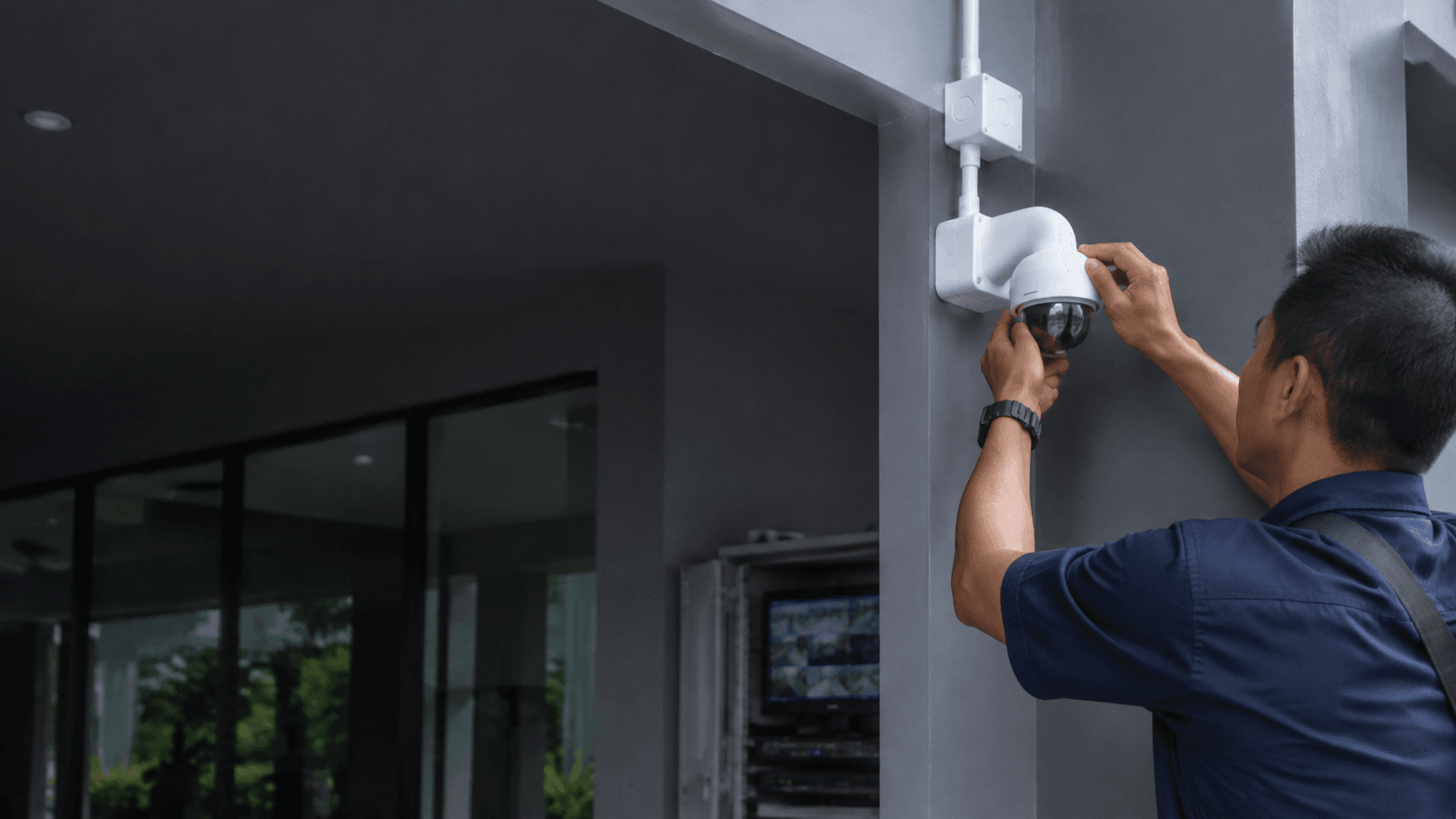
The exact-match query ups for cctv camera describes a power-continuity decision, not a single product. A surveillance system has at least two separate power paths: the low-voltage DC feed that runs the cameras, and the mains feed that runs the recorder, router and monitor. A UPS for CCTV camera planning exercise only works when both paths are covered, because a recorder that loses power stops writing footage even if every camera still has voltage.
Ups For Cctv Camera. What Matters Before Choosing
Three variables decide the outcome: the total load in watts, the runtime required, and whether the load is AC or DC. Everything else — brand, form factor, battery chemistry — follows from those three.
Load is the starting point. A recorder plus a PoE switch plus a router typically draws far less than a desktop PC, which is why small UPS units are often adequate for the mains side. Camera-side load depends on how the cameras are fed. Cameras powered by a central 12V supply box draw from that box, while PoE cameras draw from the switch, so the switch becomes the single point that must stay energised.
Runtime is the second variable, and it is a trade-off rather than a target. Battery capacity and load are inversely related: doubling the load roughly halves the runtime from the same battery. A unit that holds a small recorder for an hour may hold the same recorder for twenty minutes once a PoE switch and router are added to the protected outlets.
Power quality is the third variable and the one most often overlooked. A UPS also conditions the supply, absorbing surges, spikes and brownouts that would otherwise reach the recorder. In areas with frequent voltage fluctuation, that conditioning matters even when outages are rare.
Choosing the Right Ups For Cctv Camera
A short decision sequence keeps the choice grounded in the actual installation rather than in catalogue ratings.
- List every device that must stay alive: cameras, recorder, PoE switch, router or ONT, and any monitor used for live viewing.
- Separate the list into AC devices and DC devices, because they need different backup hardware.
- Add up the wattage of the AC devices and compare it with the UPS watt rating, not the VA rating.
- Decide how many minutes of coverage are genuinely useful — enough to ride out a short cut, or enough to cover a longer scheduled outage.
- Check the outlet type and count on the UPS against the plugs actually in use.
- Confirm whether the recorder needs a clean shutdown signal, and whether the chosen unit provides one.
The watt figure is the honest number. VA ratings look larger because they include a power factor, and a UPS rated at 1000VA may deliver only around 600W. Sizing against VA alone is the most common way a backup ends up shorter than expected.
What is ups for cctv camera in practice
In practice it is a battery-backed power stage inserted between the mains supply and the surveillance equipment. Two common forms exist. A DC uninterruptible supply sits on the low-voltage side, feeding 12V cameras and sometimes a router, and is often built as a metal cabinet with a battery link. An AC UPS sits on the mains side, feeding the recorder, switch and network equipment through standard outlets.
Some installations use both. Others use only one, depending on how the cameras are powered. The deciding question is simple. if mains power drops, which device stops first, and does that device matter more than the others?
UPS Power Backup For Security Camera Systems
Backup power protects three things at once: live viewing, recording continuity, and the integrity of files already written. The third is easy to miss. An abrupt loss of power during a write can corrupt the recording database on a recorder, and a corrupted index can make earlier footage difficult to retrieve even though the drive itself is intact.
Coverage also has a physical dimension. Cameras on a shared backup supply keep running, but if the network path between camera and recorder loses power, the footage never arrives. Protecting the recorder without protecting the switch or router produces a system that appears online and records nothing.
| Approach | What it protects | Typical constraint |
|---|---|---|
| DC uninterruptible supply | 12V cameras and low-voltage devices | Battery is often supplied separately |
| AC UPS on the recorder | Recorder, monitor, network gear | Runtime falls as load rises |
| PoE UPS | PoE cameras through the switch | Must match switch port count and power budget |
Eyonic plans, supplies and installs monitoring systems with camera placement, recording and remote viewing for homes, offices, shops and industrial sites, and its installation process runs through site survey, system proposal, installation and handover. Power backup is normally settled at the survey stage, because the answer depends on where the recorder sits and how the cameras are fed.
Runtime expectations and their limits
Runtime claims on packaging usually assume a light load. Real installations carry more. A practical approach is to treat the published figure as an upper bound and expect less once the recorder, switch and router are all connected.
Battery age changes the picture too. Sealed lead-acid batteries lose capacity over years of service, so a unit that covered a thirty-minute outage when new may cover considerably less later. Battery replacement is a maintenance item, not a one-time purchase.
Practical Considerations for Ups For Cctv Camera
Placement, heat and ventilation affect reliability more than most buyers expect. A backup unit in a closed cabinet with no airflow runs hotter, and heat shortens battery life. Recorders and backup units are often installed together in the same enclosure, which concentrates both heat sources in one place.
Cable routing matters as well. Adding a backup unit means additional mains cabling and, for DC units, additional low-voltage runs. Tidy cabling supports clearer daily site control, which is the kind of outcome Eyonic delivered for an engineering consultancy office in Kuching that needed support for staff movement, visitor handling and tidy cabling.
For public-facing sites, continuity has an operational dimension beyond security. Eyonic's work for the Kuching Immigration Office focused on arrival flow, staff areas, visitor movement and dependable daily operation — a reminder that surveillance uptime supports daily activity, not only incident review.
Two edge cases deserve attention. First, cameras with their own internal batteries or solar supply do not need the same DC backup, though the recorder still does. Second, very small installations with a single camera and a cloud subscription may find that protecting the router alone preserves most of the value, since the recording happens off-site.
Where UPS planning fits the wider installation
Power backup is one layer of a security system that also includes alarm, access and intercom equipment. Eyonic supplies and installs alarm systems, autogate systems and keyphone intercom systems alongside CCTV in Sarawak, and package pricing for a Hikvision CCTV package, a Hikvision alarm system and an autogate package is listed at RM 1,599 each. Larger project work is scoped individually; the Kuching Immigration Office project carried an approximate budget of RM 12,000 to RM 28,000, and the KTA Sarawak project an approximate budget of RM 8,000 to RM 18,000.
Camera selection interacts with backup planning in one specific way. Eyonic recommends checking actual lighting conditions before confirming placement for ColorVu-style cameras, and the same survey visit is the natural point to confirm power routes, recorder location and backup scope.
Making an Informed Choice About
The decision narrows to a few questions with concrete answers. If the cameras are PoE, the switch is the critical load and the backup belongs there. If the cameras run on 12V from a central box, a DC unit at that box covers them. If the recorder holds the only copy of footage, the recorder is the device that must not lose power abruptly.
Budget follows scope. A single small UPS protecting a recorder and router costs far less than a PoE-capable unit sized for eight or more cameras, and the difference is driven by battery capacity and port count rather than by brand.
Eric Yong, founder of Eyonic Security Systems, has worked in the industry for more than ten years with a focus on technical installation of digital security solutions for commercial businesses in Sarawak. That installation experience is the reason power continuity is treated as part of the system design rather than an accessory added afterwards.
For readers weighing the exact-match query ups for cctv camera against their own site, the useful next step is a survey that records device count, power source per camera, recorder location and the outage duration the site actually experiences. Those four facts determine the specification, and nothing in a product listing substitutes for them.
Share your location, property type and required system with Eyonic on WhatsApp at +60 11-5111 7959 for the next practical step.