
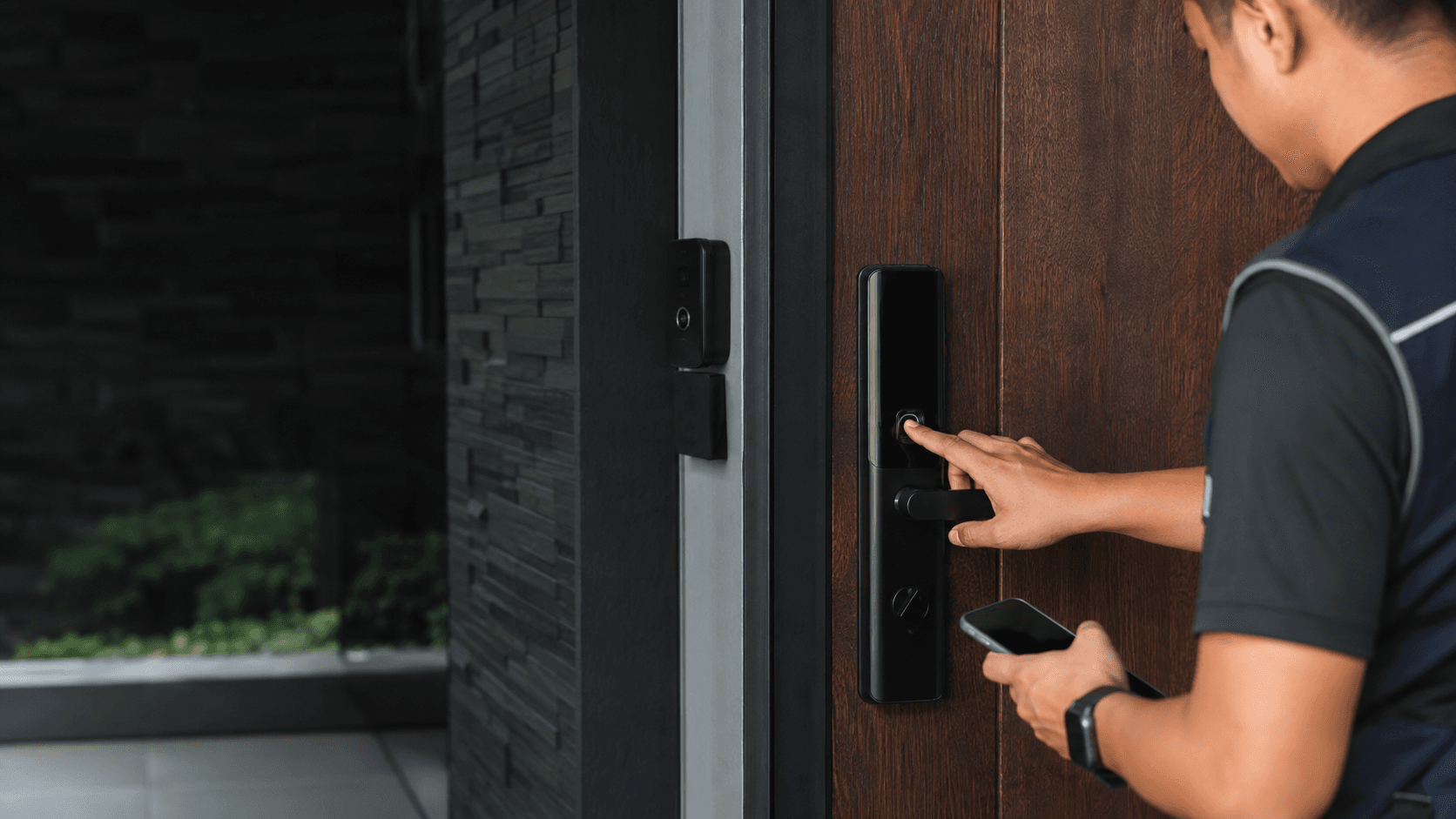
That combination matters because the handle and the deadbolt usually sit on the same backset and the same door preparation. A separate handle and a separate deadbolt can be replaced independently, but a combined set is ordered and fitted as one unit. The trade-off is straightforward: fewer parts to match, less freedom to mix brands across the two functions.
Keyless Entry Door Lock With Handle And Deadbolt: What the Combined Unit Does
The unit replaces two pieces of hardware with one electronic assembly. The handle side provides the pull or push surface for the door leaf. The deadbolt side provides the locking bolt that extends into the frame. In a combined set, the electronics drive the deadbolt, and the handle is either mechanically linked to the same credential check or free to turn only after the lock releases.
This differs from a keypad deadbolt sold alone, where the existing handle stays in place and keeps working as before. It also differs from a smart lever that locks only the latch, which offers convenience but not the throw of a deadbolt.
Three practical consequences follow from the combined form:
- Confirm the door preparation, including backset and cross-bore spacing, before ordering, because a combined set must line up with both existing holes.
- Define who needs access and at what level, since household members, staff, and occasional visitors usually need different credentials.
- Plan the backup entry method in advance, so a flat battery or a forgotten code does not leave the door unusable.
Each of those checks is cheaper to do before installation than after. A door that has been drilled or enlarged for one set is harder to return to its original state.
How a Handle and Deadbolt Set Changes Daily Entry
Daily entry changes in two ways. First, the door no longer needs a key for routine use, so arriving with full hands or in the dark does not require finding a key. Second, the deadbolt can be thrown as part of the same action as closing the door, which reduces the common habit of pulling the door shut and leaving the deadbolt open.
The second change is the one that affects security more than convenience. A latch alone can often be slipped. A deadbolt that is actually engaged is a different proposition. When the lock throws the deadbolt automatically or with one touch, the gap between "door closed" and "door locked" narrows.
There is a counterweight. Electronic sets depend on power and on the credential working. A mechanical key cylinder that still functions when the electronics fail is the usual answer, and it is worth confirming that the cylinder is accessible from outside the property rather than only from within.
Where the combined form suits a door
A combined handle-and-deadbolt set suits a main entrance where the existing hardware already includes both a handle and a deadbolt at standard spacing. It also suits a door that is being replaced or refinished, because the preparation can be cut to match the new set rather than adapted to old holes.
It suits less well where the door is thin, where the frame has moved, or where the existing holes are at a spacing the new set does not offer. In those cases a standalone keypad deadbolt that reuses the current handle is often the simpler route.
Door Condition and User Roles Before Installation
Two questions decide most installations: will the door accept the hardware, and who is allowed through it.
On door condition, the relevant checks are the door thickness, the backset distance from the door edge to the centre of the bore, the diameter of the existing cross-bore, and whether the frame has a reinforced strike area. A door that binds, swells, or has a misaligned frame will strain any electronic mechanism, and the deadbolt is usually the part that suffers first.
On user roles, the useful distinction is between people who need permanent access, people who need access for a defined period, and people who need one-off entry. Permanent users are household members or long-term staff. Defined-period users are contractors, cleaners, or short-stay guests. One-off users are delivery or service visits.
Eyonic's own review guidance on smart lock door access notes that smart locks work best when door condition, user roles, and the backup method are reviewed before installation, and that for business use the choice between a standalone smart lock and an access-control panel should be checked first. That is a useful framing for a combined set too, because a single door with a handful of users behaves differently from a door that many people pass through each day.
When a single door is not the right unit of design
If the requirement is to control several doors, log who entered, or integrate with an existing system, a standalone lock on one door may be the wrong starting point. A small office with a staff entrance, a visitor entrance, and a storeroom is usually better served by treating access as a system rather than as three independent locks.
Eyonic's work for the Kuching Immigration Office focused on arrival flow, staff areas, visitor movement, and dependable daily operation, which is the same set of concerns that decides whether one door lock is enough or whether the entrance needs to be planned as part of a wider arrangement.
Access Methods, Codes, and Backup Entry
Access methods on combined sets typically include a keypad code, a physical key, and in some models a card, fob, or phone app. The method that matters most in daily use is usually the keypad, because it needs no carried item. The method that matters most in a failure is the physical key or an external power point.
Code management is where most households and small businesses create their own problems. A shared code that is never changed is effectively a key that cannot be withdrawn. A separate code per person can be removed when that person no longer needs access, which is the main practical advantage of electronic entry over a copied key.
Backup entry deserves a decision rather than an assumption. The realistic failure modes are a flat battery, a forgotten or mistyped code, and an electronic fault. A mechanical key cylinder covers the first two if the key is stored somewhere reachable from outside the property. Some models also accept temporary external power, which covers a flat battery without a key.
What to check about codes and permissions
Before buying, it is worth establishing how many separate codes the lock supports, whether codes can be added and deleted without factory resetting the unit, and whether the lock distinguishes between permanent and temporary codes. These are the features that determine whether the lock still works for a household of five or a shop with rotating staff.
Where the answers are not published for a specific model, that is a question for the supplier rather than an assumption to make from a product photo.
in Malaysian Homes and Offices
In Malaysia, the practical context for a keyless entry door lock with handle and deadbolt is a mix of landed houses, apartments, and small commercial premises. Landed houses often have a main entrance that is exposed to rain and direct sun, which puts the keypad and the electronics in a harsher position than an internal door. Apartments usually have a main door that is sheltered by a corridor, and a second door or gate that may need separate treatment.
Small offices and shops add a different requirement: staff arrive and leave at different times, and the person locking up may not be the owner. A combined set with individual codes handles that better than a shared key, provided the codes can be managed without technical help.
Humidity is a factor that affects hardware over years rather than days. It is a reason to prefer hardware that is specified for external use where the door is exposed, and a reason to check the finish and the moving parts rather than only the electronics.
Eyonic Sdn Bhd supplies and installs security and ELV systems in Sarawak, including smart locks alongside CCTV, alarm, autogate, and intercom work, and has completed projects for government and engineering consultancy clients. For a door that is part of a wider entrance arrangement, that combination matters, because a lock decision made in isolation can conflict with how the gate, intercom, and camera coverage are set up.
What to Confirm Before Buying
The purchase decision comes down to fit, access, and failure handling. Fit is a measurement question. Access is a permissions question. Failure handling is a backup question. None of the three can be answered from a product listing alone.
It is also worth deciding whether the door is a standalone problem or part of an entrance. A single main door in a house is usually standalone. A shop entrance with a gate, an intercom, and staff movement is not, and the lock should be chosen with the rest of the entrance in view.
Where a specific model is being considered, the details that should come from the supplier rather than from assumption are the supported door thickness and backset, the number of user codes, the battery type and expected life, the weather rating if the door is exposed, and the exact backup entry method. Those are the points where a wrong assumption is expensive to correct after installation.
For readers in Sarawak who want the door assessed alongside the rest of the entrance, Eyonic can be reached on WhatsApp at +60 11-5111 7959 with the location, property type, and required system.