
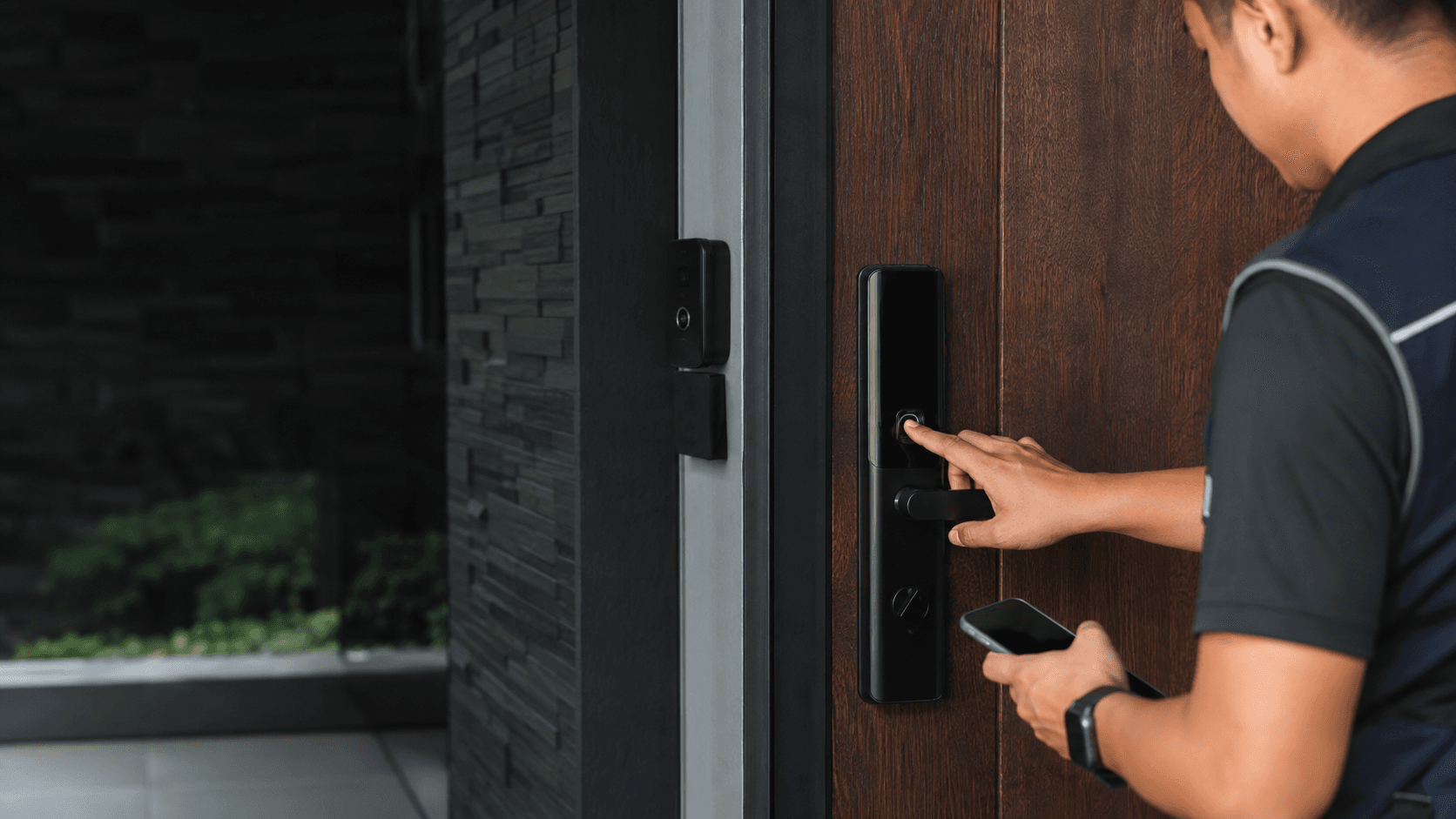
Kwikset's own product pages describe these as keyless entry levers with a digital touchpad, where a personal access code is entered to unlock and a button press locks the door. The same pages group the range under keyless entry levers and name SmartCode and SmartKey Security as the recurring product terms.
That matters for a Malaysian property because a lever handle is what most internal and office doors already carry. Swapping a keyed lever for a keypad lever keeps the door furniture familiar while changing how entry is granted, revoked and recorded in daily practice.
Kwikset Electronic Smartcode Lever: What Matters Before You Choose
A keypad lever lock puts the unlocking decision at the door itself. A code is typed on the touchpad, the lever turns, and the door opens without a key being cut, copied or handed over.
Kwikset's SmartCode 955 page describes three entry modes that change how the lock behaves through the day: Auto Lock, Passage, and Disable Passage. Auto Lock suits a door that must not be left open after someone walks through. Passage keeps the lever free for a busy period. Disable Passage stops the lever from being used as a free handle, which is the mode that matters when a space should not be open to anyone walking past.
The same page describes a programming code that sits above the everyday user codes, and an emergency user code for the situation where the normal code is not available. Those two layers are the practical difference between a lock that can be managed and one that has to be drilled out when access goes wrong.
SmartKey Security is the re-keying feature Kwikset repeats across the range. It allows the lock cylinder to be re-keyed to a different key without replacing the lock body, which is useful when a unit changes tenant or a staff member leaves with a key.
SmartCode lever variants seen in current listings
Kwikset's own listings show the range split by model number and by lever design rather than by a single specification. The model number is the part that changes behaviour; the lever name is the part that changes how the door looks.
The 911 SmartCode Electronic Tustin Lever is described as a one-touch locking motorized deadbolt lever. The 912 appears twice, once with Z-Wave Technology and once with Zigbee Technology, and both are described as touchpad smart lock levers using Home Connect technology to communicate wirelessly with other devices. The 917 appears as the Halifax Lever and the Tustin Lever, both described as keyless entry electronic levers that allow up to 30 user access codes. The 955 is presented as a commercial-grade electronic lever keypad door lock, also with 30 user codes, and it is the model Kwikset describes with the widest set of entry-mode and finish options.
Finish names that appear across the listings include Satin Nickel, Satin Chrome, Venetian Bronze, Matte Black and Polished Chrome. Lever names include Tustin, Halifax and Pembroke. Those names describe the shape and colour of the hardware, not the electronics inside it.
One limit is worth stating plainly. The available listings do not give verified dimensions, door thickness ranges, battery type, or a confirmed Malaysian compatibility list for hubs, Z-Wave or Zigbee. Any figure quoted for those details should be checked against the current official datasheet for the exact model before a door is prepared.
Where keyless lever entry fits in Malaysian properties
Keyless lever entry fits doors where several people need access and nobody wants to manage a key ring. That is a common shape in Malaysian shophouses, office suites, serviced units and family homes with a helper or a regular contractor passing through.
Eyonic's own product review notes that smart locks work best when door condition, user roles and backup method are reviewed before installation, and that for business use the choice between a standalone smart lock and an access-control panel should be checked first. That is the honest dividing line. A single door with a handful of users is a lock decision. A building with many doors, shifts and a need for records is an access-control decision, and a lever lock is only one part of it.
Eyonic's completed work in Sarawak has centred on movement through a building rather than on this product line. The Kuching Immigration Office project focused on arrival flow, staff areas, visitor movement and dependable daily operation, and the KTA Sarawak Sdn Bhd project covered staff movement, visitor handling, tidy cabling and clearer daily site control. Those projects show the kind of question that decides whether a keypad lever is the right answer: who arrives, where they go, and what has to keep working on an ordinary Tuesday.
For a residential door, the appeal is simpler. A code can be given to a family member, changed when circumstances change, and removed without collecting a key. For a rental unit, Disable Passage mode is the feature that stops the lever from being used as an open handle between tenancies.
Door, user and backup checks before installation
The checks below are the ones that decide whether a keypad lever lock will work on a specific door. They are worth completing before any order is placed, because a lever that does not fit the door preparation cannot be rescued by programming.
- Check the door itself. confirm the door thickness, the existing bore and latch preparation, the handing of the lever, and whether the door closes squarely enough for a motorised or one-touch lock to engage reliably.
- Check the user roles. list who needs entry, whether each person needs a separate code, and whether any code should be time-limited or removed after a defined period.
- Check the backup entry method. confirm what happens when the battery is flat or a code is forgotten, and whether a physical key cylinder or an emergency code path is available on the chosen model.
- Check the power and code expectations: confirm the battery type and replacement routine for the exact model, and confirm how the programming code is stored and who holds it.
The backup question is the one that causes the most trouble in practice. A keypad lever lock is still a lock, and a lock with no working backup path becomes a locksmith call. Kwikset's listings reference an emergency user code and a keyed cylinder on some models, but the exact backup arrangement differs by model, so it should be confirmed against the specific product page rather than assumed from the range as a whole.
The user-role question decides whether a standalone lock is enough. If every user needs the same code, a single lever lock is simple and cheap to run. If different people need different access at different times, the value of a code-based lock drops and the case for a managed access-control system rises.
Getting supply and installation support in Sarawak
Eyonic Sdn Bhd is a security system supplier in Sarawak that plans, supplies and installs monitoring and ELV systems for homes, offices, shops and industrial sites, and its product range includes smart locks alongside Hikvision cameras. The company's installation process runs through site survey, system proposal, installation and handover, which is the same sequence a lever lock installation follows when the door has to be checked before the hardware is ordered.
Eric Yong, the founder of Eyonic Security Systems, has worked in the industry for more than ten years on technical installation of digital security solutions for commercial businesses in Sarawak. That experience is relevant to the door-condition question, because a lever lock that fits a display board does not always fit a door that has been in service for fifteen years.
Eyonic's published packages cover a Hikvision CCTV package, a Hikvision alarm system and an autogate package, each listed at RM 1,599. Those packages describe camera supply and setup, control panel and sensor work, and motor and remote-control setup respectively. They are not a Kwikset Electronic Smartcode Lever package, and no verified Malaysian pricing, stock or warranty information for this product line is available in the current evidence, so a price should be confirmed directly rather than assumed from the package list.
For a property in Sarawak, the practical next step is to describe the door, the property type and who needs entry. Share your location, property type and required system with Eyonic on WhatsApp at +60 11-5111 7959 for the next practical step.
Questions that decide the purchase
Does a keypad lever lock replace the deadbolt? Not always. The 911 is described as a motorised deadbolt lever, while other models in the range are described as keyless entry levers. Whether the existing deadbolt stays depends on the model and the door preparation, so the door should be assessed before the lock is chosen.
How many codes can be programmed? Kwikset's listings for the 917 and 955 both state up to 30 user access codes, with a separate programming code. Code capacity for other models in the range is not confirmed in the available evidence.
What happens when the battery runs out? Kwikset's listings reference an emergency user code and a keyed cylinder on some models, but the exact backup method differs by model. The battery type and replacement routine should be confirmed against the specific product page.
Is a keypad lever lock suitable for a business with many staff? Eyonic's own review guidance notes that for business use, the choice between a standalone smart lock and an access-control panel should be checked first. A lever lock suits a small number of users on one door; a larger site usually needs the panel.
Can the lock be re-keyed without replacing it? SmartKey Security is the re-keying feature Kwikset repeats across the range, and it allows the cylinder to be re-keyed to a different key. That is the feature to confirm on the exact model being ordered.