
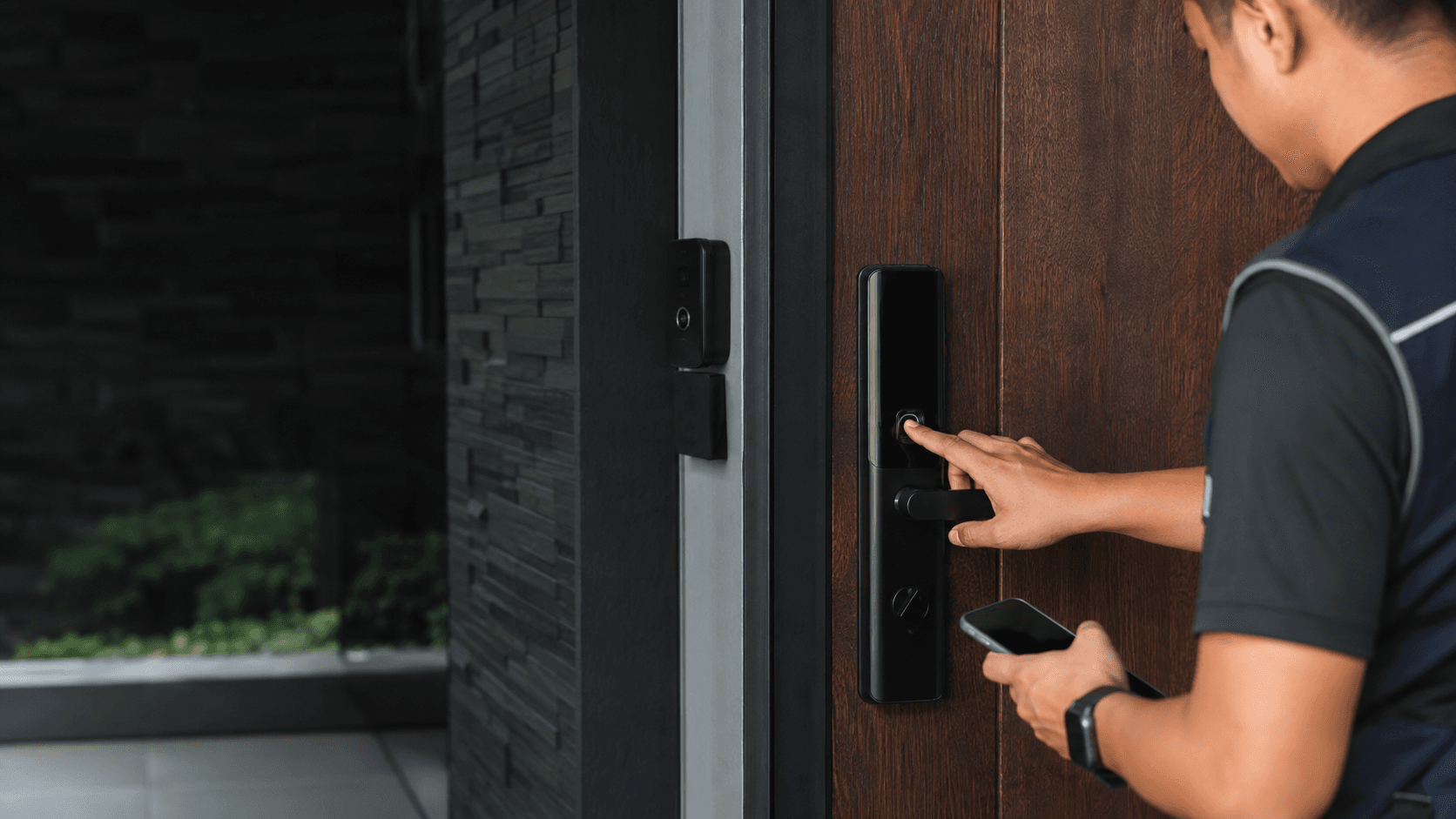
The term covers locks that join an existing wireless network rather than relying only on a local keypad or a separate hub. In Malaysian homes, offices and shoplots, that usually means the lock shares the same internet connection already used for CCTV, alarms and intercoms, so one phone can reach the door from elsewhere.
Eyonic Sdn Bhd plans, supplies and installs security and ELV systems in Sarawak, including CCTV, alarm, autogate, keyphone intercom and smart lock door access. The company's own product review notes that smart locks work best when door condition, user roles and backup method are reviewed before installation.
Wifi Controlled Door Lock. what the term covers in Malaysia
A wifi controlled door lock is a lock whose state can be changed through a network connection, usually from a phone app, a web dashboard or a scheduled rule. The lock still has a physical mechanism, a credential method such as a code or card, and a power source. The network part adds remote control and a record of who entered.
Malaysian buyers meet this category in three common settings. A home wants keyless entry for family members and a way to let a visitor in without handing over a key. A shop or office wants staff to enter with individual credentials and wants the owner to see activity. A mixed site wants the door tied into a wider system alongside cameras and an alarm.
Two practical distinctions matter more than brand names. First, whether the lock connects directly to the network or through a separate bridge or hub. Second, whether the lock is a standalone unit on one door or part of an access-control setup that manages several doors and many users. The first affects how the lock is powered and configured; the second affects cost, cabling and how permissions are administered.
Door condition, user roles and backup entry before installation
Eyonic's smart lock door access review states that smart locks work best when the door condition, user roles and backup method are reviewed before installation. Those three checks decide whether a lock will fit, who can open it, and what happens when the network or power fails.
Door condition covers the physical facts of the opening. A hollow metal door, a solid timber door, a glass door and a fire-rated door each accept different hardware. Frame depth, existing lock cut-outs, door thickness and how the door closes all affect whether a lock can be fitted without structural work. A door that does not close squarely will defeat a motorised lock regardless of how good the electronics are.
User roles decide how access is issued. A household may need a handful of permanent users and a temporary code for a cleaner or a contractor. A business may need staff credentials that can be revoked the day someone leaves, plus a visitor process. The number of users, how often they change, and whether entry needs to be time-limited are the questions that separate a simple lock from a managed system.
Backup entry is the failure plan. If the network drops, if the phone battery dies, or if the lock's own power runs out, the door still has to open for the people who need it. A mechanical key, an external power point, or a second credential path are the usual answers, and the choice should be made before installation rather than after the first lockout.
- Check the door. material, thickness, frame, existing cut-outs and whether it closes squarely.
- Map the users. how many people need access, how often the list changes, and whether any entry must be time-limited.
- Agree the backup method. mechanical key, external power point or a second credential path.
- Decide the scope. one standalone lock on a single door, or an access-control panel managing several doors and many users.
- Confirm the network path. where the lock gets its connection and how that connection is powered.
Wifi Controlled Door Lock compared with a standalone access-control panel
For business use, Eyonic usually checks whether a standalone smart lock or an access-control panel is more appropriate. The two answer different questions, and choosing the wrong one shows up later as either unnecessary cost or a system that cannot cope.
A standalone wifi controlled door lock suits a single door with a modest, fairly stable user list. It is quicker to install, needs less cabling, and can often be managed from the same phone app used for the rest of the site. Its limits appear when the user list grows, when several doors need consistent rules, or when someone needs a report of who entered where and when.
An access-control panel suits multiple doors, larger user lists and sites where permissions must be administered centrally. It costs more and involves more installation work, but it handles the things a single lock cannot: grouped permissions, doors that must open together, and a single place to add or remove a person. The trade-off is complexity, so the panel only pays off when the site genuinely has that many doors or users.
A middle path exists for sites that start small. A single lock can be installed first and the wider system added later, provided the door hardware and cabling are chosen with that growth in mind. Retrofitting a managed system onto doors that were prepared for a standalone lock is the expensive version of the same decision.
What a site survey checks before a lock is confirmed
Eyonic's installation process runs through site survey, system proposal, installation and handover. For door access, the survey is where the door, the users and the backup plan get matched to actual hardware rather than to a catalogue description.
The survey looks at the door and frame in person, because photographs rarely show whether a frame is square or whether an existing cut-out can be reused. It checks where power and network reach the door, since a lock that needs a cable run changes the installation scope. It confirms how the door is used through the day, because a main entrance with constant traffic has different demands from a store room that opens twice a week.
The survey also settles the user and backup questions in concrete terms. Who needs a credential on day one, who administers the list afterwards, and which backup method will be demonstrated at handover. Eyonic's own guidance on camera placement makes the same point in a different context: actual conditions on site should be checked before a position is confirmed, rather than assumed from a specification.
Handover is part of the process, not an afterthought. It is where users are tested, credentials are issued, and the backup method is shown to the people who will need it. A lock that works but whose backup method nobody has practised is a lock that will cause a problem on the first bad day.
Numbers that shape a Wifi Controlled Door Lock decision
Three figures frame the decision before any product is named. The first is the number of doors that need control. One door points toward a standalone lock; several doors on one site point toward an access-control panel, because managing separate locks individually becomes unworkable as the count rises.
The second is the number of users and how often that list changes. A stable list of a few people is comfortable on a standalone lock. A list that changes weekly, or that needs time-limited access for visitors and contractors, is easier to administer centrally.
The third is the number of entry methods the site needs to keep working. A door that must stay usable during a network outage, a power cut or a flat phone battery needs at least one method that does not depend on any of them. Counting those methods honestly at the start prevents the most common complaint about electronic door access.
Budget is a fourth figure, and it is where published evidence is thin. Eyonic publishes package pricing for other systems, including a Hikvision CCTV package, a Hikvision alarm system and an autogate package at RM 1,599 each, but no equivalent published price exists for door lock or access-control installation. Door access pricing depends on the door, the number of doors and the scope, so it is quoted from the survey rather than from a list.
For scale, Eyonic's completed projects give a sense of how site work is budgeted. The Kuching Immigration Office project, which covered arrival flow, staff areas, visitor movement and dependable daily operation, carried an approximate budget of RM 12,000 to RM 28,000. The KTA Sarawak Sdn Bhd office project in Kuching, covering staff movement, visitor handling, tidy cabling and clearer daily site control, carried an approximate budget of RM 8,000 to RM 18,000. Those figures describe wider site work, not a single door lock, and are useful only as an indication of how scope drives cost.
Practical next step with Eyonic
Eyonic Sdn Bhd is a security system supplier in Sarawak that plans, supplies and installs CCTV and ELV systems for homes, offices, shops and industrial sites. Its founder, Eric Yong, has worked in the industry for more than ten years, with experience in technical installation of digital security solutions for commercial businesses in Sarawak.
The useful starting point for a wifi controlled door lock is a description of the site rather than a product choice. Location, property type and the system required are the three things Eyonic asks for first, because they determine whether the answer is a single lock, a managed access-control setup, or a lock installed alongside cameras and an alarm.
Share your location, property type and required system with Eyonic on WhatsApp at +60 11-5111 7959 for the next practical step.