
That package figure is the only approved price point available here, and it is not stated as a four-camera kit. Buyers comparing quotes therefore need to understand what a four-camera set contains, how placement and recording choices change the total, and which parts of a quotation are labour rather than hardware.
4 Cctv Camera Full Set Price: What Matters Before You Choose
A four-camera set is a bundle, not a single product. The camera count is the headline, but the recorder, storage and cabling determine whether the system works as described.
Four cameras cover four fields of view. A recorder accepts the video feeds and writes them to a hard disk. Cabling carries both video and power, or a single network cable where the cameras are IP-based. A power supply feeds the cameras. Remote viewing software or an app connects the recorder to a phone or computer.
Eyonic's CCTV service covers camera placement, recording and remote viewing for homes, offices, shops and industrial sites, alongside NVR setup and site survey work. Those are the functions a four-camera set has to deliver, whatever the box contains.
Two inclusions are commonly assumed and commonly absent. Storage capacity is not fixed by camera count, and installation labour is a separate line from hardware in many quotations. The approved Eyonic package figure does not state whether labour is included, so that question belongs in any comparison.
What a four-camera set does not include by default
Camera count says nothing about resolution, night performance, storage duration or cable length. A four-camera set with 1TB of storage and a four-camera set with 4TB hold the same number of cameras and behave very differently after a week of recording.
Monitoring screens, network switches, conduit and trunking are also frequently excluded. Each of these appears as a separate cost when the site requires it.
Camera types and placement for a four-camera layout
Four cameras is a small enough number that each position has to earn its place. A typical layout covers an entry point, a perimeter or gate, a common interior area and a rear or side approach.
Dome cameras suit indoor ceilings and areas where the camera should be less conspicuous. Bullet cameras suit outdoor walls and longer sightlines. The choice affects both coverage and price, because housing, lens and weather rating differ between the two.
Lighting decides more than camera shape. Eyonic advises checking actual lighting conditions before confirming placement for ColorVu-style cameras, because low-light performance depends on what the site really looks like at night rather than on a specification line.
Placement also has practical limits. A camera aimed at a reflective surface, a bright doorway or a moving tree produces footage that is technically recorded and practically useless. The site survey exists to catch those conditions before drilling begins.
Recording, storage and remote viewing
The recorder is the part of a four-camera set that buyers underestimate. It sets how many cameras can be added later, how long footage is retained and how the system is viewed remotely.
Storage duration depends on camera resolution, frame rate, recording schedule and motion settings. Continuous recording at higher resolution fills a disk far faster than motion-triggered recording at lower resolution. Two sites with identical camera counts can need very different disk sizes.
Remote viewing is a handover item, not a hardware item. It requires the recorder to be reachable over the network and the viewing account to be configured on the devices that will actually use it. Eyonic lists remote viewing and NVR setup as part of its CCTV work, and the approved package includes mobile viewing handover.
Retention is the constraint most often discovered late. If footage has to survive a specific number of days, that requirement should be stated before the storage size is chosen, because it is cheaper to size the disk once than to replace it after handover.
Installation steps from site survey to handover
Eyonic's CCTV installation process runs through four stages. The sequence matters because each stage produces the information the next one depends on.
- Site survey. the property is reviewed for entry points, lighting, cable routes and recorder location.
- System proposal. the camera positions, recorder, storage and viewing setup are set out for the site.
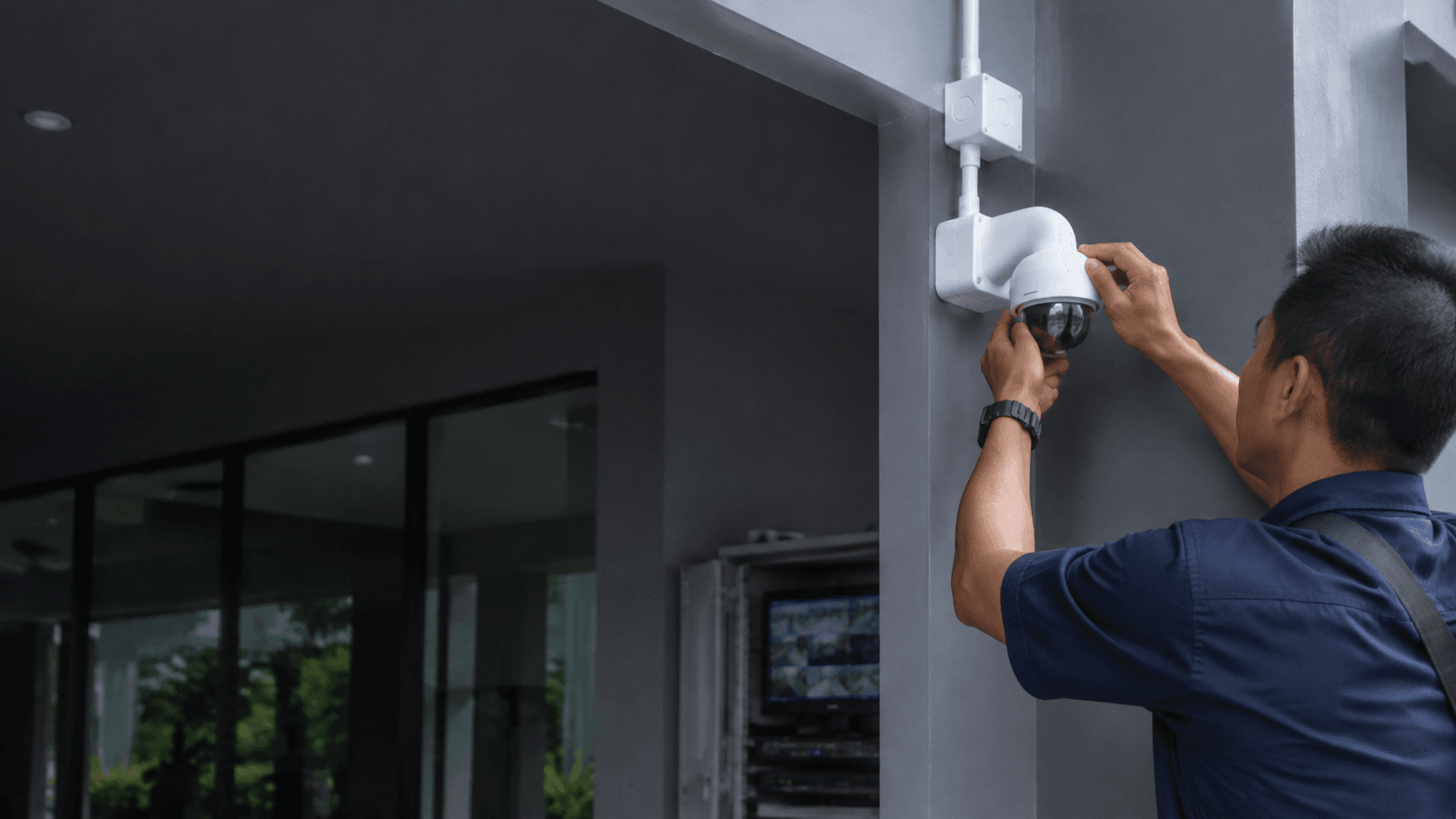
- Installation. cameras, cabling, power and the recorder are installed and configured.
- Handover. recording and mobile viewing are checked with the people who will use the system.
The survey stage is where a four-camera plan is confirmed or revised. A site that appears to need four cameras on a floor plan may need a different split once lighting, cable access and recorder placement are known.
Handover is the stage that decides whether the system is used. A recorder that records correctly but has no working mobile view is a system that gets checked less often, and the approved package treats mobile viewing handover as a deliverable rather than an optional extra.
How a public-sector project shows the same sequence
Eyonic's work for the Kuching Immigration Office focused on arrival flow, staff areas, visitor movement and dependable daily operation. That project carried an approximate budget of RM 12,000 to RM 28,000, which reflects a public office installation rather than a four-camera retail kit.
The distinction matters when reading price figures online. Project budgets for offices and consultancy sites, such as the RM 8,000 to RM 18,000 range recorded for the KTA Sarawak Sdn Bhd office setup in Kuching, cover site-specific scope, cabling and coordination. They are not comparable to a four-camera package price.
What changes the price of a four camera CCTV full set
Price moves with scope, not with the number four. The same four cameras can sit in a straightforward single-storey installation or in a multi-level site with long cable runs and difficult access.
Camera resolution and low-light capability change the hardware cost. Higher-resolution cameras also increase storage demand, so resolution decisions carry a second cost that appears on the recorder side.
Storage size changes the total directly. Cable length and routing change labour. Recorder channel count changes future expandability. Whether the site needs conduit, trunking or additional power points changes both materials and time.
Labour is the variable buyers most often overlook. A quotation that lists cameras and a recorder but no installation scope is not comparable to one that includes survey, installation and handover.
How to read a four camera quotation
Compare quotations on inclusions rather than on the headline figure. The useful questions are which cameras and resolution are specified, what storage size is provided, how long footage is retained, whether cabling and power are included, whether installation labour is included, and whether remote viewing is configured and handed over.
Where a quotation gives a single number with no component detail, the number cannot be compared with a package that lists its inclusions. The approved Eyonic package states camera supply and setup, basic recording configuration and mobile viewing handover at RM 1,599, which gives a buyer a defined scope to measure other quotations against.
For a four-camera set specifically, no approved price band is available here. Buyers in Malaysia should treat any quoted figure as a scope statement first and a price second, and ask for the component list before deciding whether the figure is normal.
what to confirm before committing
The 4 CCTV camera full set price depends on the recorder, storage, cabling and labour attached to those four cameras, so the figure only becomes meaningful once the scope is written down.
Three numbers with units belong in any comparison: the number of cameras, the storage capacity in terabytes, and the retention period in days. A quotation that states all three can be checked against another. A quotation that states only a total cannot.
Eyonic Sdn Bhd plans, supplies and installs CCTV systems in Sarawak, with founder Eric Yong working in the industry for more than ten years on technical installation of digital security solutions for commercial businesses. The company's project record includes the Kuching Immigration Office and the KTA Sarawak Sdn Bhd office setup, both in Kuching.
Share the location, property type and required system with Eyonic on WhatsApp at +60 11-5111 7959 for the next practical step.