
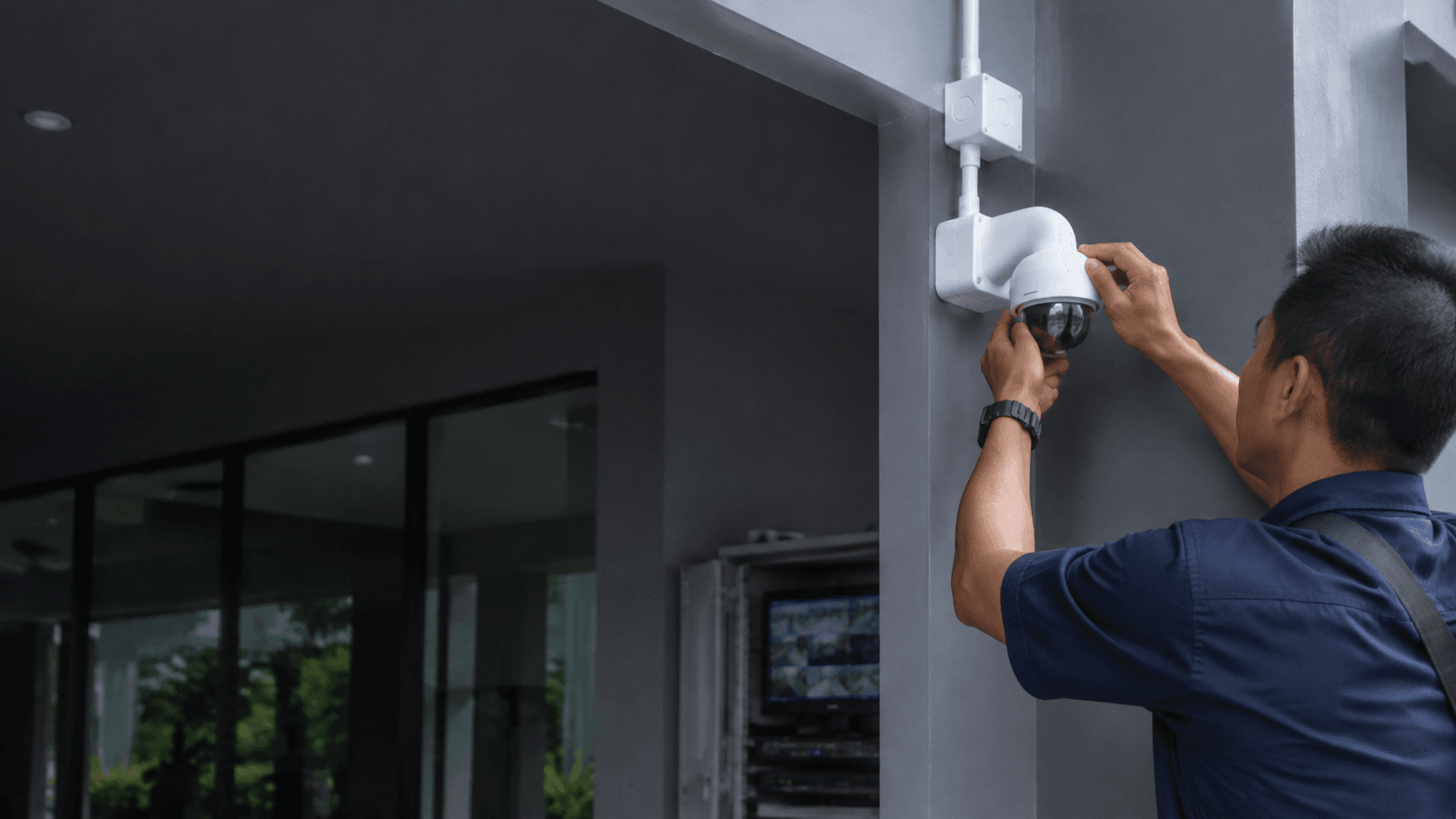
Wireless here rarely means zero cables. Cameras still need power, or a battery, or a solar panel, and the recorder still needs a network connection. What disappears is the long video cable from each camera back to a central box, which is the part that makes renovation, rented premises and heritage buildings expensive to wire.
The trade-off is signal. A wireless camera system for business depends on stable radio links, and thick walls, metal racking, mirrored glass and crowded 2.4 GHz bands all weaken those links. A site survey exists to find that out before cameras are fixed to a wall.
Wireless Camera System For Business: What Matters Before Choosing
Four things decide whether a wireless design suits a site: how each camera gets power, how strong the wireless link is at each position, how much recording storage the site needs, and who reviews footage when something happens.
- Confirm what the site actually needs to see, such as entrances, counters, stock areas or car parks.
- Check power availability and lighting at each proposed camera position.
- Test the wireless link at each position before mounting anything.
- Size the recorder and storage for the number of cameras and the retention period required.
- Agree who receives alerts and who reviews footage.
- Install, configure recording and remote viewing, then hand over with user testing.
Eyonic's own installation process follows site survey, system proposal, installation and handover, so the first three items above happen before any hardware is committed.
What is wireless camera system for business?
It is a surveillance setup where cameras send video over Wi-Fi or another wireless link to a recorder or cloud service instead of through a dedicated video cable. Power delivery, recording location and network reliability remain the deciding factors, not the word wireless.
Choosing the Right Wireless Camera System For Business
Match the system to the building rather than to a specification sheet. A single shop lot with four cameras and one router behaves very differently from a warehouse with racking that blocks line of sight.
Power, signal and storage
Battery and solar cameras avoid electrical work but need sun exposure and periodic battery attention. Mains-powered wireless cameras need a nearby socket but record continuously without battery anxiety. Storage sits either on a local recorder or in a cloud plan, and local recording keeps working when the internet drops.
Lighting and camera choice
Eyonic advises checking actual lighting conditions before confirming placement for ColorVu-style cameras, because low-light performance depends on the real scene rather than the product label. A position that looks bright during a site visit can behave differently at night.
Where wireless fits and where it does not
Wireless suits rented offices, shops, and buildings where chasing cable through finished walls is disruptive. It fits less well where many cameras must record continuously at high resolution, where metal structures block radio, or where a cable route already exists and would be cheaper and more stable.
Practical Considerations for
Budget and disruption usually decide the design more than image quality does. A wireless camera system for business can reduce cabling labour, but it shifts effort into link testing, power provision and network configuration.
| Consideration | Wireless approach | Wired approach |
|---|---|---|
| Cabling work | Minimal video cabling; power still required per camera | Video and power cable run to each camera |
| Signal risk | Depends on walls, metal and Wi-Fi congestion | Not affected by radio interference |
| Best fit | Rented, finished or hard-to-wire premises | New builds, long continuous recording, dense camera counts |
| Maintenance focus | Batteries, link stability, network health | Connectors, cable condition, recorder health |
Eyonic's published package pricing starts at RM 1,599 for a Hikvision CCTV package covering camera supply and setup, basic recording configuration and mobile viewing handover. Alarm and autogate packages are listed at the same RM 1,599 starting point. Larger commercial work sits well above that: the Kuching Immigration Office project carried an approximate budget of RM 12,000 to RM 28,000, and the KTA Sarawak Sdn Bhd office project an approximate RM 8,000 to RM 18,000.
Documented project context
The Kuching Immigration Office project focused on arrival flow, staff areas, visitor movement and dependable daily operation. The KTA Sarawak Sdn Bhd project supported staff movement, visitor handling, tidy cabling and clearer daily site control. Both show the pattern that matters for business sites: coverage follows how people and vehicles actually move, not a fixed camera count.
Questions that come up during planning
Does a wireless system still need a recorder? Usually yes for continuous local recording, though some setups record to cloud or memory card instead. Can cameras run on battery indefinitely? Battery life depends on how often the camera wakes to record and how much sun the panel receives. What happens when the internet fails? Local recording continues; remote viewing does not.
Making an Informed Choice About
The decision usually comes down to three checks: whether power reaches each position, whether the wireless link holds at each position, and whether the recording and retention plan matches how the business actually uses footage.
Eric Yong, founder of Eyonic Security Systems, has worked in the industry for more than ten years, with experience in technical installation of digital security solutions for commercial businesses in Sarawak. That background matters most at the survey stage, where camera placement and lighting are settled.
For sites in Sarawak, share the location, property type and required system with Eyonic on WhatsApp at +60 11-5111 7959 to arrange the next practical step.