
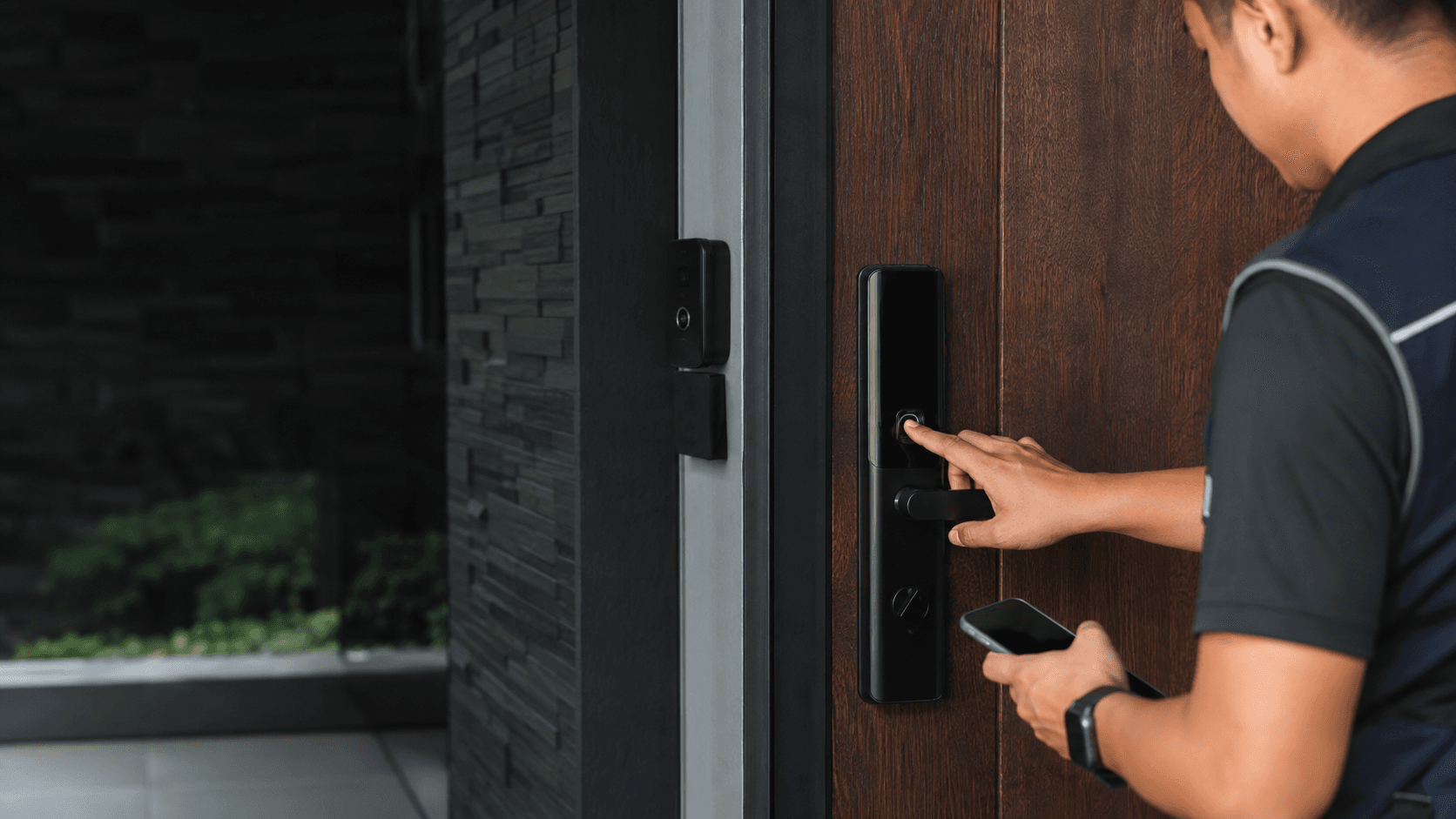
The exact-match query door lock with app describes a lock that can be locked, unlocked or monitored through a smartphone application rather than a key alone. Eyonic Sdn Bhd, a security system supplier in Sarawak, Malaysia, treats smart lock door access as a controlled-convenience product: useful when user permissions and backup entry are planned properly, and risky when they are not.
Door Lock With App. What Matters Before You Choose
Most buying mistakes with app-controlled locks happen before any product is chosen. The lock has to fit the door, the app has to fit the people using it, and the entry method has to survive a flat battery or a dropped phone.
Eyonic's own product review guidance states that smart locks work best when the door condition, user roles and backup method are reviewed before installation. For business use, the same guidance notes that Eyonic usually checks whether a standalone smart lock or an access-control panel is more appropriate. That distinction matters because a single door with a handful of users behaves very differently from a building with staff, visitors and shift changes.
Three practical checks come first:
- Confirm the door itself can carry the lock — thickness, existing deadbolt cutout, frame alignment and whether the door closes cleanly today.
- List every person who needs entry, and decide which of them should hold a permanent credential versus a temporary one.
- Agree on the backup method before installation, so a dead battery or a lost phone does not lock out the property.
These three checks are the same discipline Eyonic applies to its wider security work. The company's CCTV installation process runs through site survey, system proposal, installation and handover, and the same sequence logic applies to door access: understand the site, propose the system, install it, then hand it over with the users trained.
Choosing the Right Door Lock With App
The right choice depends less on brand and more on how the door is used each day. A home entry door, an office staff door and a gated compound entrance each create different requirements for credentials, logging and recovery.
For a home, the priorities are usually convenience and a reliable fallback. For an office, the priorities shift toward who can grant access, who can revoke it, and whether entry events need to be reviewed later. For a site with visitor movement, the priority becomes temporary access that expires without anyone chasing a key.
Eyonic's completed work for the Kuching Immigration Office focused on arrival flow, staff areas, visitor movement and dependable daily operation. That project is a useful illustration of the underlying question: access decisions follow movement patterns, not product features. A door that only staff use needs different treatment from a door that visitors pass through.
Similarly, Eyonic's work for KTA Sarawak Sdn Bhd supported staff movement, visitor handling, tidy cabling and clearer daily site control in a Kuching office. Both projects point to the same conclusion — the access method should match the traffic, and the installation should leave the site tidier and easier to manage than before.
What is door lock with app?
A door lock with app is a locking device that communicates with a phone application, allowing entry to be granted, scheduled or reviewed digitally. The lock itself is still a physical mechanism; the app is the control layer that replaces or supplements a key.
That control layer is what separates an app lock from a purely mechanical lock. It allows credentials to be issued and withdrawn without cutting new keys, and it allows entry activity to be recorded rather than guessed at. The trade-off is dependency. the lock now relies on power, connectivity or a local credential store, which is why backup entry is a design decision rather than an afterthought.
Smart Lock App To Control Your Home From Your Phone | Schlage Home App
Schlage publishes a free Schlage Home app for Apple iOS and Android that lets users control and monitor a Schlage smart lock from a smartphone. That is one concrete example of the category: the lock hardware and the phone application are sold as a matched pair, and the app is the interface for daily use.
The pattern generalises across the market. Competitor coverage of smart door lock apps lists products such as ButterflyMX, RemoteLock, Nuki, August Home, Schlage Home, Yale Access and TTLock, and the recurring themes are remote locking and unlocking, access codes, entry notifications and integration with wider smart home platforms. App store listings for locks such as Nuki describe turning a smartphone into a key, with features including key sharing, activity logs, auto unlock and auto lock.
Two constraints appear repeatedly in that coverage and are worth stating plainly. First, not every lock suits every door — retrofit models exist precisely because full deadbolt replacement is not always possible. Second, platform compatibility varies, so a lock that integrates cleanly with one ecosystem may need extra hardware or a different app to work with another.
For a Sarawak property, the practical question is often simpler than the feature list: whether the door, the network and the people using it can support app-based entry reliably every day. Where they can, an app lock removes a set of everyday frictions. Where they cannot, a keypad or a standalone access-control panel may serve the same door better.
Practical Considerations for Door Lock With App
Several constraints decide whether an app lock works well in practice, and most of them are visible before purchase.
Power and connectivity. App locks depend on batteries and, for remote control, on a network connection. A lock that only works over the internet is vulnerable to an outage; a lock that stores credentials locally keeps working when the network does not. The backup method should be decided at the same time as the lock.
Door condition. Eyonic's review guidance places door condition first for a reason. A door that does not close cleanly, a frame that has shifted, or a cutout that does not match the new lock will undermine even a well-chosen product. This is checked before installation, not after.
User roles. The number of people needing entry, and how often that list changes, determines whether a standalone lock is sufficient or whether an access-control panel is the better fit. A small household and a staffed office with rotating visitors sit at opposite ends of that scale.
Installation quality. Cabling, mounting and handover affect how the system behaves months later. Eyonic's project work in Kuching included tidy cabling as an explicit outcome, and the same standard applies to door access hardware.
Budget framing. Eyonic publishes package pricing for related security work: a Hikvision CCTV package at RM 1,599, a Hikvision alarm system at RM 1,599, and an autogate package at RM 1,599. Larger project work sits in a different range — the Kuching Immigration Office project carried an approximate budget of RM 12,000 to RM 28,000, and the KTA Sarawak Sdn Bhd project an approximate budget of RM 8,000 to RM 18,000. Door access is usually scoped as part of a wider security plan rather than priced in isolation.
Making an Informed Choice About Door Lock With App
The decision comes down to fit rather than features. An app lock suits a property where the door is sound, the users are known, and a backup entry method is acceptable. It suits less well where the door needs repair first, where users change constantly without any management process, or where a single point of failure is unacceptable.
For business premises, the honest answer is sometimes that a standalone smart lock is not the right tool. Eyonic's guidance notes that for business use the company usually checks whether a standalone smart lock or an access-control panel is more appropriate — a check that prevents an under-specified lock being installed on a door that needed a managed system.
Eric Yong, founder of Eyonic Security Systems, has worked in the industry for more than ten years and is experienced in technical installation of digital security solutions for commercial businesses in Sarawak. That installation background is relevant because door access problems are usually installation problems: alignment, power, network and handover.
Where a property needs more than one layer of security, door access is typically planned alongside cameras, alarms and intercoms rather than purchased alone. Eyonic supplies and installs CCTV, alarm systems, autogate systems, keyphone intercoms and Starlink internet across Sarawak, which means access decisions can be made with the rest of the site in view.
Share your location, property type and required system with Eyonic on WhatsApp at +60 11-5111 7959 for the next practical step.