
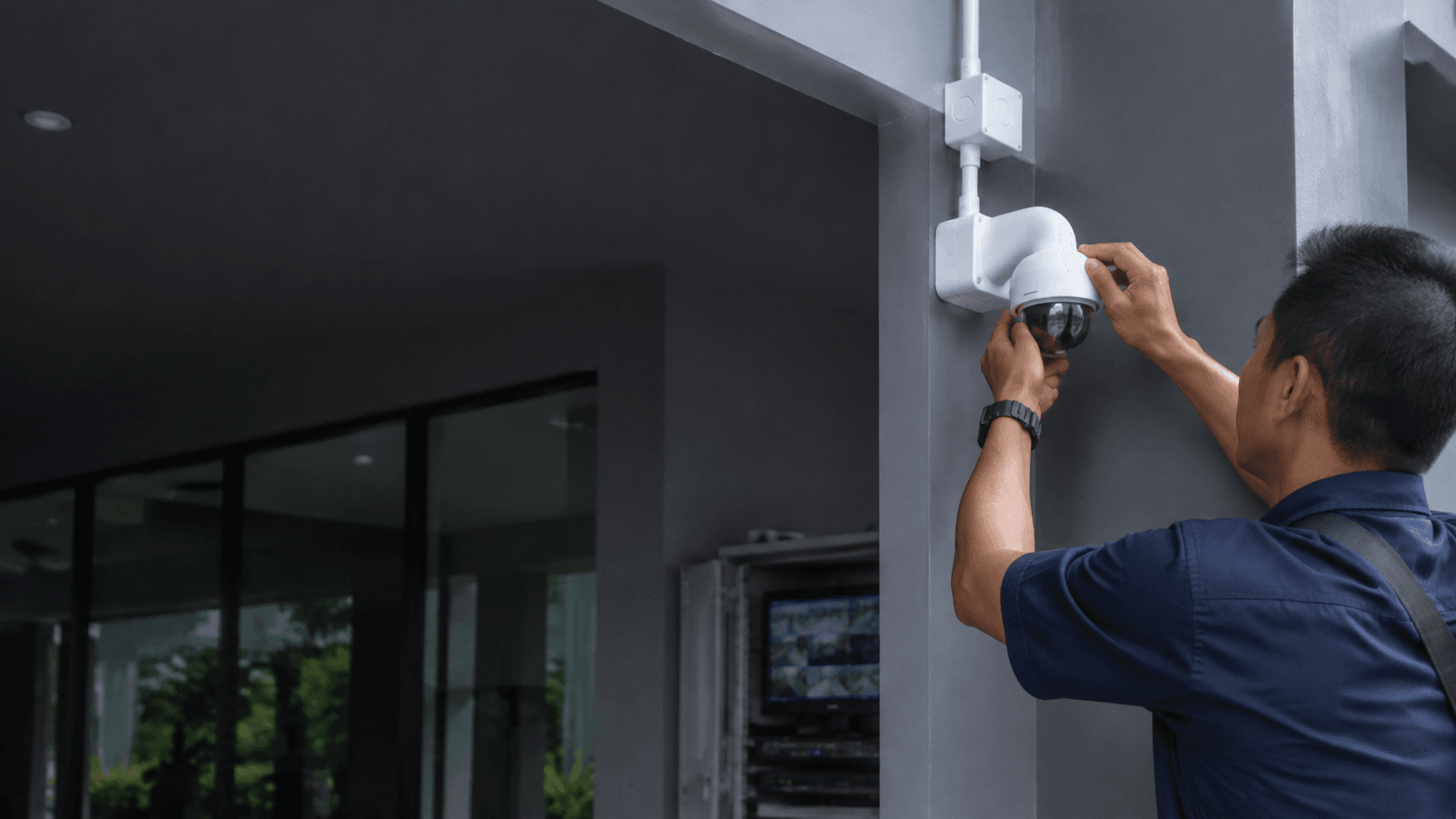
The exact-match query home security systems with cameras and monitoring describes a package rather than a single product. In Sarawak, Eyonic Sdn Bhd handles that package end to end: a site survey, a written system proposal, installation, and a handover session where the household learns to use what was fitted. The sections below set out what the arrangement contains, how positions are confirmed, what the published package prices cover, and which details are worth settling before installation day.
Home Security Systems With Cameras And Monitoring: What Matters Before You Choose
A working setup has four parts that must fit together: cameras, a recorder, a viewing method, and a power and cabling route. Eyonic's published service description names camera placement, recording and remote viewing as the core of the work, with NVR setup as the recording layer.
Cameras capture the scene. The recorder stores the footage locally so it survives a lost internet connection. Remote viewing lets the household check the property from a phone. Cabling and power decide whether all of that runs reliably or drops out.
Two limits are worth stating plainly. Eyonic's published material for this page does not include monitoring subscription terms, contract lengths or monthly fees, so any recurring arrangement has to be confirmed directly rather than assumed. The same applies to camera resolution, storage duration and channel count, which are not published here.
Cameras, Recorder And Viewing
Hikvision is the camera brand Eyonic supplies and installs. The Hikvision CCTV Package at RM 1,599 covers camera supply and setup, basic recording configuration, and mobile viewing handover. That is the entry arrangement for a home that needs coverage of the main entry points rather than a full perimeter build.
ColorVu-style cameras are designed to hold colour in low light, which changes where they are worth placing. Eyonic's own review guidance is to check the actual lighting conditions on site before confirming positions, because a camera chosen for a dark driveway performs differently on a street-lit porch.
How Eyonic Plans A Camera And Monitoring Installation
The sequence is fixed and published. It runs from the first visit through to the handover, and each stage produces something the household can review before the next one starts.
- Site survey — the property is walked to record entry points, existing cabling, power availability and lighting at each candidate position.
- System proposal — the surveyed findings are turned into a written scope covering camera positions, recorder location and viewing method.
- Installation — cameras, recorder and cabling are fitted to the agreed positions and the recording configuration is set up.
- Handover — the household is shown how to view footage remotely and how the recording setup behaves day to day.
The survey is the stage that decides cost and coverage. A home with an existing cable route and a spare power point near the recorder is a shorter job than one needing new runs through finished walls. Because the proposal is written after the survey, the scope reflects the actual property rather than a standard template.
Eyonic's project record shows the same approach applied at larger scale. The Kuching Immigration Office project focused on arrival flow, staff areas, visitor movement and dependable daily operation — the same questions of where people move and which views matter, answered on a public building rather than a house.
Camera Placement And Lighting Checks Before Confirming Positions
Placement is confirmed on site, not from a floor plan. The useful checks are about what each camera will actually see at the times that matter.
Entry points come first. the main door, any side gate, and the route a vehicle takes onto the property. A camera aimed at a door records faces; a camera aimed down a driveway records vehicles. Trying to cover both from one position usually produces a view that identifies neither clearly.
Lighting decides the camera type. A position that is dark for most of the night needs a camera built for low light, while a position under a porch lamp may not. Eyonic's guidance on ColorVu-style cameras is to verify the real lighting conditions at each position before confirming placement, since the same model can be the right choice in one spot and the wrong one a few metres away.
Practical constraints also shape the plan. Cabling has to reach the recorder, power has to reach the camera, and the recorder itself needs a position that is secure, ventilated and out of casual reach. Where those conditions cannot be met at a preferred camera position, the position changes rather than the requirement being ignored.
Package Pricing And Project Budget Ranges
Eyonic publishes three packages at RM 1,599 each, and they cover different jobs rather than different tiers of the same job.
The Hikvision CCTV Package at RM 1,599 covers camera supply and setup, basic recording configuration, and mobile viewing handover. The Hikvision Alarm System at RM 1,599 covers a control panel and sensors, siren and zone setup, and user testing and handover. The Autogate Package at RM 1,599 covers motor recommendation, remote-control setup, and safety testing and handover.
For a home that needs cameras and monitoring together, the CCTV package is the relevant starting point. The alarm and autogate packages address different risks and are separate purchases.
Larger or more complex work sits well above the package level. Eyonic's published project budgets give a sense of the range: the KTA Sarawak Sdn Bhd office project in Kuching carried an approximate budget of RM 8,000 to RM 18,000, and the Kuching Immigration Office project carried an approximate budget of RM 12,000 to RM 28,000. Both were commercial sites with wider coverage and tidier cabling requirements than a typical house, so they indicate the upper end rather than a home figure.
What the RM 1,599 package does not state is the number of cameras, the recorder capacity, or the storage duration. Those depend on the property and are settled at the proposal stage.
Questions To Settle Before Installation Day
Most installation-day problems trace back to a detail that was never confirmed. Settling these beforehand keeps the visit to a single pass.
Confirm the camera count and positions in writing, with the lighting check already done at each one. Confirm where the recorder will sit and that it has power and ventilation. Confirm how remote viewing will work on the household's phones, and whether the internet connection at the property supports it. Confirm who supplies any additional cabling or mounting hardware if the survey found a gap.
Confirm what happens after handover as well. Eyonic's published material for this page does not include warranty terms, after-sales response times or service-level commitments, so those need to be agreed directly rather than assumed from the package price.
One further point is worth raising early: whether the household wants recording only, or an arrangement that includes monitoring beyond on-site storage. The two are different scopes, and the second depends on terms that are not published here.
Eyonic Sdn Bhd is a security system supplier based in Sarawak, Malaysia, working across homes, offices, shops and industrial sites. The founder, Eric Yong, has more than ten years in the industry and works on technical installation of digital security solutions for commercial businesses in Sarawak.
For a home in Malaysia weighing up home security systems with cameras and monitoring, the practical next step is to share the location, property type and required system with Eyonic on WhatsApp at +60 11-5111 7959, so the survey and proposal can be scoped against the actual property.