
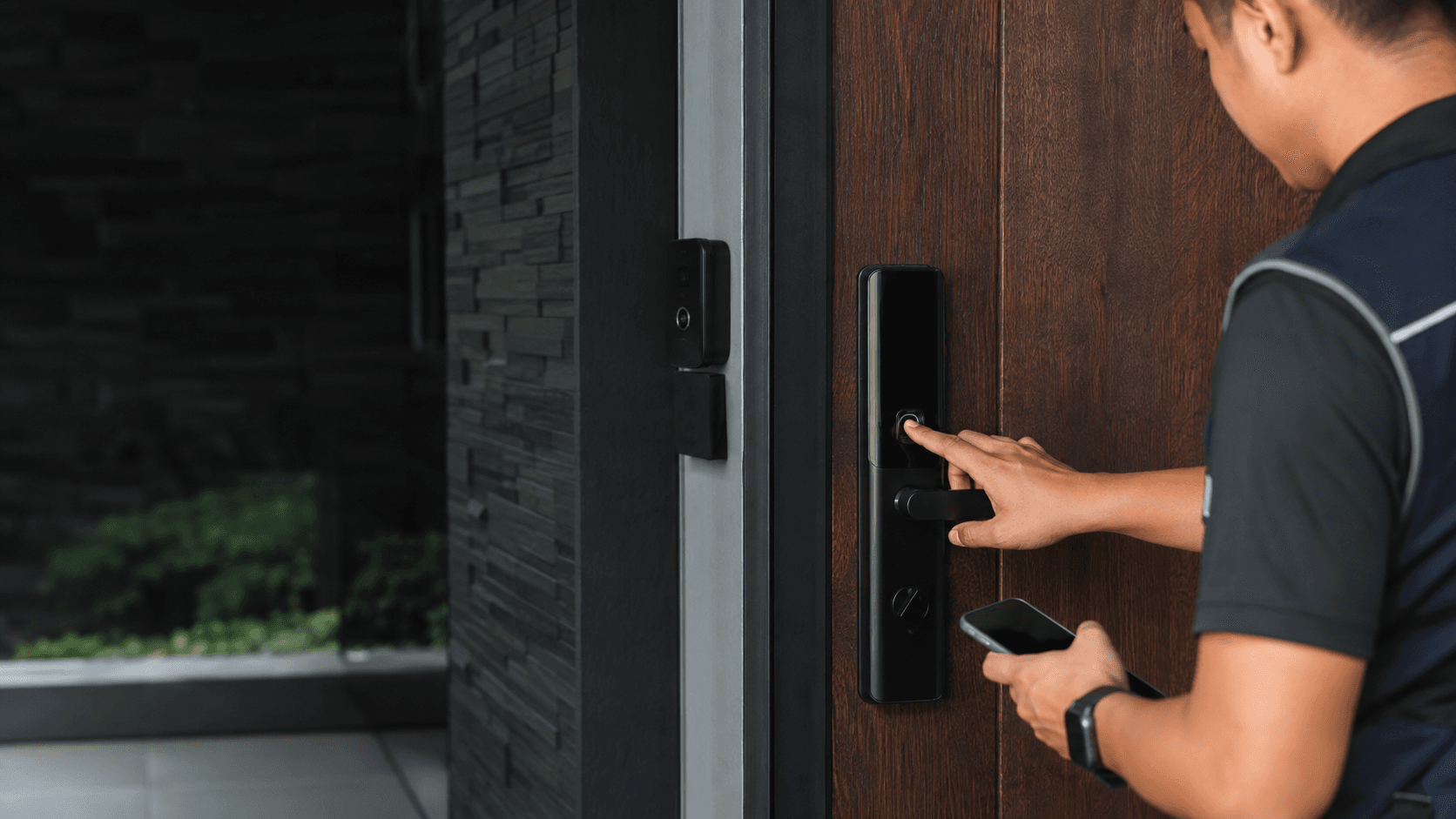
Eyonic Sdn Bhd, a security system supplier in Sarawak, Malaysia, treats smart lock door access as suitable for controlled convenience when user permissions and backup entry are planned properly. That framing matters because a residential lock decision is rarely about the lock alone. It is about the door it sits in, the people who need to pass through it, and what happens when power, network or credentials fail.
Most published material on this topic is written for a global audience and concentrates on product roundups. This article takes a different route: what a door lock system for home actually covers in a Malaysian residential setting, what to compare before committing, and how installation is sequenced from first survey to handover.
What a door lock system for home covers
The phrase covers more than a single lock body. A residential door lock system normally combines the locking hardware itself, the method used to present a credential, the way that credential is managed, and the fallback that keeps the door usable when the primary method is unavailable.
Eyonic's own product review notes describe smart lock door access as multi-brand and suited to controlled convenience when user permissions and backup entry are planned properly. That description points to the two halves of the decision. The first half is physical. what the door can accept. The second half is operational. who is allowed through, when, and how that permission is changed or withdrawn.
Two broad approaches appear in residential work. A standalone smart lock handles a single door and manages its own users. An access-control arrangement coordinates multiple doors or multiple user groups under one management layer. Eyonic's review of smart lock door access states that for business use the company usually checks whether a standalone smart lock or an access-control panel is more appropriate. The same question applies to a home with more than one controlled entry, such as a main door plus a side gate or a rented room.
What the system does not do is compensate for a door that cannot hold it. Hardware selection follows the door, not the other way around.
Door condition and user roles decide the fit
Eyonic's smart lock review puts door condition first among the things to review before installation, alongside user roles and the backup method. Those three checks are worth taking in order.
Door condition
A residential door has to be assessed for what it is made of, how it closes, and whether the existing locking point can be adapted or must be replaced. A door that does not sit squarely in its frame will keep causing problems after any lock is fitted, because the lock depends on alignment to latch reliably. This is a physical inspection, not a specification comparison, and it is the reason a survey comes before a proposal.
User roles
User roles determine how much management the system needs. A single household with a fixed set of residents needs less than a home with regular domestic help, short-stay guests, or a family member who needs access without carrying a key. Each additional category of user adds a requirement: how that person is enrolled, how their access is removed, and whether their entry is recorded.
Where roles are simple, a standalone smart lock can be enough. Where roles change often or overlap with other controlled doors, the management layer becomes the deciding factor rather than the lock body.
Backup entry
Backup entry is the check most often skipped. Every electronic access method has conditions under which it will not work, and the household needs a defined answer for those conditions before installation rather than after. The backup method is part of the system design, not an afterthought, which is why Eyonic's review lists it alongside door condition and user roles.
Planning permissions and backup entry
Residential door hardware can sit inside rules that the household does not control. A rented property, a stratified building, or a door that forms part of a shared escape route may all carry conditions on what can be changed and by whom.
No supplied evidence in this brief establishes Malaysian residential lock standards, fire-door requirements, or strata and landlord approval rules, so those points cannot be stated as fact here. What can be said is that the question belongs in the survey stage. If a door is a shared escape route or the property is not owned by the occupant, the approval position should be settled before hardware is ordered, because a lock that has to be removed after fitting is a wasted installation.
Backup entry planning runs alongside this. The practical points to settle are who holds the fallback credential, where it is kept, and how it is used if the primary method fails while nobody with management access is present. For a household with domestic help or short-stay guests, the fallback should not be the same credential handed to every user, because that removes the ability to withdraw access from one person without affecting the others.
These are design decisions, and they are cheaper to make on paper than on a fitted door.
Installation steps from survey to handover
Eyonic's installation process for its security work follows a four-stage sequence: site survey, system proposal, installation, and handover. The same sequence applies to a residential door lock project, and the order is not interchangeable.
- Site survey. The door, frame, existing locking point and surrounding conditions are inspected on site. This is where door condition is confirmed and where any approval question about the property is raised.
- System proposal. The survey findings are turned into a recommendation covering the locking approach, how users will be managed, and the backup entry method. This is the stage where a standalone smart lock and an access-control arrangement are compared against the actual door and the actual user roles.
- Installation. The agreed hardware is fitted and configured, including user enrolment and the backup method.
- Handover. The household is shown how the system works, how users are added or removed, and what to do when the primary access method is unavailable.
The survey stage carries the most weight. A proposal built without seeing the door is a guess, and the two most common causes of a poor outcome — a door that cannot hold the hardware cleanly and a user-role requirement that was never stated — are both identified at survey rather than at installation.
Handover is not a formality either. A system whose user management is not understood by the household tends to accumulate stale credentials, which quietly undoes the access control the system was installed to provide.
Where a fits alongside CCTV and alarms
A door lock system for home controls who passes through a door. It does not record what happens elsewhere on the property, and it does not raise an alert when an intrusion occurs through a different route.
Eyonic supplies and installs CCTV security systems, alarm systems, autogate systems and keyphone intercom systems alongside door access work, with documented packages for the Hikvision CCTV package, the Hikvision alarm system and the autogate package each listed at RM 1,599. Those figures cover the documented packages only; no pricing for a residential door lock system is established in the available evidence, so no figure is quoted here.
The practical relationship between the systems is coverage. A lock secures a controlled entry point. Cameras cover the areas a lock cannot, and Eyonic's own guidance on camera placement notes that actual lighting conditions should be checked before confirming placement rather than assumed from a specification. An alarm covers the interior zones that neither a lock nor an external camera addresses. An autogate covers vehicle entry, which is a separate access decision from the pedestrian door.
For a household planning more than one of these, the sensible order is to settle the door access question first, because it determines how the main entry is used daily, and then place cameras and alarms around the routes that remain uncontrolled. Eyonic's completed work for the Kuching Immigration Office focused on arrival flow, staff areas, visitor movement and dependable daily operation — the same logic of mapping movement first and placing equipment second applies at a smaller scale in a home.
Where a household is unsure whether a standalone smart lock or a wider arrangement is the better fit, the deciding factors are the number of controlled doors, how often the user list changes, and whether entry needs to be recorded. A single door with a stable household points one way; multiple doors with changing users points the other.
Eyonic is based in Sarawak and works across residential, office, shop and industrial sites. Households in Malaysia planning a door lock system for home can share the location, property type and required system with Eyonic on WhatsApp at +60 11-5111 7959 to arrange the next practical step.