
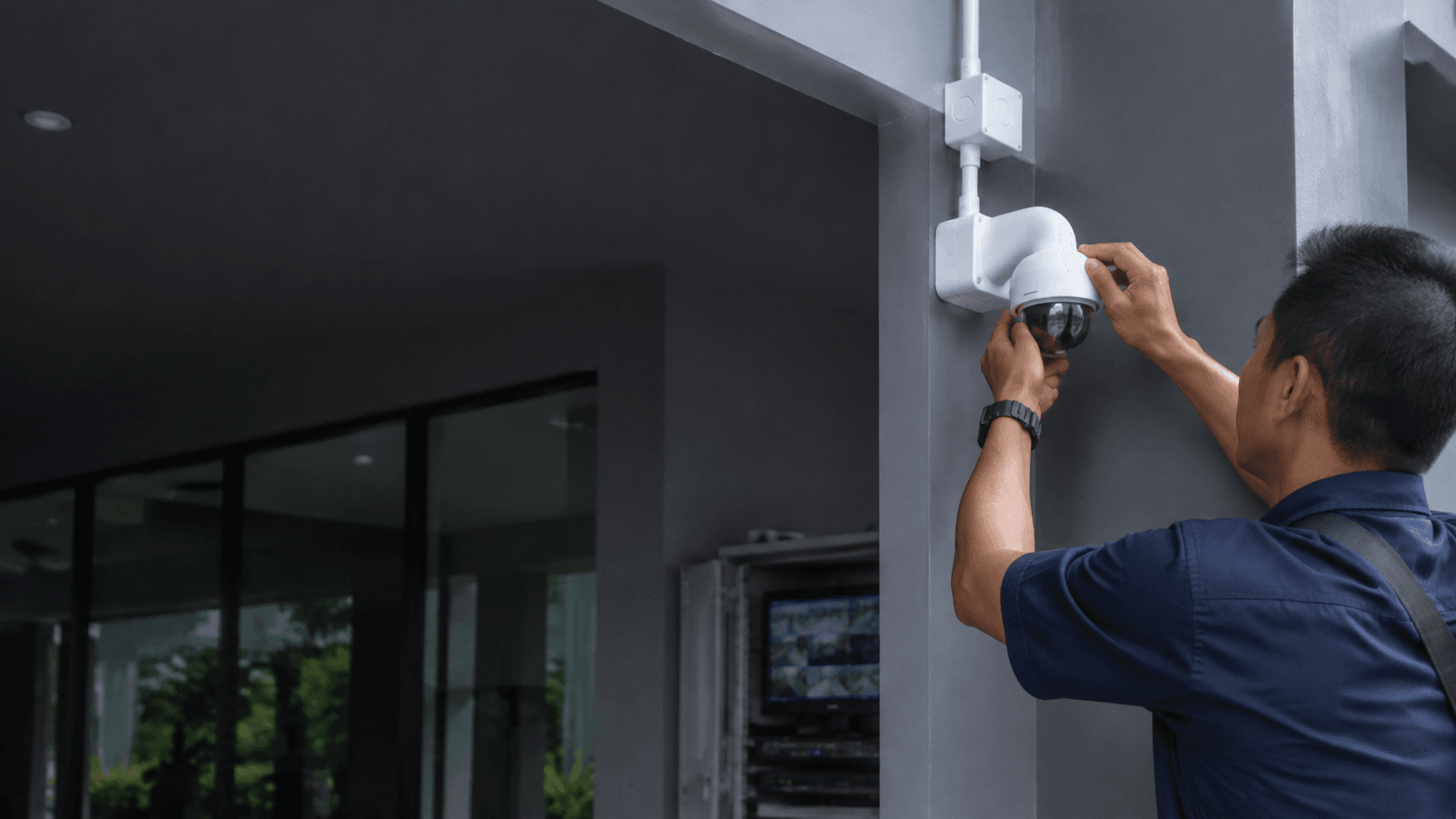
Search results for this product mix official-looking storefronts, review posts and affiliate pages. None of the nine pages analysed for this topic used the exact phrase in a heading, and several carried discount language and unverified performance claims. That makes the practical question less about the product name and more about what a light-socket camera can actually do on a real wall, and who checks the wiring, the angle and the recording before money changes hands.
What a light-socket 360 camera changes about placement
A light-socket camera takes its power from an existing bulb fitting. That single design choice reshapes the whole installation, because the camera can only go where a socket already exists.
Ceiling sockets usually sit near the centre of a room or under a porch soffit. That position gives a wide downward view, which suits open areas such as a car porch, a shop floor or a small office lobby. The trade-off is that the socket height and the socket position were chosen for lighting, not for surveillance. A bulb fitting placed to light a walkway may leave a gate, a side lane or a rear door outside the useful frame.
Wall-mounted sockets behave differently again. A socket on a side wall pushes the view along the wall rather than across the yard, which can leave the approach path partly hidden. Moving the camera is not a matter of drilling a new bracket; it means the socket itself has to move, and that is electrical work rather than camera work.
Indoor and outdoor sockets also differ in exposure. A porch soffit socket sits under cover. A socket on an open wall faces rain, sun and dust directly. The supplied evidence does not confirm the weatherproofing rating of the Safe Cam 360 Security Camera, so outdoor mounting on an exposed wall remains an open question that a site visit should settle rather than an assumption made from a product page.
Lighting conditions decide whether the picture holds up
Eyonic's own guidance on ColorVu-style cameras is to check actual lighting conditions before confirming placement. The same discipline applies to any camera being considered for a specific spot.
Lighting matters because a camera's low-light behaviour depends on what light is already there. A porch with a warm bulb burning through the night gives the sensor something to work with. A back lane with no light at all is a different problem, and it is the one most often discovered after installation rather than before.
Three conditions are worth checking on site:
- Whether the socket's own light stays on at night, and whether the camera replaces that bulb or shares the circuit.
- Whether street lighting, neighbouring lights or security floodlights reach the target area after dark.
- Whether the area is lit evenly or has a bright patch next to deep shadow, which affects how much detail survives in the recording.
Removing a bulb to fit a camera also removes the light that bulb provided. On a porch or a stairwell, that changes how the space feels at night and may need a separate light fitting to compensate. This is a planning point, not a technical fault, and it is easier to resolve before the camera goes up.
How a Safe Cam 360 Security Camera fits a recording and remote-viewing setup
A camera on its own records nothing useful unless something stores the footage and something lets a person watch it. Eyonic's CCTV service covers camera placement, recording and remote viewing for homes, offices, shops and industrial sites, so the camera is treated as one part of a system rather than a standalone purchase.
Recording usually means a recorder on site, such as an NVR, with storage sized to the number of cameras and the number of days of footage required. Remote viewing means the recorder or camera is reachable over the internet so footage can be checked from a phone. Both depend on the camera being compatible with the recorder and the app in use.
The supplied evidence does not confirm whether a light-socket 360 camera works with Eyonic's recording, NVR or remote-viewing setup. That compatibility question is the single most important thing to resolve before buying, because a camera that cannot feed the recorder becomes a separate app on a separate phone rather than part of one system.
Where a light-socket camera does fit is in a small setup with one or two viewpoints and a simple recording requirement. Where it fits less well is a site that needs several cameras on one timeline, consistent retention, or footage that has to be handed to a third party. In those cases a wired camera on a recorder is the more predictable route, and the light-socket format becomes an addition rather than the foundation.
Site survey, proposal, installation and handover in sequence
Eyonic's CCTV installation process runs through four stages. The order matters because each stage removes a decision that would otherwise be guessed at later.
- Site survey. The property is visited to check socket positions, lighting after dark, cable routes, recorder location and the areas that actually need coverage.
- System proposal. The survey findings are turned into a proposed setup covering camera positions, recording and remote viewing, so the scope is agreed before any work starts.
- Installation. Cameras, recorder and connections are fitted and configured according to the agreed proposal.
- Handover. The system is tested and the user is shown how to view footage and check the recording, so the setup is usable from day one.
The survey stage is where a light-socket plan is either confirmed or changed. A socket that looked suitable on a floor plan may turn out to face a blank wall, sit too low, or lose its only light source when the bulb comes out. Finding that during a survey costs a conversation. Finding it after purchase costs a return, a re-drill or a second camera.
Handover is the stage most often skipped in do-it-yourself setups. A camera that streams to a phone is not the same as a system with confirmed recording, confirmed retention and a confirmed way to find a specific clip later. Testing that at handover is what turns a camera into evidence.
What a completed project looks like in practice
Eyonic's work for the Kuching Immigration Office covered arrival flow, staff areas, visitor movement and dependable daily operation. That project is a useful reference point because it shows the kind of question a survey answers: which movement matters, which areas need continuous coverage, and what has to keep working every day without intervention.
Eyonic's work for KTA Sarawak Sdn Bhd covered staff movement, visitor handling, tidy cabling and clearer daily site control. Cabling tidiness and daily usability are not decorative concerns. They decide whether a system is still trusted a year after installation.
Approximate budgets for that class of work sit in the RM 12,000 to RM 28,000 range for the Kuching Immigration Office project and RM 8,000 to RM 18,000 for the KTA Sarawak project. Those figures describe office-scale installations, not a single light-socket camera, and they are useful mainly as a sense of scale for what a surveyed, recorded, multi-camera system involves.
For smaller jobs, Eyonic's published packages are priced at RM 1,599 for a Hikvision CCTV package covering camera supply and setup, basic recording configuration and mobile viewing handover, RM 1,599 for a Hikvision alarm system, and RM 1,599 for an autogate package. Those packages describe Eyonic's own scope and pricing, not the price of the Safe Cam 360 Security Camera, which the supplied evidence does not confirm for Malaysia.
Where the evidence stops and what still needs checking
Most of what appears online about this product cannot be verified from the material available here. The gaps are specific and worth naming, because each one changes what a buyer should ask before paying.
Technical specification is unconfirmed. Resolution, field of view, night vision range, audio, storage and power rating are not established by the supplied evidence. A product page that lists these figures is making a claim that should be checked against manufacturer or distributor documentation rather than accepted from a review post.
Price, warranty, subscription and availability in Malaysia are unconfirmed. Several competitor pages lead with discount percentages and money-back guarantees, but those are marketing statements on affiliate-style pages, not verified commercial terms. Whether the product is sold through an authorised channel in Malaysia is also unconfirmed.
Manufacturer identity and authorised sellers are unconfirmed. That matters for warranty claims and for firmware or app support later. A camera bought through an unofficial channel can be difficult to service even when the hardware itself works.
Review data and performance measurements are unconfirmed. Testimonial blocks and user counts on promotional pages are not independent evidence, and none of the analysed pages provided verifiable measurement of how the camera performs in low light or over time.
Compatibility with an existing recorder or remote-viewing setup is unconfirmed. This is the gap most likely to affect a real installation, and it is the one a site survey can close quickly by checking what the recorder supports.
Malaysian electrical, socket and weatherproofing requirements for light-socket camera installation are unconfirmed. Socket condition, circuit loading and outdoor exposure are all site-specific, and none of them can be settled from a product listing.
What can be settled is the local sequence. A survey establishes whether a socket position gives usable coverage, whether lighting after dark supports the picture, and whether the camera can join a recording and remote-viewing setup. Eric Yong, founder of Eyonic Security Systems, has worked in technical installation of digital security solutions for commercial businesses in Sarawak for more than ten years, and that experience is applied at the survey stage rather than after the hardware arrives.
For a property in Sarawak, the practical next step is to share the location, property type and required system with Eyonic on WhatsApp at +60 11-5111 7959, so the socket positions and lighting can be assessed against the coverage that is actually needed.