
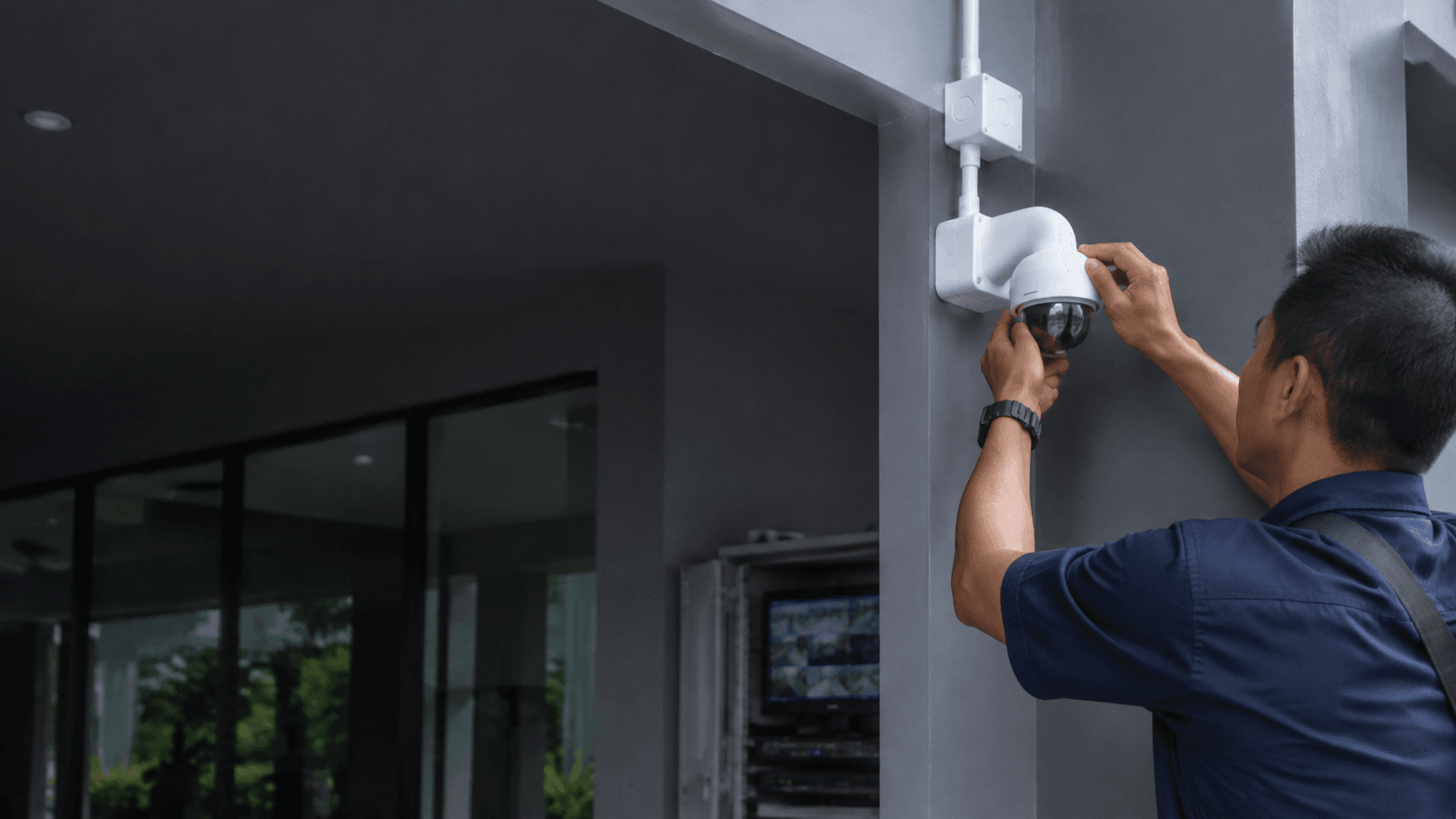
The eufy spotlight camera sits in a category that Malaysian buyers often meet for the first time while comparing outdoor options. The appeal is straightforward. one unit watches an area and throws light on it when something moves. The practical questions are less about the product name and more about whether the property's power, mounting points, and lighting conditions suit this type of device at all.
Eyonic Sdn Bhd plans, supplies, and installs monitoring systems with camera placement, recording, and remote viewing for homes, offices, shops, and industrial sites. That work starts with a site survey rather than a product decision, because placement and lighting conditions shape what any outdoor camera can realistically deliver.
What a eufy spotlight camera does
A spotlight camera combines two functions in one housing: video capture and a directed light that activates on motion. The camera records the scene; the spotlight adds illumination at the moment something enters the detection area. Both functions share the same field of view, so the light lands roughly where the camera looks.
That shared aim is the main difference from a separate camera and lamp. A standalone floodlight can be pointed independently of the lens. A spotlight camera cannot, which makes its mounting angle a decision that affects both the recorded image and the lit area.
Motion detection drives the light, so detection behaviour matters as much as brightness. Zones, sensitivity, and scheduling determine when the light fires and when it stays dark. Buyers who want the light off during certain hours, or who live near a busy road, need to confirm that the app supports the control they expect before committing.
Night vision is the second half of the low-light story. A spotlight helps at the moment of an event, but the camera still needs to render usable footage when the light is off. How well that works depends on the specific model and the ambient light at the site, which is why a survey matters more than a specification sheet.
Spotlight and floodlight coverage compared
The comparison that matters is coverage shape, not brand. A spotlight camera typically concentrates light in a narrower beam aimed along the lens axis. A floodlight camera spreads a wider wash over a larger area. Neither is universally better; they solve different problems.
A narrow, aimed beam suits a defined approach: a gate, a side path, a single doorway, a parking bay. The light lands on the person or vehicle entering that specific line. A wide wash suits open ground where the point is to illuminate a broad zone and deter movement across it.
Field of view interacts with this. A wide lens sees more but spreads the light thinner across the frame. A narrower lens concentrates both the image and the illumination. For a Malaysian terrace house with a narrow side lane, the concentrated option often fits the geometry better than a wide flood pattern that spills onto a neighbour's wall.
Power source is the other axis. Wired units draw continuous power and can hold a light on for longer. Battery and solar units trade that endurance for easier placement where no circuit exists. The trade-off is real. a battery spotlight camera that fires often will need more charging attention than one that fires rarely.
Placement checks before a eufy spotlight camera is mounted
Placement decides most of the outcome. Eyonic recommends checking actual lighting conditions before confirming placement for ColorVu-style cameras, and the same discipline applies to any light-bearing camera. The checks below are the ones that change a mounting decision.
- Confirm the target area. identify exactly what the camera must cover, such as a gate, a driveway, or a back door, rather than "the whole compound".
- Check existing light at night. observe the area after dark to see whether street lighting, porch lights, or neighbouring lights already illuminate it, since constant ambient light changes how the spotlight behaves.
- Check the power route. confirm whether a circuit reaches the intended mounting point, or whether the unit will rely on battery or solar.
- Check the mounting surface and height: verify that the wall, pillar, or soffit can take the bracket and that the height gives the lens the angle the area needs.
- Check the Wi-Fi signal at the mounting point: a camera position that sits at the edge of coverage will affect live viewing and notifications.
- Check the light spill. confirm where the beam lands at night so it does not wash into a neighbour's window or a bedroom.
- Check the cable path. plan how power and any network cable will run, and whether the route can be kept tidy and protected.
Two of these checks catch most problems. The first is ambient light. a spotlight camera near a bright street lamp may behave differently than expected, because the light sensor reads the surrounding conditions. The second is the Wi-Fi signal at the actual mounting point, not at the router. A position that looks convenient on a ladder can sit outside reliable coverage.
Power, storage and app setup
Power, storage, and app control are the three settings that determine daily experience. Each has a constraint worth understanding before purchase.
On power, wired units need a permanent supply and are best planned during the survey so the circuit and cable route are settled before mounting. Battery and solar units avoid that constraint but introduce a maintenance rhythm: the more the spotlight and camera work, the more often the unit needs attention. A camera that fires dozens of times a night will drain faster than one that fires a few times a week.
On storage, the choice is local versus cloud. Local storage keeps footage on a card or a base unit in the property, which avoids an ongoing subscription and keeps recordings on site. Cloud storage adds remote access to footage if the device itself is taken, at the cost of a recurring fee. The right answer depends on whether the priority is avoiding subscriptions or surviving the theft of the camera.
On the app, the settings that matter are motion zones, sensitivity, spotlight scheduling, and notification behaviour. Motion zones reduce false alerts from passing traffic. Sensitivity controls how readily the camera reacts. Spotlight scheduling decides when the light is allowed to fire. These are the controls that separate a camera that is useful from one that is muted because it alerts too often.
Installation and handover in Sarawak
Eyonic's CCTV installation process runs through site survey, system proposal, installation, and handover. That sequence exists because the decisions that matter are made before anything is fixed to a wall. The survey establishes the target areas, the power and cable routes, and the Wi-Fi conditions. The proposal sets out what will be installed and where. Installation follows the agreed placement. Handover covers the app, the recording configuration, and the settings the user will actually touch.
Local conditions shape this work. Sarawak properties range from terraced houses with narrow side lanes to shophouses and industrial sites with long perimeters, and each geometry favours a different placement. Eyonic's completed work includes the Kuching Immigration Office, where the focus was arrival flow, staff areas, visitor movement, and dependable daily operation, and the KTA Sarawak Sdn Bhd project, which needed a practical office setup in Kuching supporting staff movement, visitor handling, and tidy cabling. Both cases show the same pattern: the camera is the last decision, not the first.
Handover is where a light-bearing camera differs from a plain one. The user needs to know how to adjust the spotlight schedule, how to change motion zones, and what to do when the light behaves unexpectedly. Without that, a capable unit gets switched off or ignored.
Questions to settle before buying
Several questions decide whether a eufy spotlight camera is the right fit for a given property. Working through them before purchase avoids a unit that is mounted in the wrong place or configured badly.
Does the area already have light at night? If a street lamp or porch light keeps the scene lit, the spotlight's contribution is smaller and the camera's low-light performance carries more of the load. If the area is genuinely dark, the spotlight matters more.
Is there power at the mounting point? If not, the choice narrows to battery or solar, with the maintenance rhythm that follows. If power exists, a wired unit removes the charging question entirely.
Is local storage or cloud storage the priority? Local storage avoids recurring fees and keeps footage on site. Cloud storage protects footage if the device is removed. The answer depends on which risk matters more at that property.
Who will install and hand over the system? A camera mounted at the wrong height or angle cannot be fixed by app settings. The installation and handover step is where placement, recording, and app configuration are settled together.
What does the property actually need covered? A single entry point and a long perimeter call for different placements and possibly different camera types. Settling that question first keeps the product choice aligned with the job.
Eyonic's founder, Eric Yong, has worked in the industry for more than ten years and is experienced in technical installation of digital security solutions for commercial businesses in Sarawak. For a property-specific assessment, share the location, property type, and required system with Eyonic on WhatsApp at +60 11-5111 7959.