
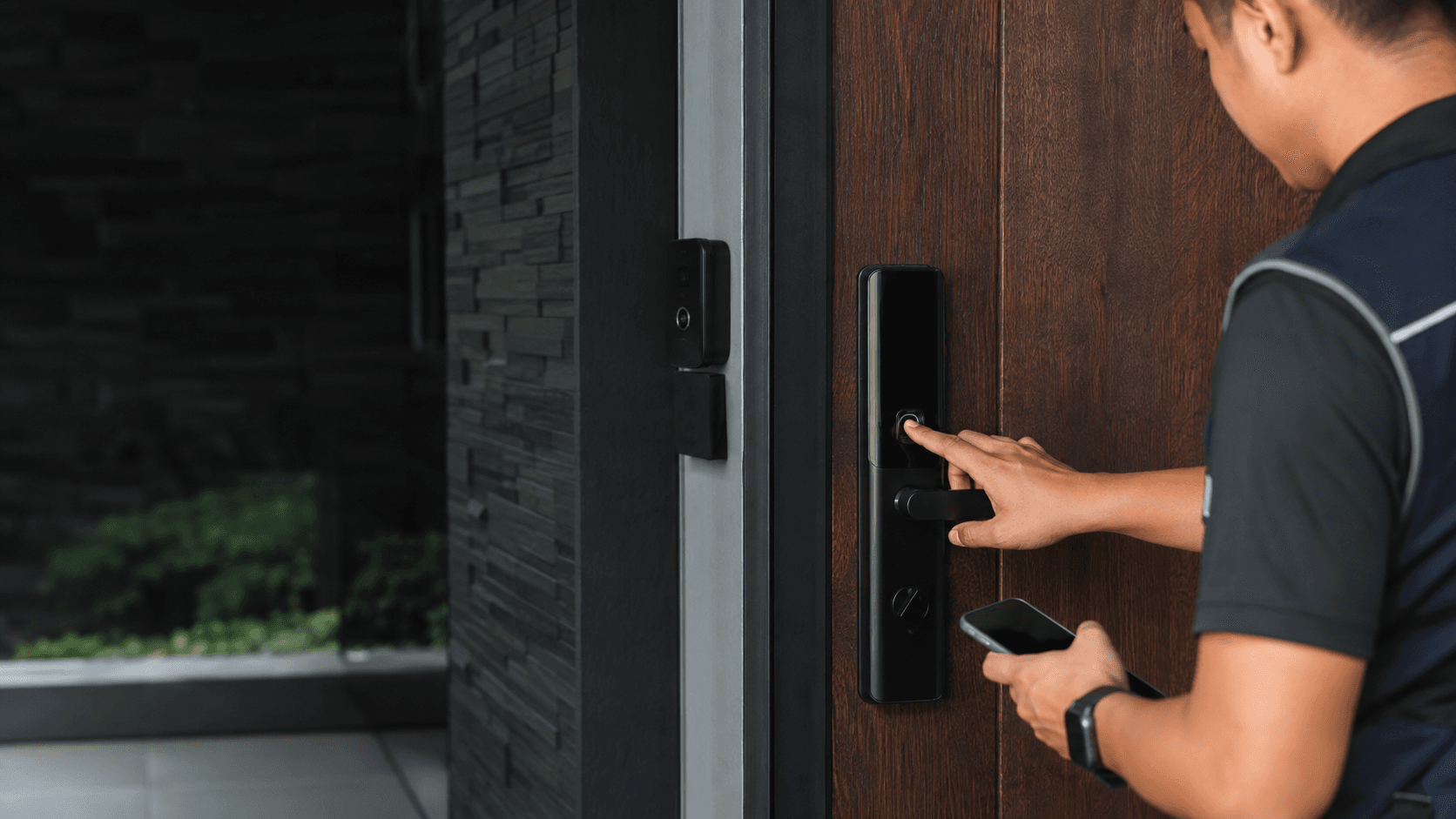
The appeal is simple. no key to carry, a record of who entered, and codes that can be changed without rekeying a cylinder. The catch is that a wireless lock is a small computer bolted to a door, and it inherits every weakness of that door, that frame, and that household's habits.
Most of the buying decision is not about the lock at all. It is about what the door can accept, who needs to get through it, and what happens on the day the batteries die or the Wi-Fi drops. Those three questions decide more than the brand name on the box.
What a Yale Wireless Door Lock Does in Daily Use
In daily operation, a Yale wireless door lock replaces the key turn with a code, a phone, or a fob. Entry becomes a short action rather than a search for metal, and the lock can be told that a cleaner's code expires on Friday while the family code stays active.
That is the practical difference between a wireless lock and a mechanical one. A mechanical lock has one secret, shared by everyone. A wireless lock can hold several, each tied to a person and a schedule.
Eyonic's own product review position is that smart locks work best when door condition, user roles, and backup method are reviewed before installation, and that for business use the choice between a standalone smart lock and an access-control panel should be checked first. That is a fair summary of where most installations go wrong: the lock is chosen before the door and the access list are understood.
Wireless connectivity is what makes remote control and entry records possible, and it is also the part most likely to disappoint if the network at the door is weak. A lock that reports every entry is only useful if it can reach the network that carries those reports.
Door Condition and Lock Type Before Anything Else
Door condition decides whether a wireless lock is a straightforward swap or a fabrication job. A solid timber door with a healthy mortise or cylindrical cutout is the easy case. A hollow-core door, a warped frame, or a strike plate that no longer aligns is the hard case, and no amount of smart features fixes a door that will not close cleanly.
The existing lock type matters just as much. Deadbolt replacements, lever-handle replacements, and adapter-style locks that sit over an existing deadbolt are different products with different installation demands. A lock designed to replace a deadbolt will not fit a door that only has a lever latch, and an adapter-style lock assumes the existing deadbolt is sound.
Frame alignment, door thickness, and the gap between door and frame all affect whether the bolt throws freely. A lock that binds on a hot afternoon will drain batteries faster and generate more complaints than any feature list can offset.
Pre-installation checks in sequence
- Confirm the door and frame condition, including alignment, thickness, and whether the door closes without force.
- Confirm the existing lock type, so the replacement is matched to the cutout rather than forced into it.
- Define who needs access, and whether each person needs a permanent code, a temporary one, or a scheduled one.
- Decide the backup entry method before installation, not after the first lockout.
- Confirm power and network availability at the door, including how far the signal has to travel.
- Confirm installation and handover, so codes, app access, and admin rights are tested and transferred properly.
Working through that list in order prevents the most common failure: buying a lock that suits a photograph rather than the door it will live on.
Access Roles, Codes and Backup Entry
Access roles are the reason a wireless lock earns its place in a business. A shop needs a manager code that always works, a staff code that works during shifts, and a delivery code that expires the same day. A home needs something simpler, but the same logic applies to a tenant, a cleaner, or a relative who visits weekly.
The question Eyonic raises for business use is whether a standalone smart lock is enough or whether an access-control panel is more appropriate. A standalone lock manages one door and a modest list of users. A panel manages many doors, many users, and a central record, which is usually what a larger site actually needs.
Backup entry deserves a decision before installation. Options include a mechanical key override, a keypad that still works when the app does not, or a second entrance that remains independent of the wireless lock. Whichever is chosen, it should be tested while someone is still on site, not discovered during a lockout.
Code hygiene is the quiet part of access management. Codes shared by message, written on a wall, or reused across staff who have left will undermine a lock that is otherwise well specified. A wireless lock makes code changes easy, which only helps if someone actually makes them.
Power, Network and App Dependence
Every wireless lock depends on batteries, and every app-controlled lock depends on a network path to the lock. Those two dependencies define the failure modes: a flat battery, a dropped connection, or a phone that is lost, uncharged, or signed out.
Battery behaviour is not uniform. A lock on a door that is used fifty times a day, in a humid climate, with a bolt that binds slightly, will consume batteries faster than the same lock on a quiet internal door. Planning for replacement before the low-battery warning becomes an alert nobody acts on is part of running the lock, not an afterthought.
Network reach at the door is the other variable. A lock at the far end of a building, behind a thick wall, or outside the coverage of the property's Wi-Fi may not deliver remote control or entry records reliably. Where coverage is thin, the practical answer is often to treat the lock as a local device with a code, and to accept that remote features will be intermittent.
App dependence also raises a question about who holds the administrator account. If the person who set up the lock leaves, changes phone, or loses access to the account, the site can be left managing a lock nobody fully controls. Administrator access should be held by the property or business, not by an individual's personal account.
Installation and Handover in Sarawak
Eyonic's installation process runs through site survey, system proposal, installation, and handover, and that sequence applies to door access as much as to cameras. The survey is where door condition, lock type, user roles, and network reach get checked against the actual door rather than a description of it.
The handover stage is where a wireless lock installation is either finished or left half-done. Codes should be created and tested, administrator access transferred to the right person, backup entry demonstrated, and the low-battery and connectivity behaviour explained in plain terms.
Eyonic has completed work for the Kuching Immigration Office, focused on arrival flow, staff areas, visitor movement, and dependable daily operation, and for KTA Sarawak Sdn Bhd, where the requirement was a practical office setup supporting staff movement, visitor handling, tidy cabling, and clearer daily site control. Both are the kind of environment where access roles and backup entry matter more than the lock's finish.
For a single home door in Sarawak, the same checks apply at a smaller scale. For a shop, office, or industrial site, the access list and the choice between a standalone lock and a panel usually decide the shape of the project before any product is selected.
Where a wireless lock is part of a wider setup, it is worth confirming how it relates to the alarm, autogate, intercom, or CCTV systems already on site. Compatibility between those systems is not something to assume, and it is better confirmed during the survey than discovered after installation.
Share your location, property type and required system with Eyonic on WhatsApp at +60 11-5111 7959 for the next practical step.