
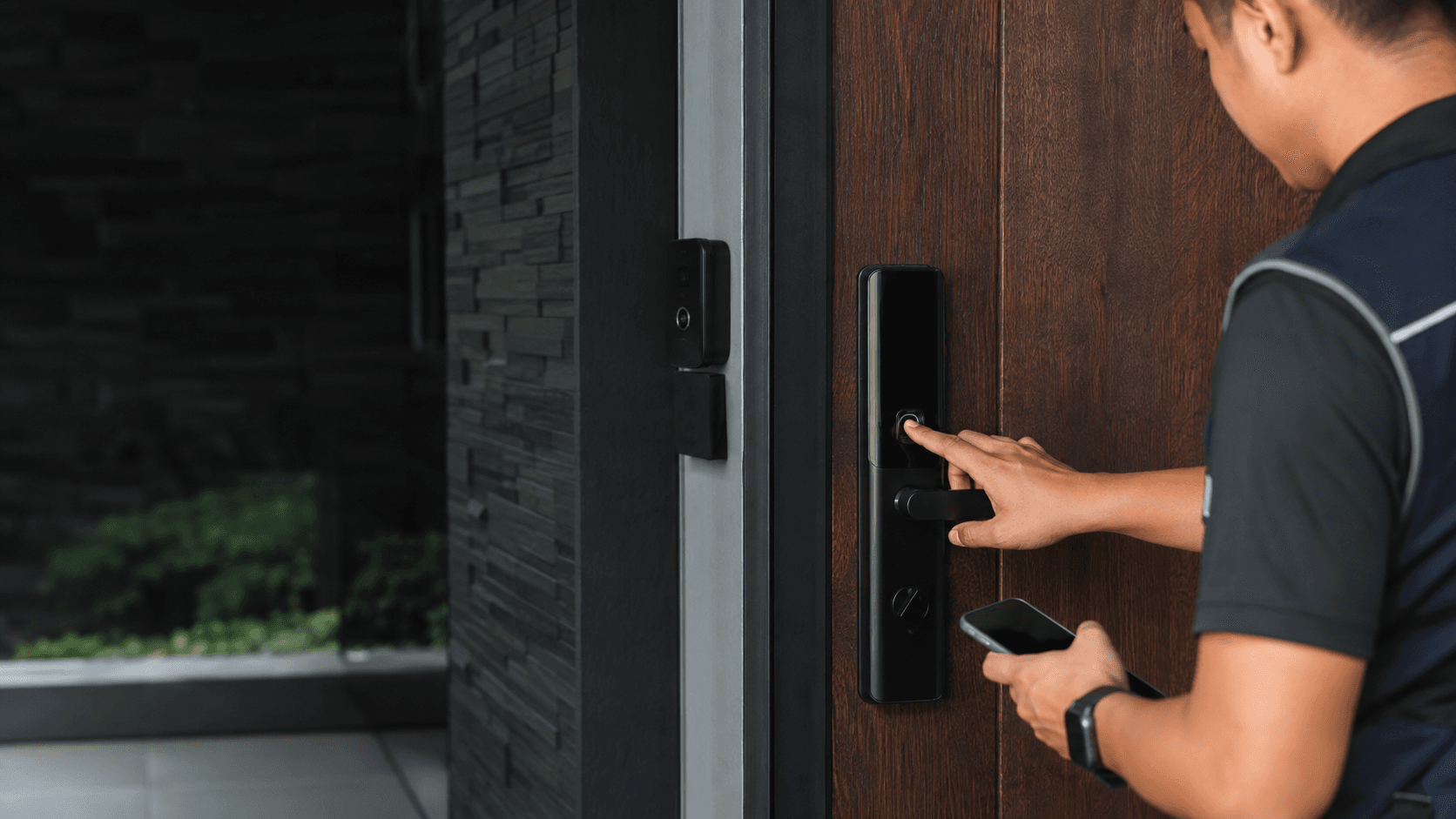
The phrase best smartlock 2026 gets used loosely online. Most published rankings are lab tests of American deadbolts, judged on app polish and battery charts. That framing misses what decides whether a lock works in a Malaysian home, shop, or office: whether the existing door can carry the hardware, who needs to enter and when, what happens during a power or network failure, and who installs and supports the unit afterward.
Eyonic Sdn Bhd is a security system supplier in Sarawak that plans, supplies, and installs CCTV and ELV systems, and its product review section covers smart lock door access as a multi-brand category. Its own guidance is blunt. smart locks work best when door condition, user roles, and backup method are reviewed before installation, and for business use the company checks whether a standalone smart lock or an access-control panel is the better fit. That review-first sequence is the spine of this page.
Best Smartlock 2026: What Matters Before You Choose
A smartlock replaces the act of carrying and turning a key with a credential: a code, a card, a phone, a fingerprint, or a remote release. The lock body still has to throw a bolt into a strike plate, so the mechanical job at the door does not disappear. What changes is who can open it, when, and whether a record exists of the opening.
That shift matters most where keys are hard to control. A shop with staff turnover, an office with visitors, a rental unit with changing occupants — each loses track of physical keys over time. Digital credentials can be issued and revoked without rekeying. The trade-off is dependency. a credential system needs power, and it needs a plan for the day the power or the network is not there.
Eyonic's project work shows the same logic at building scale. At the Kuching Immigration Office, the focus was arrival flow, staff areas, visitor movement, and dependable daily operation. At KTA Sarawak Sdn Bhd, an engineering consultancy office in Kuching, the requirement was staff movement, visitor handling, tidy cabling, and clearer daily site control. Both are access questions before they are hardware questions, and a single door lock is a small version of the same problem.
Door condition and access roles decide the shortlist
Two doors of the same width can accept completely different locks. The variables that matter are the ones a site survey can see: door material and thickness, whether the frame is hollow or solid, whether the existing lock is a deadbolt, a lever, or a mortise set, and whether the door closes squarely enough for a bolt to seat without force.
Retrofit hardware that keeps the existing cylinder suits doors where the owner wants to preserve the keyed lock and add smart entry alongside it. Full replacement suits doors where the existing lock is worn, mismatched, or not rated for the traffic the door receives. Neither option is universally better; the door decides.
Access roles decide the rest. A household needs a handful of credentials and a guest code that expires. A shop needs staff codes that can be removed the day someone leaves. An office needs a distinction between staff areas and visitor-facing doors, which is where a standalone lock often stops being enough and an access-control panel starts to make sense. Eyonic states that for business use it checks exactly this question — standalone smart lock or access-control panel — before recommending hardware.
Where a standalone smartlock fits
A standalone unit fits a single door with a small, stable group of users: a home's main entrance, a back door, a small office's staff entry, a server room. It is self-contained, so there is no panel to program and no cabling to run to the door. The limit is scale. Once several doors need to be managed together, or entry needs to be tied to a wider system, a standalone lock becomes an island.
Where access control fits better
Access control fits multiple doors, shared buildings, and sites where entry records or integration with other systems matter. It costs more and depends on infrastructure, but it handles the cases a single lock cannot: consistent rules across doors, central changes, and a clearer picture of who entered where. The Kuching Immigration Office and KTA Sarawak projects both sit in this territory — public and commercial spaces where movement between zones is the actual requirement.
Smartlock access methods and backup entry
Every access method is a convenience layer over one question: what opens the door when the convenient method fails. A shortlist is only as good as its weakest entry path.
Keypad codes suit shared use because they need no hardware in the user's pocket, but codes get shared and rarely changed. Cards and fobs are fast and easy to revoke, but they get lost and passed on. Phone-based entry is convenient until a phone is flat, replaced, or left behind. Fingerprint entry removes the carried credential entirely, but enrolment quality varies between users and fingers. Mechanical key override is the oldest fallback and still the most reliable, which is why locks that keep a keyway remain practical.
Eyonic's stated position is that smart lock door access is good for controlled convenience when user permissions and backup entry are planned properly. The two conditions are not decoration. User permissions determine who can be removed and how quickly. Backup entry determines whether a dead battery or a dropped phone becomes a locked-out household or a closed shop.
Planning permissions before hardware
Write down the user groups first: permanent residents, staff, regular visitors, one-time visitors, and whoever holds the master credential. Then decide which group needs which door at which hours. That list usually settles the hardware question faster than any specification sheet, because a lock that cannot express the required roles will fail in daily use regardless of how well it reviews.
Power connectivity and daily reliability
A smartlock is a powered device on a door that must open every day. Reliability therefore has two halves: the lock's own power source, and the network it depends on for remote features.
Battery-powered locks avoid cabling but introduce a maintenance task, and the failure mode is a lock that stops responding rather than one that breaks. Wired or panel-connected hardware avoids battery swaps but depends on the building's power and cabling. Neither is free of failure; the difference is which failure the owner prefers to manage.
Connectivity is the second dependency. Remote unlocking, entry notifications, and central permission changes all need a working link between the lock and whatever manages it. When that link drops, local entry methods should still work. A lock that only opens through an app is a lock that fails when the network does, which is why local credentials and a mechanical override belong on the shortlist even when remote features are the reason for buying.
Daily reliability also depends on the door itself. A bolt that has to be pushed into alignment wears the mechanism and drains batteries faster. Fixing a misaligned frame before installation is cheaper than replacing a lock that was never the problem.
Installation handover and local support in Sarawak
Hardware that arrives without installation and handover is a box, not a working door. Eyonic's installation process runs through four stages, and the same sequence applies to smart lock work.
- Site survey — the door, frame, existing lock, and access requirements are checked on site.
- System proposal — the recommended hardware and configuration are put forward based on what the survey found.
- Installation — the lock is fitted and configured, including user credentials and permissions.
- Handover — the system is explained and tested with the people who will use it daily.
The survey stage is where most shortlist mistakes get caught. A lock that looked ideal online can fail at the first step because the door is too thin, the frame cannot take the hardware, or the required user roles exceed what a standalone unit can express. Checking before purchase avoids returning hardware that was never going to fit.
Handover matters more than it sounds. A lock configured but not explained tends to be used through one method only, with the rest forgotten. Walking through code changes, adding and removing users, and the backup entry path at handover is what turns installed hardware into a system the owner can actually run.
Local support is the last piece and the one hardest to judge from a review page. A lock sourced from overseas may be perfectly capable and still leave the owner without anyone nearby to fit it, adjust it, or replace a failed part. Eyonic operates in Sarawak, with project work in Kuching, and its service scope covers planning, supply, and installation for homes, offices, shops, and industrial sites. For buyers in the state, that local presence is part of the shortlist criteria rather than an afterthought.
What the shortlist cannot yet say
Specific smartlock model names, prices for the Malaysian market, battery figures, wireless protocols, durability ratings, and warranty terms are not established here, so no model ranking is offered. Published rankings from other markets cover those details for the brands they test, but they do not answer whether a given lock fits a given door in Sarawak or who will service it. Those answers come from a site survey, not a specification table.
For a property in Sarawak, the practical next step is to share the location, property type, and required system with Eyonic on WhatsApp at +60 11-5111 7959, so the door and access requirements can be reviewed before any hardware is chosen.