
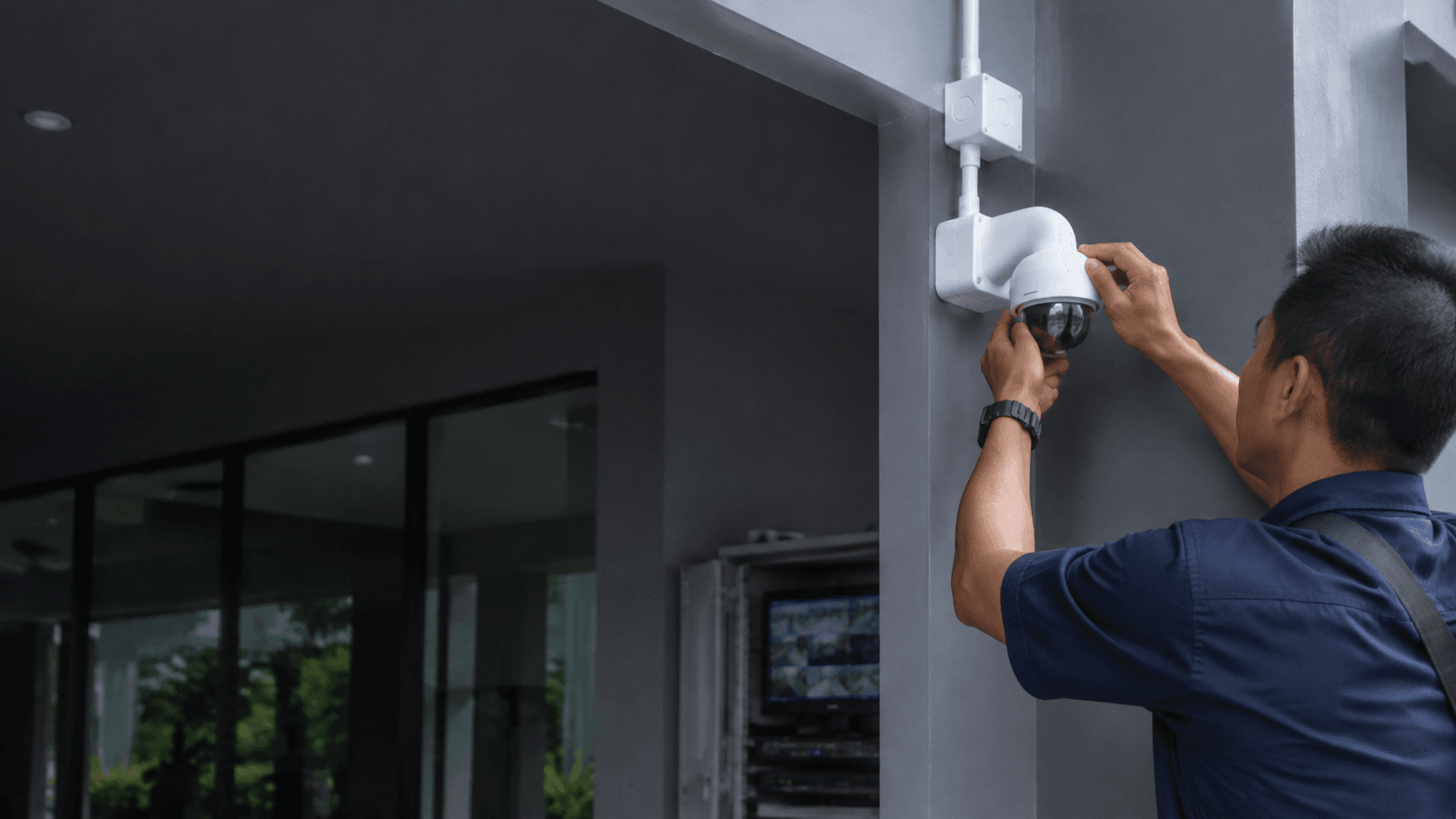
The term covers a wide range of products, from a simple metal shell around a box camera to a sealed cabinet that holds a PTZ unit with cooling and a wiper. Most fixed dome cameras already ship with their own sealed body, so a separate cctv housing is not always required. The decision comes down to the camera body style, the mounting spot, and what the camera will face over its service life.
What a camera housing actually does
A housing is not just a cover. It changes the physical conditions around the camera, and that changes how long the camera keeps producing a usable image.
The main jobs are straightforward. A housing blocks direct rain and water spray from reaching the camera body and lens. It keeps dust and grit off the lens surface, which matters most where vehicles, machinery, or open ground generate airborne particles. It adds a physical barrier against accidental knocks and deliberate interference. On some models it also manages temperature, either by trapping warmth in cold conditions or by moving air away from the camera in hot ones.
There is a trade-off. Every layer of glass or plastic between the lens and the scene can reduce light transmission and add reflections, particularly at night when infrared illumination is in use. A housing with a poorly fitted window, a scratched visor, or trapped moisture inside the glass can make a good camera perform worse than a bare unit. That is why fit and sealing matter as much as the shell itself.
Housings also change the maintenance picture. A sealed enclosure with a wiper or a removable visor can be cleaned without touching the camera. An open bracket mount leaves the lens exposed to the same dirt that the housing was meant to stop.
Indoor, outdoor, and industrial housing types
Housing types are usually grouped by where they are installed and what the camera body looks like, because those two factors decide almost everything else.
Indoor housings are the simplest. They typically provide a clean look, some protection from dust and accidental contact, and a mounting point for a box camera. They rarely need sealing against rain, and they usually do not need heating or cooling.
Outdoor housings add weather resistance. They are built to shed water, resist wind-driven rain, and survive direct sun. Many include a sun shield or visor, and some include a heater or blower for temperature control. A weatherproof housing is the common choice for a box camera mounted on a wall, pole, or roof edge where the camera body itself is not sealed.
Industrial and specialty housings go further. They may be built for corrosive atmospheres, high dust loads, explosive-risk zones, or very high ambient heat. Cooled housings exist for locations where a camera would otherwise shut down from thermal load. Vandal-resistant housings add thicker material and tamper-resistant fasteners for public or exposed locations.
Dome and turret cameras usually do not need a separate housing because the camera body is already enclosed. PTZ cameras are a mixed case. some are sold as sealed outdoor units, while others are designed to sit inside a dedicated PTZ housing that provides the weather seal and, in some cases, the mounting interface.
Protection ratings and environmental factors
Protection ratings are the clearest way to compare housings, but they only describe part of the picture.
Ingress protection ratings use two digits. The first digit covers solids such as dust, and the second covers liquids such as water spray or immersion. A higher second digit means the enclosure tolerates more water exposure, which is why outdoor installations generally call for a higher liquid rating than sheltered indoor ones. The rating describes the enclosure, not the camera inside it, and it does not describe impact resistance, corrosion resistance, or temperature performance.
Impact resistance is often stated separately, and it matters in public areas where a housing can be struck. Corrosion resistance depends on the material and finish, which matters near the coast or in chemical environments. Temperature performance depends on whether the housing is passive, heated, or actively cooled.
Three environmental factors decide most real installations:
- Confirm the camera body style, because a box camera, a PTZ unit, and a dome camera each need a different housing approach.
- Confirm the mounting location, including whether it is sheltered, exposed, or reachable by the public.
- Check the actual lighting and weather exposure at that spot, since sun angle, rain direction, and night illumination change what the housing must handle.
- Confirm the required protection rating against the real exposure, not against a general outdoor assumption.
- Confirm cable entry, bracket, and power compatibility so the housing, mount, and camera work as one assembly.
That last point is where many installations go wrong. A housing that fits the camera but not the bracket, or that seals the camera but leaves the cable entry exposed, does not deliver the protection it appears to offer.
How cctv housing choice fits an installation plan
Housing selection belongs inside the wider installation plan, not after it. Eyonic's CCTV installation process runs through site survey, system proposal, installation, and handover, and the housing decision sits in the survey and proposal stages because it affects mounting, cabling, and power.
A site survey is where the real exposure gets checked. The same building can have a sheltered corridor, a west-facing wall that takes afternoon sun, and a gate area fully open to rain. Treating all three as identical outdoor positions usually produces at least one camera that fails early or produces poor night images.
Lighting deserves its own check. Eyonic recommends checking actual lighting conditions before confirming placement for ColorVu-style cameras, and the same discipline applies to housing choice. A housing with a tinted or dirty window can undermine a camera chosen specifically for low-light performance, so the enclosure and the camera should be assessed together rather than separately.
Completed projects show how this plays out in practice. Eyonic's work for the Kuching Immigration Office focused on arrival flow, staff areas, visitor movement, and dependable daily operation, which is the kind of environment where camera positions face different exposure conditions within one site. The KTA Sarawak Sdn Bhd project needed a practical office setup in Kuching supporting staff movement, visitor handling, tidy cabling, and clearer daily site control, where cable routing and mounting discipline matter as much as the camera itself.
For readers weighing a full system rather than a single enclosure, Eyonic's published Hikvision CCTV package is RM 1,599 and covers camera supply and setup, basic recording configuration, and mobile viewing handover. That figure describes a package, not a standalone housing price, and housing cost depends on type, rating, and whether heating or cooling is included.
Questions to settle before ordering a cctv housing
Most ordering mistakes trace back to a small number of unresolved questions. Settling them first avoids returns and rework.
Does the camera actually need a housing? A sealed outdoor dome or turret camera generally does not. A box camera, or a PTZ unit not sold as a sealed outdoor model, usually does. Buying a housing for a camera that is already sealed adds cost and can reduce image quality.
What is the real exposure at the mounting point? Direct rain, wind-driven rain, salt air, dust, and direct sun are different problems with different answers. A sheltered position under a wide eave may need far less protection than an exposed pole.
Does temperature control matter? In consistently hot locations, a camera inside a sealed housing can run hotter than the same camera in open air, and some units shut down or degrade when they overheat. In cold locations, a heater may be needed to keep the lens clear and the camera within its operating range.
Will the housing be cleaned and serviced? A housing that is difficult to open or reach tends to stay dirty. If the site has no maintenance routine, a simpler enclosure with easier access is often the better choice.
Do the housing, bracket, and cable entry work together? This is the compatibility question that decides whether the assembly is actually sealed. Cable glands, conduit entries, and bracket interfaces need to match the housing, not just the camera.
Where a housing is genuinely required, the practical sequence is to confirm the camera body style, confirm the mounting location, check the actual lighting and weather exposure, confirm the required protection rating, and then confirm cable and bracket compatibility. Working in that order keeps the decision tied to the site rather than to a product listing.
For readers in Sarawak planning a system rather than a single part, sharing the location, property type, and required system with Eyonic on WhatsApp at +60 11-5111 7959 is the next practical step.