
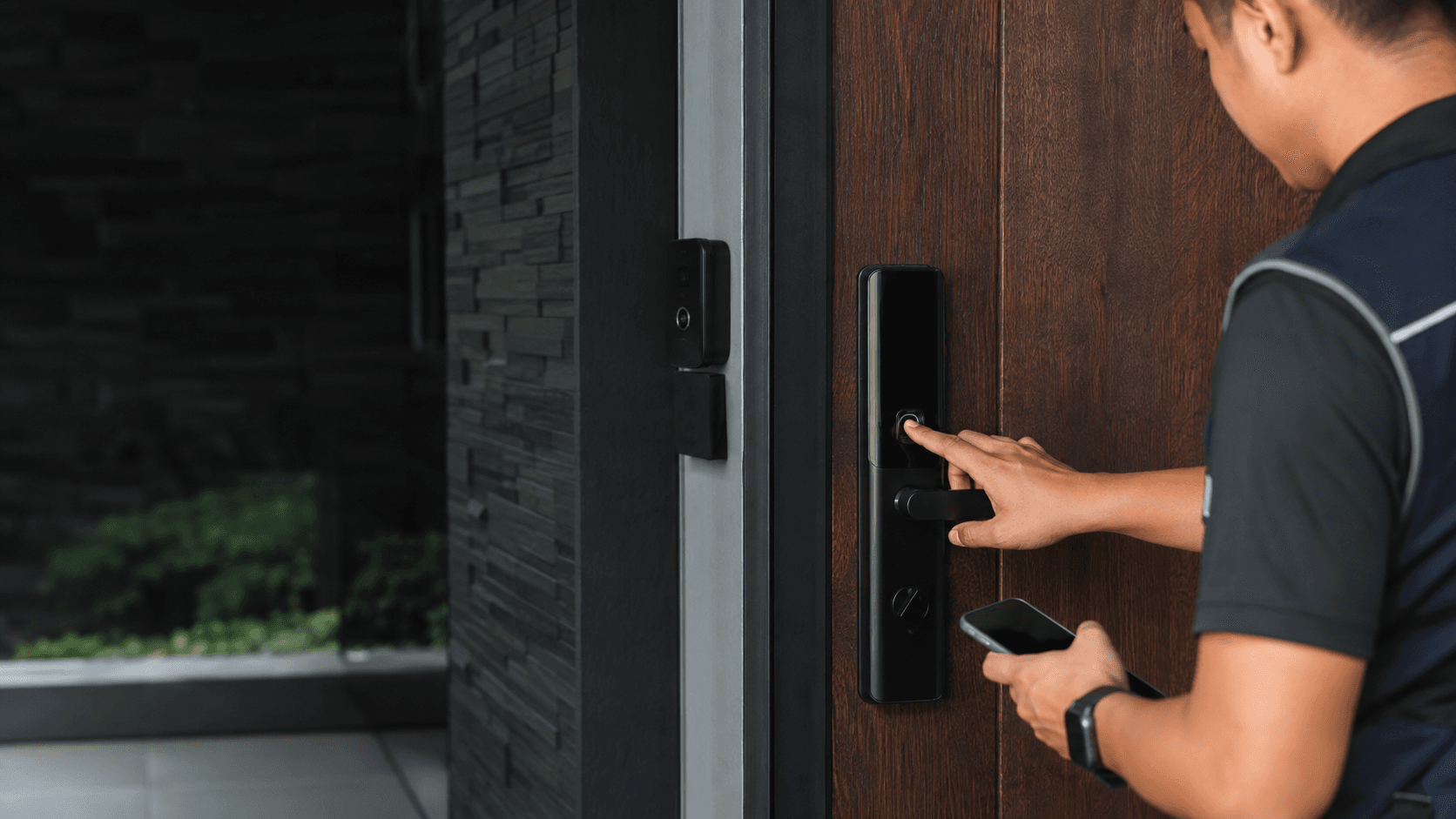
That single design choice shapes everything else about the product. Because the radio sits inside the lock, the lock talks to the router directly, and the phone talks to the lock through Kwikset's cloud service. There is no bridge, no hub, and no extra box on a shelf. The trade-off is that the lock depends on the home network and on Kwikset's servers being reachable, so a Wi-Fi lock is only as reliable as the internet connection behind it.
Kwikset's own product pages describe the Halo as a Wi-Fi enabled smart door lock and deadbolt that works with the home's existing internet router, and the Halo Select as a touchscreen model that adds Matter support for integration with a compatible Matter hub. Those two descriptions frame the whole category: one model family for straightforward app control, one for households that also want ecosystem integration.
How Wi-Fi control works without a hub
A hub-based smart lock uses a low-power radio such as Z-Wave or ZigBee to reach a bridge, and the bridge connects to the router. A Wi-Fi lock removes that middle device. The lock joins the 2.4 GHz network directly, the Kwikset app authenticates against the account, and commands travel from phone to cloud to lock.
Kwikset states plainly that the Halo requires no smart home hub and works using the home's existing internet router. That is the core convenience. one fewer device to power, pair, and troubleshoot.
The constraint is equally clear. Wi-Fi radios draw more current than Z-Wave or ZigBee, so battery behaviour matters more on a Wi-Fi lock than on a hub-based one. Signal strength at the door also matters, because a deadbolt sits inside a steel-and-timber assembly at the edge of the house, often the worst place in the building for reception. A router in a back room and a front door at the far end of a terrace house is a realistic weak spot.
Remote lock and unlock depends on three things working at once: the lock has power, the lock has Wi-Fi, and the Kwikset service is reachable. When any one of those fails, the lock still opens by keypad code or by physical key. That fallback is the reason a Wi-Fi lock remains usable during an outage rather than becoming a locked door with no way through.
Entry modes and user codes
Kwikset describes three entry modes on the Halo: the app, a keypad or touchscreen code, and a traditional keyway. Each covers a different situation. The app suits remote access and checking status. The code suits daily entry by household members, staff, or regular visitors. The keyway covers the case where electronics or batteries fail.
User codes are where a Kwikset Wifi Lock earns its place in a rental or a small business. Kwikset's Halo documentation lists code types that can be limited by date, limited by weekday and time, or set as a one-time code valid within 24 hours. That structure lets a host issue a code that works only for a guest's stay, or a cleaner's code that works only on a scheduled weekday window, without rekeying anything.
Activity tracking supports the same use case. Kwikset states that the app tracks lock activity and sends notifications, and that multiple locks across multiple homes can be managed from one account. For a landlord with two or three units, that is the practical difference between a smart lock and a keyed deadbolt: the record of who entered and when exists without anyone standing at the door.
Two limits deserve attention before relying on codes alone. A code is only as private as the person holding it, so codes should be removed when a tenancy or contract ends rather than left active. And a keypad lock still needs a backup entry method planned in advance, which is the same principle Eyonic applies to smart lock door access generally: permissions and backup entry should be settled before installation, not after.
What to check before choosing a Kwikset Wifi Lock
The lock is the easy part of the decision. The door, the network, and the support arrangement decide whether the installation works in daily use. Working through the checks below in order prevents the common failure where a lock is bought, fitted, and then found to be unreliable because of something that had nothing to do with the lock itself.
- Confirm the door condition. measure the existing bore hole and backset, check that the door and frame are square and that the deadbolt aligns with the strike, because a misaligned door causes motorised deadbolts to bind and drain batteries.
- Decide who needs access and in what pattern: permanent household members, recurring staff, short-stay guests, or one-off contractors, since each pattern maps to a different code type.
- Agree the backup entry method before installation: a physical key kept off-site, a second code held by a trusted person, or a documented procedure for battery failure.
- Test Wi-Fi coverage at the door itself, not in the room behind it, because the door assembly is the least favourable position for reception in most homes.
- Confirm who supplies, installs, and supports the lock locally, including what happens when the lock loses connection or the app account needs recovery.
Door condition is the check most often skipped and the one most likely to cause a return visit. A deadbolt that has to force itself into the strike plate draws extra current on every cycle, and on a Wi-Fi lock that shortens battery life noticeably. Checking alignment before purchase is cheaper than correcting it afterwards.
Installation and door condition
Kwikset's Halo documentation describes a motorised deadbolt with one-touch locking, a traditional keyway, tamper resistance, a code alarm, low battery alerts, and a Secure Mode. Those features assume the lock is mounted on a door that closes cleanly. A motorised bolt pushing against a misaligned strike will trigger the same symptoms as a fault: short battery life, failed lock cycles, and app notifications that do not match what happened at the door.
Preparation therefore follows a familiar sequence. A site survey establishes the door type, the existing hardware, and the network conditions at the entrance. A proposal sets out what will be supplied and fitted. Installation covers the lock, the app setup, and the code structure. Handover confirms that the household or staff know how to add a code, remove one, and open the door when the electronics are unavailable. That sequence mirrors how Eyonic runs its installation work, including the Kuching Immigration Office project, where the focus was arrival flow, staff areas, visitor movement, and dependable daily operation rather than hardware for its own sake.
For a business entrance, the choice is not automatically a standalone smart lock. Eyonic's own review guidance notes that smart locks work best when door condition, user roles, and backup method are reviewed first, and that for business use the question is whether a standalone smart lock or an access-control panel is more appropriate. A shop with a single staff door and a handful of keyholders fits a smart lock. A site with shift changes, visitor logging, and multiple controlled doors usually fits a panel.
Local supply and support in Malaysia
Malaysian buyers face a specific practical question that product pages do not answer: who handles the lock after it is fitted. Kwikset's own site provides support documentation and a where-to-buy route, but availability, pricing, and warranty handling in Malaysia depend on the local distributor or installer rather than on the manufacturer's global pages.
That makes the supply route part of the decision. A lock bought online and fitted by a general contractor leaves the buyer to manage app setup, code structure, and fault diagnosis alone. A lock supplied and installed by a local security systems provider keeps those tasks with the party who fitted it. Eyonic Sdn Bhd is a security system supplier in Sarawak that plans, supplies, and installs CCTV and ELV systems for homes, offices, shops, and industrial sites, and its product range includes smart locks alongside Hikvision cameras. The company's founder, Eric Yong, has more than ten years in technical installation of digital security solutions for commercial businesses in Sarawak.
Two local conditions affect how a Kwikset Wifi Lock performs in practice. The first is network quality at the door, which varies considerably between a landed property and a high-rise unit where the router may sit several walls away. The second is the door itself, since Malaysian homes and shoplots use a range of door constructions and existing lock types, and the bore and backset need checking against the lock before ordering.
For buyers comparing a Wi-Fi lock against a hub-based system, the deciding factor is usually whether the household already runs a smart home platform. A home with an existing hub gains more from a lock that integrates with it. A home with no hub gains more from a lock that connects directly, because there is nothing to integrate with and one fewer device to maintain.
Where a property needs door access as part of a wider security setup, the lock is one component among several. Eyonic's published packages cover a Hikvision CCTV package, a Hikvision alarm system, and an autogate package, each at RM 1,599, which gives a sense of how door and perimeter work is typically bundled in Sarawak. A Kwikset Wifi Lock would sit alongside that kind of work rather than replace it, since a lock controls entry at one door while cameras and alarms cover the wider property.
Share your location, property type and required system with Eyonic on WhatsApp at +60 11-5111 7959 for the next practical step.