
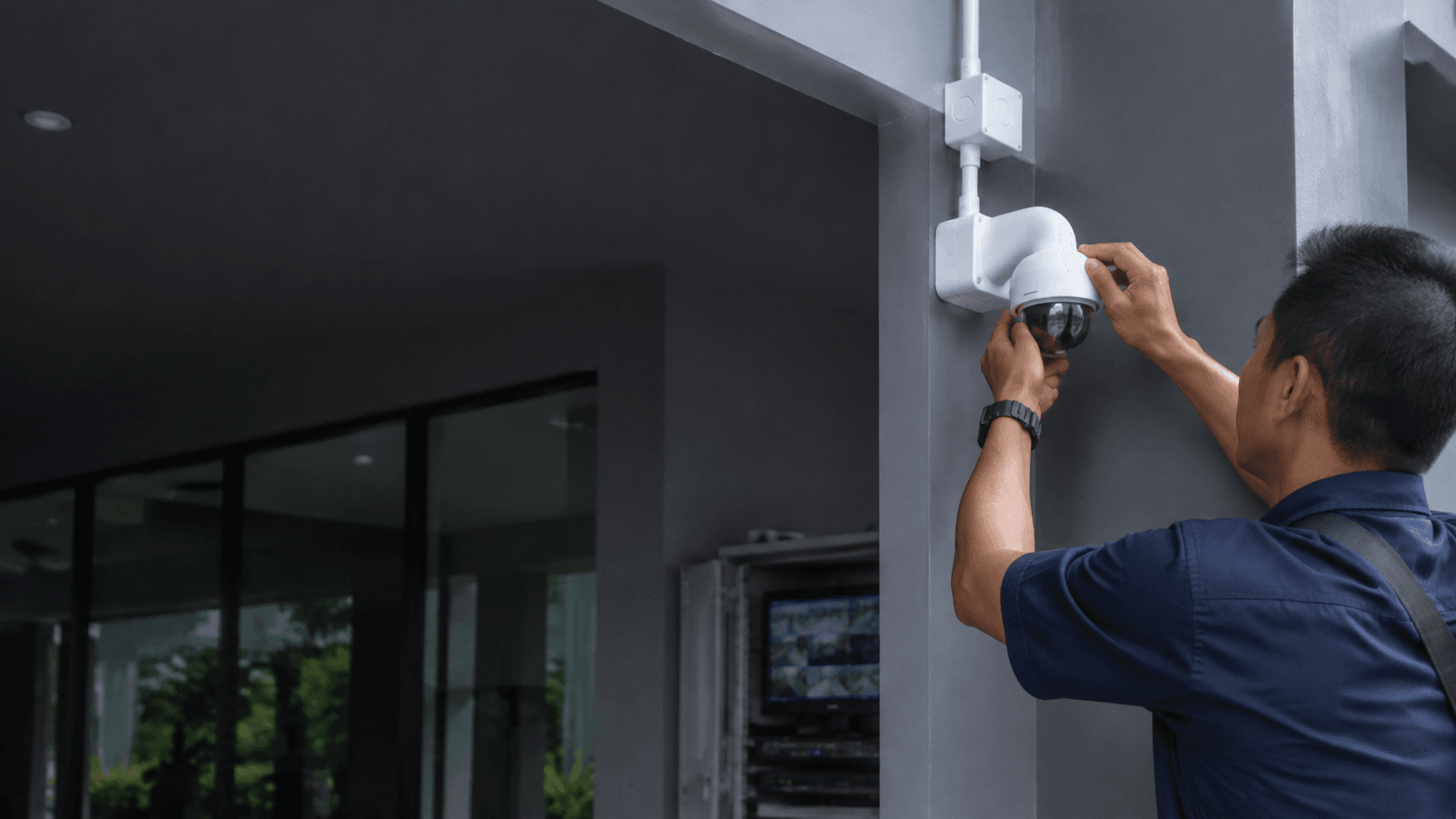
The appeal is simple. a camera position that has no power point nearby stops being a problem. The trade-off is that the panel, the battery, and the camera position all have to work together, and that relationship depends on the site rather than the box.
What Solar Cctv Means in Practice
Solar cctv is a monitoring setup where the camera draws energy from a small solar panel instead of a fixed electrical supply. The panel charges a battery, and the battery runs the camera. That chain is what makes an off-grid monitoring position possible on a gate, a perimeter wall, a store yard, or a rooftop corner where running cable would be slow, costly, or visually messy.
Because the camera is not tied to a power point, placement decisions shift. A wired camera is limited by where cable can reach. A solar-powered camera is limited by where sunlight reaches. Those are different constraints, and they change which corner of a building is the practical one.
Solar cctv still needs to deliver the same outcomes as any other camera: a usable image, a recording path, and a way to view footage remotely. The power source changes; the purpose does not.
What the panel and battery actually do
The panel's job is to put charge back into the battery during daylight. The battery's job is to carry the camera through the hours when the panel produces little or nothing. A position that looks tidy but sits in shade most of the day asks the battery to do work the panel cannot replace.
That is why a solar-powered camera is best judged as a system rather than a single device. A strong camera on a poorly lit mounting point will underperform a modest camera on a well-exposed one.
Why off-grid monitoring suits some sites
Off-grid monitoring removes the trenching, conduit, and electrical work that a remote camera position would otherwise require. On a construction site, a farm edge, a temporary compound, or a rented premises where permanent wiring is not wanted, that difference matters. It also means a camera can be repositioned later without redoing electrical work.
When Solar Cctv Suits a Site
Solar cctv fits sites where the camera position matters more than the wiring convenience, and where the position receives dependable daylight. It is a weaker fit where the only sensible camera angle sits under deep shade, inside a covered walkway, or facing a direction that never catches sun.
Several site types come up repeatedly:
- Perimeter and boundary positions far from any power point.
- Construction sites and temporary compounds that will not stay in one configuration.
- Farm, plantation, and yard edges where cable runs would be long.
- Rented or leased premises where permanent electrical alterations are restricted.
- Gate and entrance areas where a camera is wanted but a supply is not available.
The common thread is a camera position that is genuinely useful but awkward to power. Where a mains supply already exists at the right spot, a wired camera usually remains the simpler and more predictable choice.
Where it fits less well
Deep shade is the main constraint. A camera mounted under a wide roof overhang, inside a covered corridor, or on a wall that faces away from the sun for most of the day gives the panel little to work with. In those positions, a wired camera or a different mounting point is the more honest recommendation.
Another edge case is a site where the camera must run continuously at high activity with frequent alerts and long recording sessions. Higher demand draws more from the battery, so the balance between panel exposure and camera workload becomes tighter.
What to Compare Before Choosing Solar Cctv
Comparisons between solar cctv options are usually made on the wrong axis. Resolution and price are easy to line up side by side, but the deciding factors are usually the ones tied to the specific site.
Four things are worth settling before any model is chosen:
- Site survey — confirm the mounting position, the daylight it receives, and what the camera needs to cover.
- System proposal — match the camera, panel, and recording setup to that position and to how footage will be viewed.
- Installation — mount the camera and panel, configure recording, and set up remote viewing.
- Handover — confirm the live view, playback, and alert behaviour work as expected before the job closes.
That sequence is the same one Eyonic uses for CCTV installation work, and it applies to solar positions because the survey step is what decides whether the position is viable at all.
Daylight at the mounting point
The single most useful question is how much direct sun the panel will see across a normal day. A position that catches morning sun only is a different proposition from one that stays exposed from mid-morning to late afternoon. Trees, neighbouring buildings, and roof lines all change the answer, and they change it seasonally.
How footage will be viewed and stored
Remote viewing and recording still need a path. Whether footage is stored locally or accessed over a network affects what the installation needs to include, and it should be settled during the proposal rather than after mounting. Eyonic's CCTV work covers camera placement, recording, and remote viewing as one scope, which keeps those decisions connected.
Coverage versus power demand
A wider coverage requirement often means more camera activity, more alerts, and more recording. Each of those draws on the battery. Matching coverage ambition to the available daylight is part of the survey, not an afterthought.
Lighting and Placement Checks That Matter
Lighting conditions decide whether a camera produces a usable image after dark, and they decide whether a solar panel produces enough charge during the day. Both checks belong in the same site visit.
Eyonic recommends checking actual lighting conditions before confirming placement for ColorVu-style cameras, because the real light at the position is what determines night performance. The same principle applies to the panel: the real light at the position is what determines charging.
Practical checks at the mounting point include:
- Whether the panel position is shaded by structures or foliage during the day.
- Whether the camera angle is lit by existing street, porch, or security lighting at night.
- Whether the mounting height keeps the camera out of easy reach while still covering the target area.
- Whether the position will stay clear as trees grow or site layout changes.
These checks are cheap to do before installation and expensive to discover afterwards. A camera that has to be moved means the panel, the bracket, and the configuration all move with it.
Why the survey decides the outcome
A survey turns a general product question into a specific site answer. It establishes the mounting point, the daylight available there, the coverage required, and the recording and viewing path. Without it, any recommendation is a guess dressed as a specification.
Eyonic's completed work for the Kuching Immigration Office focused on arrival flow, staff areas, visitor movement, and dependable daily operation. That project shows the kind of thinking a survey produces: camera positions chosen around how a site is actually used, not around where cable happens to run.
Practical Next Step for a Survey
The useful starting point is a site survey rather than a product shortlist. A survey answers whether the intended camera position receives enough daylight, what coverage is realistic from that position, and how footage will be recorded and viewed.
Eyonic plans, supplies, and installs monitoring systems with camera placement, recording, and remote viewing for homes, offices, shops, and industrial sites. The company is based in Sarawak and works across CCTV and ELV systems, with founder Eric Yong bringing more than ten years in technical installation of digital security solutions for commercial businesses in Sarawak.
Documented package pricing covers a Hikvision CCTV package, a Hikvision alarm system, and an autogate package at RM 1,599 each. Solar cctv pricing is not published, because the panel, battery, and camera combination depends on the site and the coverage required.
Share the location, property type, and required system with Eyonic on WhatsApp at +60 11-5111 7959 for the next practical step.