
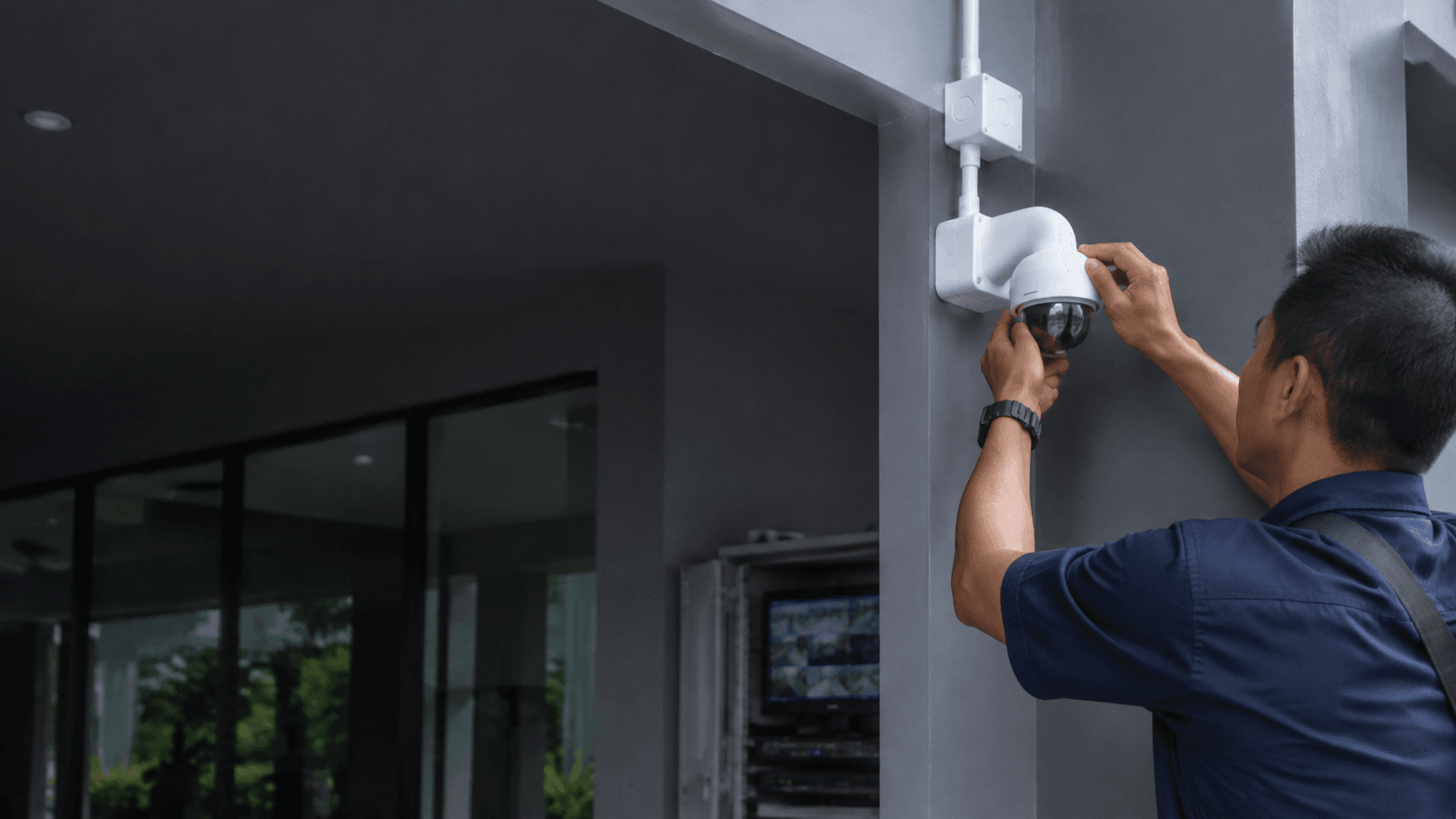
The exact-match query cellular security camera outdoor describes a camera that sends video over a mobile network instead of Wi-Fi or a wired internet line. That single change moves the hard problems away from the recorder and onto the site itself. Coverage, power, placement and data arrangements decide whether the installation works six months later, not the camera body.
Eyonic Sdn Bhd plans, supplies and installs monitoring systems with camera placement, recording and remote viewing for homes, offices, shops and industrial sites in Sarawak. The company's CCTV installation process runs through site survey, system proposal, installation and handover.
Cellular Security Camera Outdoor: What the Setup Actually Depends On
A cellular camera replaces the network cable or Wi-Fi link with a mobile data connection. Everything else in the chain still has to exist: a power source, a mounting position with a clear view, a recording or storage arrangement, and a way to view footage remotely.
That is why the useful question is not which camera to buy. The useful question is whether the site can support a cellular camera at the exact point where the view is needed. A position with a good view but weak signal fails. A position with strong signal but no practical power fails differently. Both problems are visible during a site survey and invisible in a product listing.
Malaysia's cellular coverage is broad in urban Sarawak and thinner in the interior, on large industrial plots, and inside reinforced structures. Signal at ground level near a gate or guardhouse is not the same as signal at a pole three metres up. The only reliable check is measurement at the intended mounting point.
Why a cellular security camera outdoor unit suits sites without reliable Wi-Fi
Some sites cannot reasonably be cabled. A construction site office, a farm store, a remote pump house, a temporary sales office or a plot with no fixed broadband all share the same constraint: there is no dependable network to plug into.
For those locations, a cellular camera removes the need to run network cable to the camera position. Power still has to come from somewhere, which usually means mains power where it exists, or a battery and solar arrangement where it does not.
The trade-off is ongoing. A cellular camera depends on a SIM arrangement and a data plan that continues to be paid. It also depends on the mobile network staying usable at that position. Where a wired or Wi-Fi camera can be installed, that option usually costs less to run and carries fewer moving parts. Cellular is the right answer when cabling is genuinely impractical, not when it is merely inconvenient.
What to check before confirming a cellular security camera outdoor placement
These checks run in order, because each one can rule out a position before the next is worth doing.
- Measure cellular signal at the intended mounting height, not at ground level, and confirm which network is usable there.
- Confirm the power source. mains supply at the position, or a battery and solar arrangement sized for the site's sunlight and shade.
- Check the actual lighting at the position across the day and night before fixing the camera angle, since a view that looks clear in daylight can be unusable after dark.
- Decide the recording and storage arrangement, including whether footage is kept locally at the site or sent over the mobile connection.
- Confirm the remote viewing setup and complete a handover so the people who need the footage can actually reach it.
Signal measurement is the step most often skipped. A phone showing bars at the gate does not prove the camera position has usable signal, because the camera sits at a different height, often against a different surface, and may be enclosed in a housing.
Power is the second constraint. A camera drawing from a battery needs enough sunlight to recover between charges, and shaded positions or monsoon-season cloud cover reduce that recovery. Where mains power reaches the position, the power question largely disappears and the cellular link becomes the only live dependency.
Lighting deserves its own check. Eyonic's guidance on ColorVu-style cameras is to verify actual lighting conditions before confirming placement, because the difference between a lit approach and a dark corner changes what the camera can usefully record. The same discipline applies to any outdoor position.
How Eyonic plans, supplies and installs monitoring systems in Sarawak
Eyonic's confirmed scope is CCTV and ELV planning, supply and installation, delivered through site survey, system proposal, installation and handover. The company's project work includes the Kuching Immigration Office, where the focus was arrival flow, staff areas, visitor movement and dependable daily operation, and KTA Sarawak Sdn Bhd, where the requirement was a practical office setup supporting staff movement, visitor handling, tidy cabling and clearer daily site control.
Those two projects show the pattern that matters for any outdoor camera decision. The survey comes first, the proposal follows from what the site can actually support, and the handover closes the loop so the system is usable rather than merely installed.
Eyonic's published packages are the Hikvision CCTV Package at RM 1,599, the Hikvision Alarm System at RM 1,599, and the Autogate Package at RM 1,599. These are the confirmed package prices. A cellular camera deployment is a different configuration, and its cost depends on the survey findings, so no package price should be assumed to cover it.
Eric Yong founded Eyonic Security Systems and has worked in the industry for more than ten years, with experience in technical installation of digital security solutions for commercial businesses in Sarawak.
Cellular security camera outdoor questions buyers ask before installation
Does a cellular camera need a SIM card and a data plan? Yes. The camera connects through a mobile network, so it needs a SIM arrangement and an active data plan. The plan terms and the carrier that works at the site are carrier-side questions, not camera-side ones.
Can a cellular camera work without mains power? It can run from a battery, often paired with a solar panel. Whether that works at a specific position depends on sunlight, shade and how much the camera records, so the power arrangement has to be matched to the site rather than assumed.
Is cellular better than Wi-Fi for an outdoor camera? Cellular is better where no reliable network reaches the camera position. Where a stable network connection already exists at that point, a wired or Wi-Fi camera usually costs less to run and depends on fewer ongoing arrangements.
What happens if cellular signal is weak at the chosen position? The position has to change, or the approach has to change. A camera with a good view and unusable signal records nothing useful, so signal measurement belongs before installation, not after.
How much data does a cellular camera use? Consumption depends on resolution, how often the camera records, and whether footage is streamed or stored locally. No figure should be assumed without checking the specific camera and recording settings.
Planning the next practical step with Eyonic
The decision comes down to the site. If cellular signal is measurable at the position, a power arrangement is workable, and the lighting supports the view required, a cellular camera is a practical option. If any of those three fails, the survey should say so before anything is ordered.
Share your location, property type and required system with Eyonic on WhatsApp at +60 11-5111 7959 for the next practical step.