
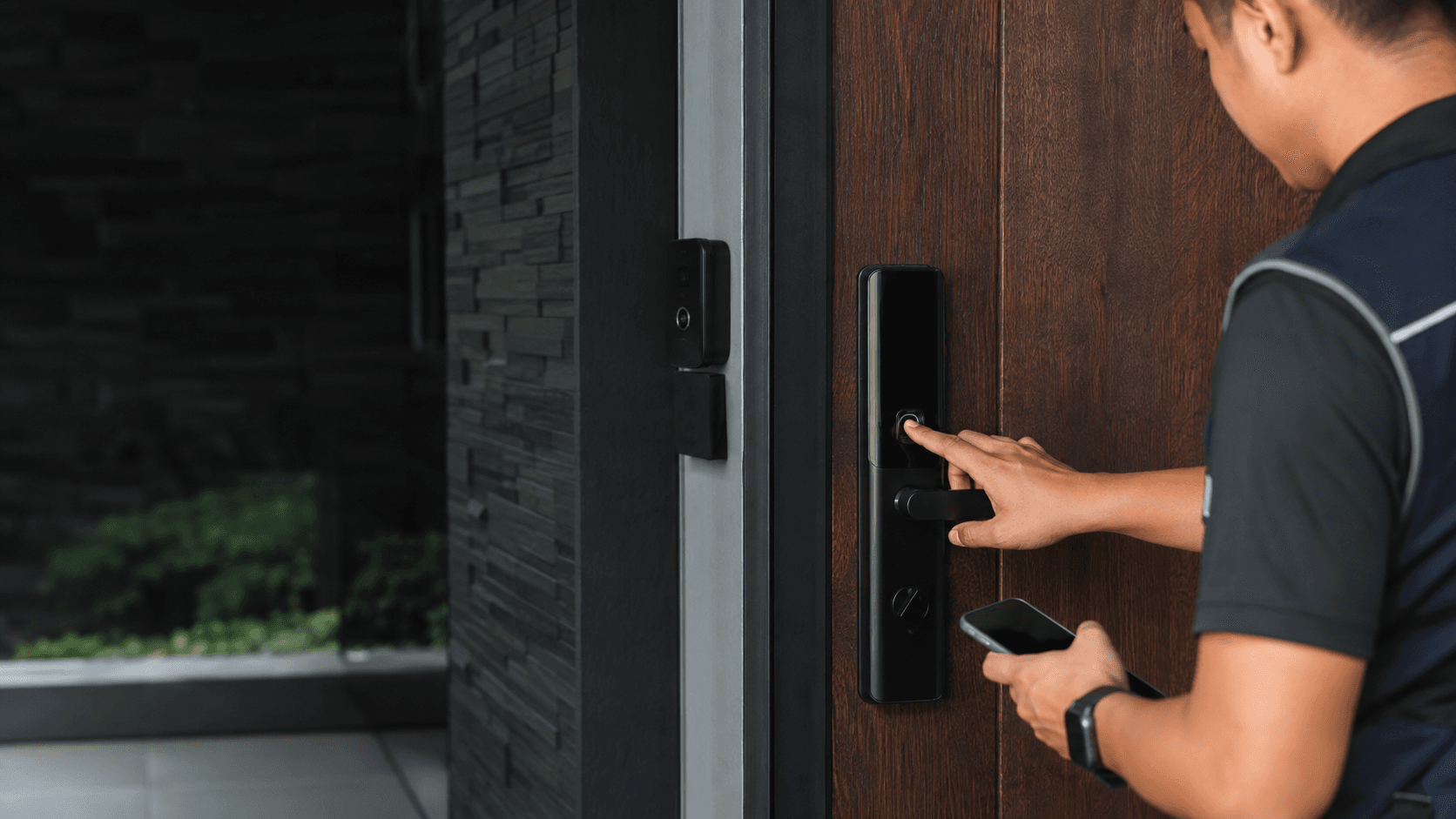
The exact-match query best door lock for airbnb is a comparison question, not a product question. Hosts in Malaysia are usually weighing three things at once: whether a lock physically suits the door, who controls guest codes, and what happens when power, Wi-Fi or batteries fail. Eyonic's own product review guidance states that smart locks work best when door condition, user roles and backup method are reviewed before installation, and that for business use the company usually checks whether a standalone smart lock or an access-control panel is more appropriate.
That framing matters because most published comparisons rank lock brands. Ranking is the easy part. The hard part is that a lock which performs well on a solid timber door in a temperate market may behave differently on a metal gate, a hollow-core door or a unit with unstable connectivity. The decision core is fit, permissions and failure planning.
Best Door Lock For Airbnb: What Matters Before You Choose
A short-term rental lock has to do four jobs that a household lock never has to do. It must let a stranger in without a handover. It must stop letting that stranger in once the stay ends. It must let cleaning or maintenance staff in on a separate schedule. And it must still open when the normal method fails.
Those four jobs pull in different directions. Convenience pushes toward remote code issuance. Security pushes toward short-lived credentials and an audit trail. Reliability pushes toward a mechanical key override or a physical key safe. A lock that satisfies only the first job creates a recurring operational problem rather than solving one.
Eyonic's published position is that smart lock door access is good for controlled convenience when user permissions and backup entry are planned properly. The word "controlled" is doing real work in that sentence. Convenience without permission design is just an open door with extra steps.
Guest access codes and who owns them
Guest access codes are the single most consequential design choice. A fixed code shared across every booking is simple to administer and impossible to audit. A per-stay code is harder to set up and far easier to reason about when something goes wrong.
The practical question is not whether a lock supports codes. It is who issues them, who can revoke them, and whether revocation happens automatically at checkout or depends on someone remembering. If the answer is "someone remembers", the process has a single point of failure that has nothing to do with the lock.
Remote access and its dependency
Remote access is only as reliable as the connection behind it. A lock that depends on Wi-Fi to issue a code will not issue that code during an outage, and a lock that depends on a hub inherits the hub's failure modes as well as its own.
This is where Malaysian properties diverge from the assumptions in most English-language lock guides. Unit connectivity, router placement and building infrastructure vary considerably, and a lock chosen on the strength of its app will be judged on the strength of the connection it sits behind.
Door Lock For Airbnb Options Compared
Two broad approaches cover most short-term rental doors. A standalone smart lock replaces or augments the existing locking hardware on a single door. An access-control panel manages entry across a door or a set of doors as part of a wider system.
The choice between them is not about quality. It is about how many doors, how many user roles and how much central administration the property actually needs.
| Consideration | Standalone smart lock | Access-control panel setup |
|---|---|---|
| Typical fit | A single rental unit with one main entry door | A property with multiple controlled doors or shared entry points |
| User permission handling | Managed per lock, usually through the lock's own app or keypad | Managed centrally across the doors the panel controls |
| Backup entry planning | Planned per door, often a mechanical override or a separate key safe | Planned as part of the wider system, including what happens during an outage |
| Door suitability | Depends on the individual door and frame condition | Depends on the door set and the cabling or infrastructure available |
Eyonic's review guidance draws the line in the same place: for business use, the company usually checks whether a standalone smart lock or an access-control panel is more appropriate. That check happens before a model is chosen, not after.
Where each option tends to break down
A standalone lock tends to break down when the property grows. Adding a second door means adding a second independent permission system, and the two drift apart. A panel setup tends to break down when the property is small. The administration overhead and infrastructure requirements can exceed what a single unit justifies.
There is also a middle case worth naming. A property with one guest door and one staff or service door may not need a full panel, but it does need a coherent answer for both doors rather than two unrelated locks.
Door Condition And Installation Checks Before Buying
Door condition is the constraint that most lock comparisons skip, and it is the one most likely to invalidate a purchase. A lock that cannot be fitted to the actual door is not a candidate regardless of its features.
The checks below are ordered deliberately. Each one can rule out an option before the next becomes relevant.
- Confirm the door and frame condition, including whether the existing hardware can be replaced or only supplemented.
- Confirm whether a standalone lock or an access-control panel suits the property, based on the number of doors and user roles involved.
- Define user roles for guests, cleaning staff and maintenance access, including who issues and revokes each one.
- Plan the backup entry method for each door before installation, not after the first lockout.
- Confirm power and connectivity expectations, including what the lock does when either is unavailable.
Eyonic's installation process for its security work follows a comparable sequence: site survey, system proposal, installation and handover. The survey stage exists precisely because the site, not the catalogue, determines what will work.
Why the survey stage is not optional
A survey answers questions that no product page can. Is the door solid enough to carry the hardware? Is the frame aligned well enough for the bolt to seat reliably? Is there a power source or a viable route for one? Is the connectivity at the door the same as the connectivity in the living room?
Eyonic applies the same principle elsewhere in its work. Its guidance on ColorVu-style cameras is to check actual lighting conditions before confirming placement, rather than assuming the specification translates directly to the site. Door hardware deserves the same treatment.
Guest Codes Permissions And Backup Entry
Permissions and backup entry are the two areas where a rental lock differs most from a residential one, and they are usually decided last. Deciding them last is the reason most lock problems appear in the first month of operation.
A workable permission structure separates roles rather than sharing one code. Guests need access for the length of a stay. Cleaning staff need access in a window between stays. Maintenance needs access on request. Each role should be revocable independently, and revocation should not depend on the same person who issues access.
Backup entry deserves the same specificity. A mechanical key override, a separate key safe or a second independent entry method each solve the problem differently, and each introduces its own risk. A key safe that is never re-coded is a permanent key. A mechanical override that is stored inside the unit is not an override at all.
What happens when power Wi Fi or batteries fail
These are three different failures and they need three different answers. A power failure affects anything mains-powered. A Wi-Fi failure affects anything that depends on remote code issuance. A battery failure affects the lock itself, and it is the failure most likely to strand a guest at the door.
The planning question is not whether these failures can be prevented. It is what the guest does at the door when one occurs, and whether that answer is written down somewhere the guest can reach before they arrive.
Where Eyonic Fits For Malaysian Properties
Eyonic Sdn Bhd is a security system supplier based in Sarawak, Malaysia, working across CCTV and ELV systems with planning, supply and installation for homes, offices, shops and industrial sites. Its product range includes Hikvision cameras and smart locks.
The company's relevant experience is in access and movement rather than in lock retail. For the Kuching Immigration Office, Eyonic provided practical support focused on arrival flow, staff areas, visitor movement and dependable daily operation. For KTA Sarawak Sdn Bhd, the work supported staff movement, visitor handling, tidy cabling and clearer daily site control.
Both projects share the same underlying problem as a short-term rental: people arriving, moving through a controlled space, and needing the arrangement to work every day without supervision. The Kuching Immigration Office project carried an approximate budget of RM 12,000 to RM 28,000, and the KTA Sarawak Sdn Bhd project an approximate budget of RM 8,000 to RM 18,000. Those figures describe project-scale work, not the cost of a single lock, and they are not a guide to lock pricing.
Eyonic's founder, Eric Yong, has worked in the industry for more than ten years, with experience in technical installation of digital security solutions for commercial businesses in Sarawak. That background is relevant to the survey stage, where door condition and infrastructure decide what is feasible.
What Eyonic does not claim
No verified technical specifications, model numbers, battery ratings or security certifications for any specific lock are available in the material behind this article, so none are stated. No verified pricing for door locks or lock installation in Malaysia is available, so none is given. No verified claim that any specific lock integrates natively with the Airbnb platform is available, so no such integration is asserted here.
Those gaps are worth naming because they are exactly the claims most lock comparisons make without support. A host comparing options should treat an unverified integration claim as a question to put to the supplier, not as a feature.
Eyonic's published packages cover a Hikvision CCTV package, a Hikvision alarm system and an autogate package, each at RM 1,599, covering supply, setup and handover. Those are separate systems from door locking, and they are listed here only to be clear about what the published pricing does and does not cover.
A practical next step
The useful starting point is not a lock model. It is a description of the property: how many doors need controlling, what those doors are made of, who needs access and on what schedule, and what should happen when the normal entry method fails. Share the location, property type and required system with Eyonic on WhatsApp at +60 11-5111 7959, and the survey stage can establish whether a standalone lock or a wider access arrangement fits the building.