
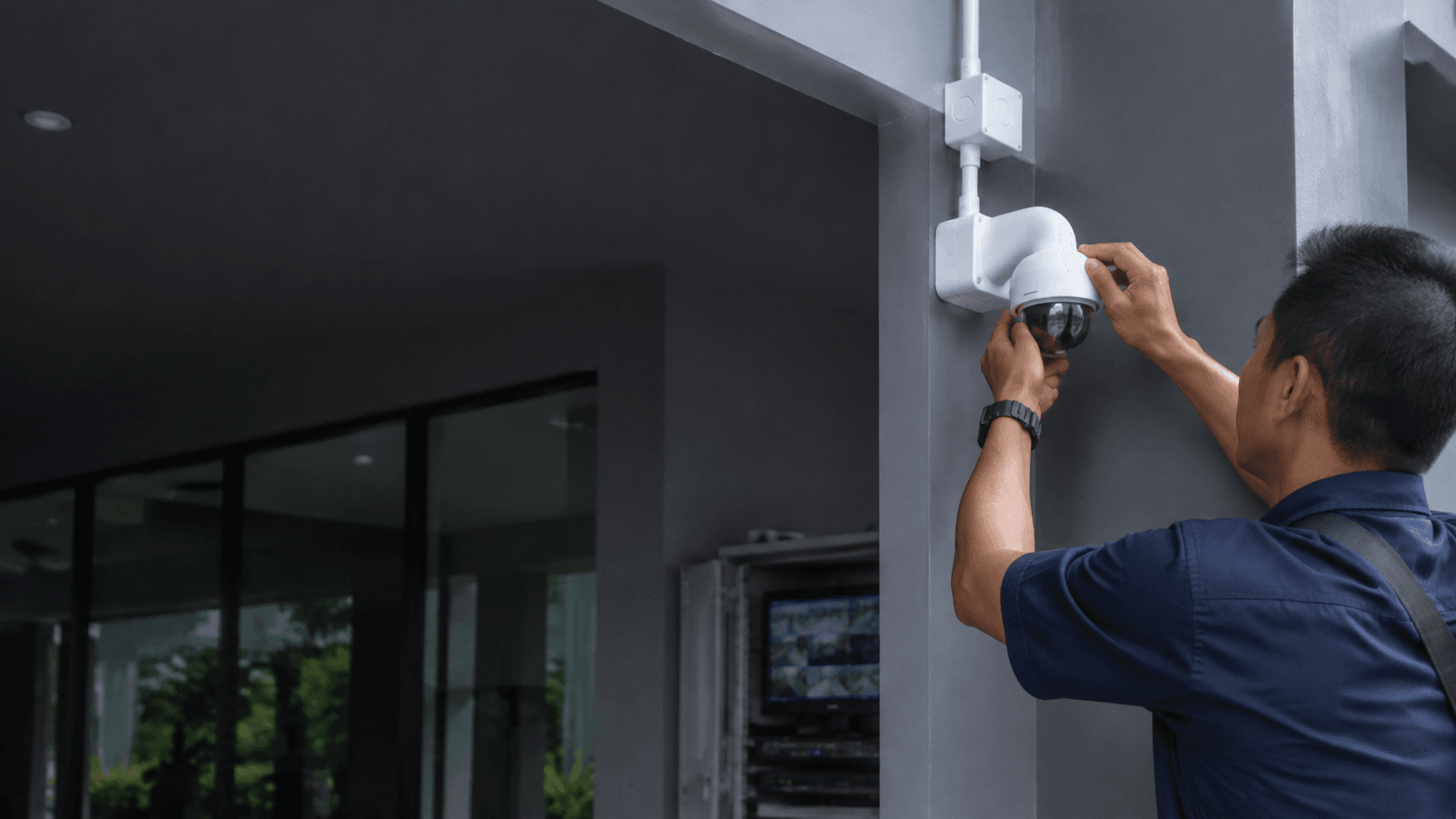
Yale is a security brand owned by Assa Abloy, and its camera line sits alongside smart locks and alarms rather than standing alone. The range splits into three practical groups: standalone Wi-Fi cameras, wired kits with a DVR, and app-based viewing for existing Yale systems. Buyers comparing yale cctv options usually weigh how the cameras connect, where recordings are stored, and whether the setup has to work with locks and alarms already in the building.
- Confirm what the property needs watched: a single entrance, a full perimeter, or an indoor room.
- Decide between a standalone Wi-Fi camera and a wired kit with a DVR.
- Check power and network at each camera position before committing to placement.
- Confirm where recordings live. local storage, cloud storage, or both.
- Verify the viewing app matches the camera generation, since Yale uses more than one app.
- Plan the installation route for cabling, mounting height, and weather exposure.
Yale Cctv. What Matters Before Choosing
The first decision is not brand, it is architecture. A standalone Wi-Fi camera needs only power and a wireless network. A wired kit needs cable runs back to a DVR, which adds labour but removes dependence on Wi-Fi stability at each camera.
Yale's own product pages describe the range as covering CCTV cameras and systems, Wi-Fi enabled cameras, IP cameras, and standalone cameras, with smartphone connectivity for live streaming and remote monitoring. That description matches how the market is structured: the same brand name appears on very different products, so the model number matters more than the logo.
Yale's smart home CCTV systems are described as letting a property be checked while away, with the Yale View app providing viewing from a smartphone and cameras offering enhanced night vision for clearer images in poor weather. That is the core promise of the category, and it is worth testing against the actual lighting at the installation site rather than assuming it holds everywhere.
Choosing the Right Yale Cctv Setup
Match the product type to the job. A single outdoor camera suits a gate, a driveway, or a back door. A multi-camera kit suits a shopfront, an office with several entrances, or a house with a perimeter to cover.
Yale's outdoor camera line includes a battery-powered smart outdoor camera with motion detection, night vision, two-way audio, app control, and adjustable detection zones. Battery power removes the cable run but introduces a charging routine, which is a real constraint for high-traffic positions where the camera triggers constantly.
Yale's kit range includes multi-camera configurations sold as single add-on cameras, two-camera kits, and four-camera kits, alongside a doorbell chime, an indoor camera, and a video doorbell. Buyers who start with one camera and expand later should confirm the kit supports add-on cameras before buying the first unit.
Wired Kits Versus Standalone Cameras
Wired kits with a DVR record continuously to local storage and keep working when the internet drops. Standalone Wi-Fi cameras are faster to install and easier to reposition, but they depend on the network and often on a subscription for cloud clips.
The trade-off is straightforward. Wired favours reliability and continuous recording; wireless favours speed, flexibility, and lower installation disruption. A property with existing cable routes usually gets more value from a wired kit, while a rented unit or a heritage building with hard walls often suits standalone cameras better.
What Is Yale Cctv in Practice
In practice, yale cctv is a family of cameras and viewing apps rather than one product. The brand covers indoor cameras, outdoor cameras, video doorbells, and DVR-based kits, and the viewing experience depends on which app the specific model uses.
Yale's app ecosystem is split. The Yale View app is listed for Yale HD1080 cameras and smart home and CCTV XL DVRs, with multi-channel viewing, playback, and motion notifications. A separate Yale CCTV app is listed as compatible with the Yale Easy Fit CCTV system and supports DVR playback and live streaming over Wi-Fi, 3G, or 4G. Both apps are published by Assa Abloy Ltd.
That split is the single most common source of confusion. A camera and an app that do not belong to the same generation will not pair, so the model number should be checked against the app listing before purchase. The app store listings also note that streaming uses mobile data, which matters on a metered plan.
Security Cameras and the Wider Yale System
Yale cameras are part of a broader smart living range that includes alarms, locks, and door access. A property already running Yale locks or a Yale alarm has a reason to stay inside the ecosystem, because one app can cover more of the building.
That advantage is real but limited. Cameras and locks do not automatically share automation, and the level of integration depends on the specific models and the app in use. Buyers should confirm what actually links together rather than assuming the brand name guarantees it.
For properties starting from nothing, the brand decision matters less than the installation quality. Camera angle, mounting height, lighting, and cable protection determine whether footage is useful. A well-placed mid-range camera outperforms a poorly placed premium one in almost every case.
Where Installation Quality Decides the Outcome
Eyonic, a security system supplier in Sarawak, Malaysia, runs CCTV work through site survey, system proposal, installation, and handover. The company's project for the Kuching Immigration Office covered arrival flow, staff areas, visitor movement, and dependable daily operation, which shows how much of the work is about coverage planning rather than hardware alone.
Eyonic also advises checking actual lighting conditions before confirming placement for ColorVu-style cameras, the low-light models that rely on available light rather than infrared. The same caution applies to any camera chosen for night performance: the specification sheet describes ideal conditions, and the site describes real ones.
Practical Considerations for
Storage, power, and network are the three constraints that decide whether a system works long term.
Storage. DVR kits record to a local drive, which means no ongoing fee and no dependence on upload speed, but the drive is a single point of failure and should be sized for the retention period required. Cloud storage survives theft or damage to the recorder but adds a recurring cost and depends on upload bandwidth.
Power. battery cameras avoid cable runs but need charging, and cold or high-traffic positions drain faster. Wired cameras need a power source at each position, which is the main installation cost in a retrofit.
Network. Wi-Fi cameras need stable signal at the mounting point, not at the router. A camera mounted on a far wall may show a strong phone signal and still drop frames, because the phone and the camera are not in the same place.
Weather and mounting. outdoor cameras need a position sheltered from direct rain where possible, and mounting height should balance coverage against the ability to clean the lens and reach the unit for maintenance.
Making an Informed Choice About
The decision comes down to three questions: how many areas need coverage, whether recording must survive an internet outage, and whether the property already runs Yale locks or alarms.
Answers pointing to a single area and a flexible setup favour a standalone camera. Answers pointing to multiple entrances and continuous recording favour a wired kit. Answers pointing to an existing Yale smart living setup favour staying in the ecosystem, provided the app generation matches.
For buyers in Sarawak, local installation support matters because cabling, mounting, and handover are where most systems succeed or fail. Eyonic handles CCTV planning, supply, and installation for homes, offices, shops, and industrial sites, and its published package pricing starts at RM 1,599 for a Hikvision CCTV package covering camera supply and setup, basic recording configuration, and mobile viewing handover. Comparable packages are listed at RM 1,599 for an alarm system and RM 1,599 for an autogate package.
Larger commercial work scales well beyond that. Eyonic's Kuching Immigration Office project carried an approximate budget of RM 12,000 to RM 28,000, and its KTA Sarawak Sdn Bhd office project carried an approximate budget of RM 8,000 to RM 18,000. Those figures show the gap between a small package and a multi-area commercial installation, and they are useful as a rough frame rather than a quote.
One practical step remains. share the location, property type, and required system with Eyonic on WhatsApp at +60 11-5111 7959 so the next step is based on the actual site rather than a general comparison.