
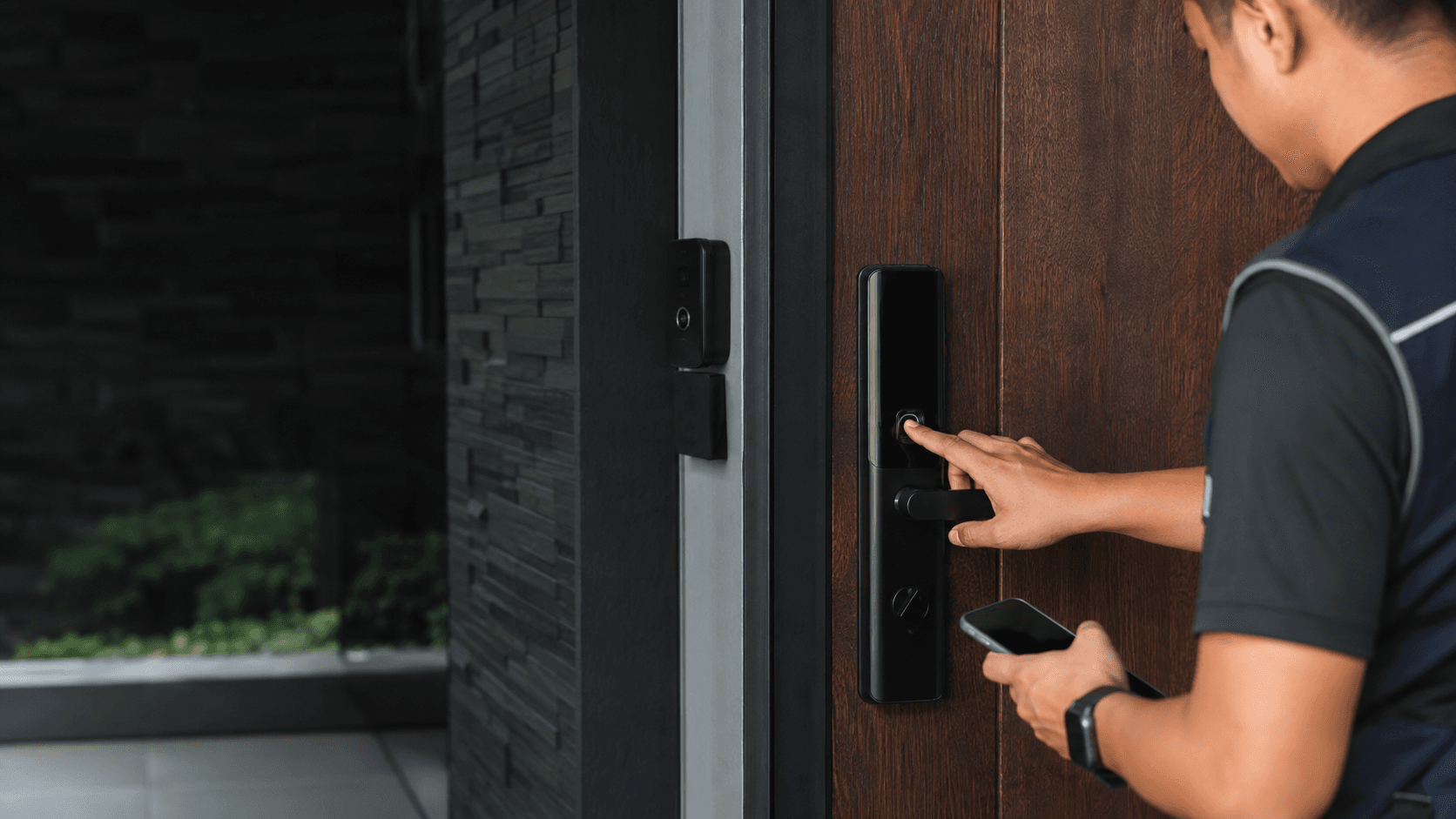
The exact-match query biometric deadbolt lock describes a deadbolt body that releases when a stored fingerprint template matches a scan. Everything else — keypad codes, app control, auto-lock timing, the physical key — exists to cover the moments when a finger is wet, cold, dirty or simply not enrolled.
Malaysian doors complicate that picture. Metal gates, solid timber doors, hollow-core interior doors and older frames all behave differently under the torque a motorised bolt applies. The checks below are the ones that decide whether a unit works reliably for years or becomes a nuisance within months.
Biometric Deadbolt Lock. What Fingerprint Entry Changes at the Door
A conventional deadbolt asks one question: does the key turn? A biometric deadbolt lock asks several. Is the finger recognised, is the bolt aligned with the strike, is there power, and does the fallback credential work when the first two answers are no?
That shift changes daily habits more than it changes raw security. Nobody carries a key for the main door, so the household stops treating "who has the key" as the access question and starts treating "who is enrolled" as the access question. Removing a user is a menu action rather than a locksmith visit.
It also changes failure modes. A lost key is a rekey. A failed sensor is a lockout unless a keypad code or mechanical key still works. Planning for the second and third entry methods is not optional extras — it is the difference between convenience and a door that will not open.
How a Biometric Deadbolt Lock Reads a Finger and Releases the Bolt
The reader captures a fingerprint image, converts it into a mathematical template, and compares that template against stored templates. A match triggers the motor or solenoid that throws or retracts the bolt. A non-match returns an error and, on most designs, counts toward a lockout after repeated failures.
Two practical consequences follow. First, enrolment quality matters more than sensor marketing: a finger enrolled once, badly, will fail intermittently forever. Second, the mechanical deadbolt still has to travel freely. If the bolt binds against a misaligned strike plate, the electronics can report success while the door stays shut.
This is why a smart lock review process that starts with the door, not the chip, tends to produce fewer callbacks. Smart locks work best when the door condition, user roles and backup method are reviewed before installation, and for business use the choice between a standalone smart lock and an access-control panel should be settled first.
Door Condition, Thickness and Frame Alignment Before Any Purchase
Door preparation decides more outcomes than any feature list. The checks below run in order, because each one can rule out the next.
- Confirm the door thickness and the existing backset, so the replacement body matches the bore already cut.
- Check frame alignment and strike plate seating, watching for a bolt that drags or needs a shoulder to close.
- Confirm the existing deadbolt bore and cross-bore are clean and undamaged, with no enlarged or elongated holes.
- Verify Wi-Fi or hub availability at the door if remote features, notifications or app logs are wanted.
- Confirm the backup key and the backup power method before committing, and test both after installation.
Hollow-core and lightweight doors are the common edge case. A motorised bolt applies force every cycle, and a door that flexes under that force will eventually wear the bore. Solid timber and metal doors tolerate it better, but a metal gate needs its own assessment because the mounting surface and the closing action differ from a timber frame.
Weather exposure matters too. A covered porch and an exposed landing are different environments for the same unit, and the reader surface is the part most likely to be affected by rain, dust or direct sun.
Fingerprint, Keypad, Key and App: Planning Backup Entry
Backup entry should be planned as a hierarchy, not a list of features. The fingerprint is the everyday method. The keypad code is the method for a wet hand, a bandaged finger or a visitor. The mechanical key is the method when power or electronics fail. The app is a management layer, not an entry method to rely on during a lockout.
After installation, setup order matters as much as the hardware:
- Enrol the primary fingerprint, using a clean, dry finger and a consistent placement each time.
- Enrol secondary fingers from the same hand and at least one from the other hand.
- Set keypad codes per user rather than one shared code, so a code can be removed without affecting anyone else.
- Test auto-lock timing against the actual closing behaviour of the door.
- Test the mechanical key override and confirm the key is stored somewhere reachable from outside the property.
User permissions are where household and business use diverge. A home needs a handful of enrolled fingers and perhaps a cleaner's code. An office, shop or clinic needs codes that can be issued and revoked by role, and a record of who entered when. Where that record has to stand up to scrutiny, a standalone lock is usually the wrong instrument and an access-control panel is the right one.
Eyonic's work at the Kuching Immigration Office centred on arrival flow, staff areas, visitor movement and dependable daily operation — the same questions that decide whether a single door lock is sufficient or whether the door needs to sit inside a wider access plan.
Power, Battery and Failure Behaviour Over Months of Use
Battery behaviour is the least glamorous and most disruptive part of ownership. The variables are straightforward: how many cycles per day, how much the motor works against a stiff bolt, and how often the reader is woken by a hand brushing past it.
A door used by four people twice a day drains far more slowly than a shop entrance used forty times a day. A bolt that binds draws more current on every cycle. A reader that wakes on approach draws current even when nobody enters.
Low-power warnings are the point where planning pays off. A warning that arrives while the household is away is only useful if a keypad code or mechanical key still works. The practical rule is to treat the first low-battery alert as the deadline, not the second, and to keep a spare of the correct battery type on hand rather than discovering the type at the moment it fails.
Failure behaviour also includes the lockout after repeated failed attempts. That feature protects against someone guessing codes, but it can also lock out a legitimate user who is tired, wet or wearing gloves. Knowing how long the lockout lasts, and whether the mechanical key bypasses it, is worth confirming before purchase rather than after.
Where a Biometric Deadbolt Lock Fits With CCTV, Alarm and Intercom
A lock controls who passes through one door. It does not record what happens after that, and it does not tell anyone that a door was forced. Those jobs belong to the camera, the alarm and the intercom, and the three work best when they are planned together rather than added one at a time.
The useful division of labour is simple. The lock handles entry credentials and, on connected models, an entry log. The camera covers the approach and the doorway, so an entry event has a matching image. The alarm covers forced entry and door-open events. The intercom handles the conversation with a visitor before the door is opened at all.
Integration is where expectations need tempering. Compatibility between a specific lock and a specific recorder, alarm panel or intercom is a per-model question, and it should be confirmed against documentation for the exact units involved rather than assumed from brand names. Where the door is one of several controlled openings, a coordinated plan is usually cheaper than retrofitting each door separately later.
Eyonic's installation process runs through site survey, system proposal, installation and handover, which is the sequence that surfaces door condition, user roles and backup method before hardware is ordered. The same discipline applies to a single door as to a full site.
For households and small businesses in Sarawak, the practical next step is to describe the door, the number of daily users and the systems already in place. Share the location, property type and required system with Eyonic on WhatsApp at +60 11-5111 7959 for the next practical step.