
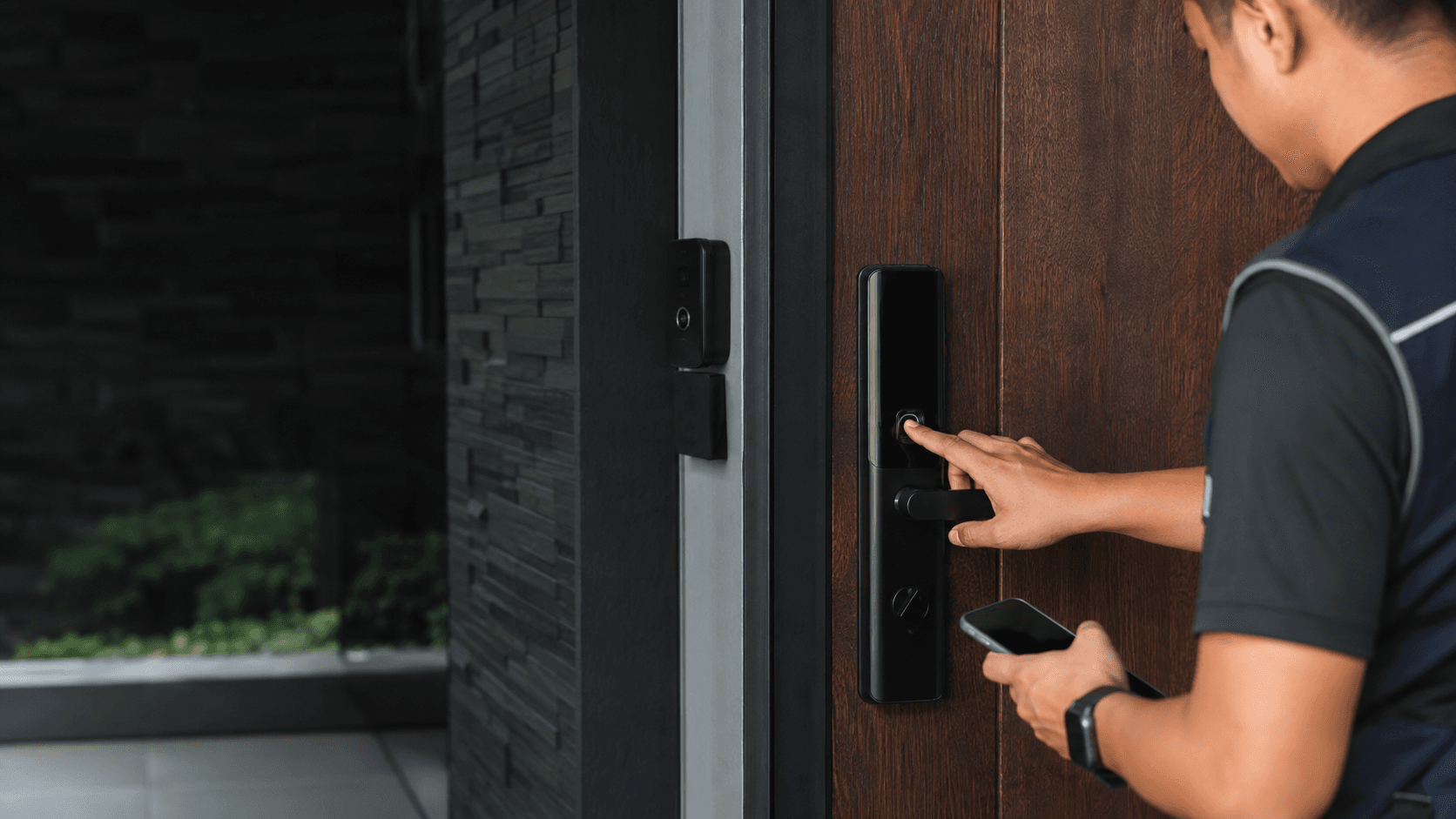
The exact-match query biometric door lock for home describes a residential lock that opens on a verified fingerprint rather than a key alone. Eyonic's own product review position is that smart locks work best when the door condition, user roles and backup method are reviewed before installation, and that for business use the choice between a standalone smart lock and an access-control panel is checked first. That same review-first logic applies to a house.
Malaysian homeowners searching this term are usually weighing three things at once: whether the existing door can take the hardware, who gets enrolled, and what happens on the day the reader or the battery fails. Those three questions decide more outcomes than brand choice does.
Biometric Door Lock For Home. What Malaysian Households Should Check First
Before any model is compared, the practical checks below settle whether a biometric door lock for home is even the right purchase for a particular door. They run in order, because each answer changes the next one.
- Confirm the door condition and thickness, including whether the leaf is solid enough to carry new hardware and whether the frame is square.
- Confirm the existing deadbolt or handle type, so the replacement either matches the cutout or the door is prepared for a new one.
- Decide which entry methods are actually needed for the household, not which ones are advertised.
- Plan user roles and permissions, including who can add or remove a fingerprint later.
- Plan the backup entry method before installation, not after the first lockout.
- Confirm who will survey, install and hand over the lock, and what that handover includes.
Eyonic's stated smart lock position covers the first, fourth and fifth checks directly: door condition, user roles and backup method are the three items reviewed before installation. The remaining checks are physical and logistical, and they are the ones that most often turn a straightforward swap into a door-preparation job.
Fingerprint, keypad, app and key: how entry methods differ
Entry methods are not interchangeable. Each one depends on something working, and each one fails differently. The table below contrasts what each method needs and what happens when it is unavailable.
| Entry method | What it needs to work | When it is unavailable |
|---|---|---|
| Fingerprint | An enrolled finger and a powered reader | Another enrolled finger or a different method is used |
| Keypad code | A powered keypad and a remembered or stored code | A second code or another method is used |
| App | A paired phone, working connectivity and a charged phone battery | The lock is opened at the door instead of remotely |
| Physical key | A key that is kept outside the house | No electronic method remains, so the key becomes the only route |
The pattern is consistent. fingerprint access and keyless entry are conveniences layered on top of a lock that still needs one mechanical fallback. A household that stores the physical key inside the house has removed its own last resort. A household that leaves a key with a neighbour or family member has not.
App control adds a dependency that the other methods do not have. It needs a phone, a network path and a charged battery on the phone side, on top of the lock's own power. Where connectivity is unreliable, the app becomes the least dependable method rather than the most convenient one.
Which entry method suits which household
A household with regular domestic help or recurring visitors benefits most from separate credentials that can be removed later, because a fingerprint or code can be withdrawn without changing the door hardware. A household where the same two or three people always enter gains less from multiple methods and more from a reliable single one plus a key. A rental property raises a different question, because the lock may need to be returned to the owner's original hardware at the end of a tenancy.
Door condition, thickness and existing deadbolt before ordering
Door condition is the constraint that decides most installations. A hollow or lightweight door leaf may not carry the same hardware as a solid one, and a frame that has moved out of square can prevent a bolt from seating cleanly no matter how good the reader is. These are physical facts about the door, and they are checked on site rather than from a photograph.
The existing deadbolt or handle type matters for a second reason: it determines whether the new lock replaces the current cutout or requires the door to be prepared again. A door that has already been cut for one lock body may not accept a different one without further work. Confirming this before ordering avoids a lock that arrives and does not fit.
Eyonic's smart lock review notes that for business use the company usually checks whether a standalone smart lock or an access-control panel is more appropriate. The same fork appears at home in a milder form: a single residential door is normally a standalone lock, while a property with several controlled doors starts to look like an access-control question rather than a lock question.
What a site survey resolves that a product page cannot
A survey resolves door thickness, frame condition, existing cutout, hinge side and the physical route the lock will occupy. Eyonic's installation process for its security work runs through site survey, system proposal, installation and handover, and the survey stage is where door-specific facts are established. A product listing cannot confirm any of them for a specific door.
User roles, guest access and backup entry when the reader or battery fails
User roles are the part of a biometric door lock for home that is easiest to leave unplanned. The practical questions are who can enrol a new fingerprint, who can delete one, and whether a temporary visitor receives a credential that expires or one that must be manually removed. A lock that only the installer can administer becomes inconvenient the first time a credential needs to change.
Backup entry is the second unplanned item. Every electronic method depends on power, and every reader depends on the finger being readable. A finger that is wet, dirty or injured may not read reliably, which is why a second enrolled finger and a non-biometric method both matter. The physical key remains the method that works when nothing electronic does, and it only works if it is stored somewhere other than inside the locked property.
Eyonic's stated position places backup entry alongside door condition and user roles as one of the three items reviewed before installation, which reflects how often it is the item that decides whether a lock is workable in daily use.
Guest and temporary access
Temporary access is where a keypad code or an app-issued credential is more practical than a fingerprint, because a code can be shared and later changed without enrolling anyone. A fingerprint cannot be lent, which makes it strong for permanent household members and awkward for short-term visitors. Households that regularly host guests tend to need at least one non-biometric method as the guest route.
Installation handover and daily operation in Sarawak
Eyonic Sdn Bhd is a security system supplier based in Sarawak, and its installation work follows a site survey, system proposal, installation and handover sequence. That sequence matters for a lock because the survey establishes door facts, the proposal fixes what will be supplied, and the handover is where enrolled users and the backup method are confirmed with the household.
The company's completed work includes the Kuching Immigration Office project, which focused on arrival flow, staff areas, visitor movement and dependable daily operation, and the KTA Sarawak Sdn Bhd project, which covered staff movement, visitor handling, tidy cabling and clearer daily site control. Both are commercial rather than residential, but both turn on the same two concerns that decide a home lock: who moves through the door, and whether the setup holds up in daily use.
Daily operation after handover comes down to a small number of habits. Keeping the physical key outside the house. Enrolling a second finger on each regular user. Reviewing credentials when household circumstances change. Checking that the lock still latches fully rather than assuming it does because the reader responds.
What handover should cover
A useful handover confirms which credentials are active, how a credential is added or removed, where the backup key is kept, and what the household should do if the lock stops responding. Without that, the first credential change becomes a service call.
Costs packages and the next practical step with Eyonic
Eyonic's published package pricing covers three systems at RM 1,599 each: a Hikvision CCTV package with camera supply and setup, basic recording configuration and mobile viewing handover; a Hikvision alarm system with control panel, sensors, siren and zone setup, and user testing and handover; and an autogate package with motor recommendation, remote-control setup, and safety testing and handover. These are the evidenced package prices, and they are not biometric door lock prices.
No verified Malaysian retail or installed price for a biometric door lock for home is available in the evidence behind this page, so no figure is quoted here. A lock price depends on the model, the door preparation required and whether the work is supply-only or supply-and-install, and those are established at survey rather than in advance.
Two larger completed projects give a sense of scale for security work in Sarawak: the Kuching Immigration Office project carried an approximate budget of RM 12,000 to RM 28,000, and the KTA Sarawak Sdn Bhd project carried an approximate budget of RM 8,000 to RM 18,000. Both are commercial office scopes and neither represents a residential lock installation.
For a household in Sarawak considering a biometric door lock for home, the practical next step is to share the location, property type and required system with Eyonic on WhatsApp at +60 11-5111 7959, so the door can be assessed before any hardware is specified.