
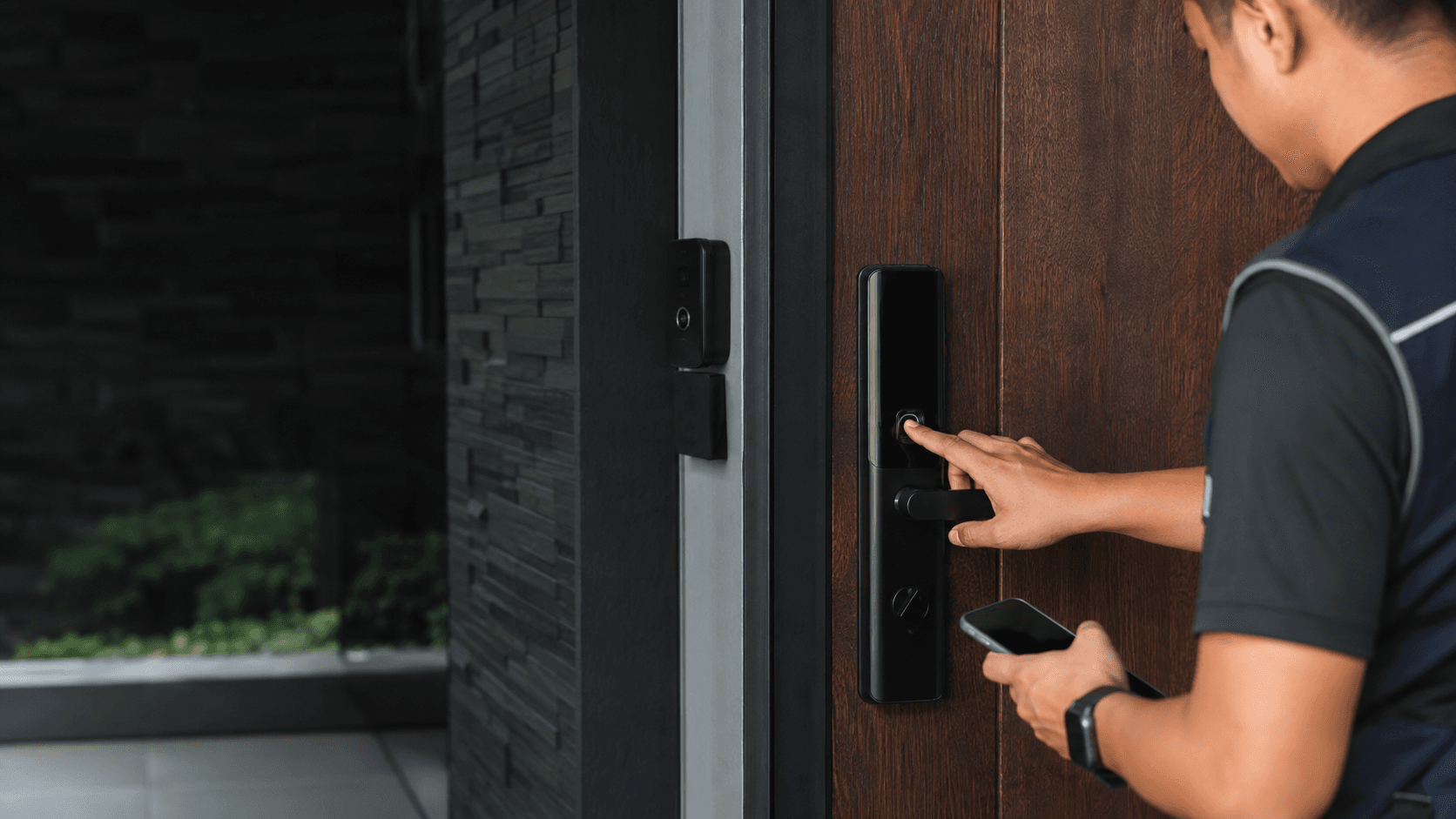
The phrase describes an entrance where daily access no longer depends on handing out metal keys. In practice, that decision covers more than the lock body. It covers the door slab, the frame, the strike, who gets in, what happens when a credential fails, and who signs off the finished work.
Eyonic Sdn Bhd is a security system supplier in Sarawak that plans, supplies, and installs monitoring and access equipment, and its published installation process runs through site survey, system proposal, installation, and handover. That sequence matters here because a keyless entry front door is only as reliable as the survey behind it.
Keyless Entry Front Door. What Changes at the Entrance
Removing the key changes three things at once: how a person proves identity, how the door physically releases, and how the household recovers access when the normal route fails. A keyed lock collapses all three into one object. Keyless access splits them, which is why the planning load is higher.
The first change is identity. A code, card, fingerprint, or app credential replaces the cut key. Each of those can be issued, limited, and revoked without re-cutting anything, which is the main practical gain for a home with regular visitors, tenants, or staff.
The second change is the release mechanism. The door still needs a working latch or bolt, a strike that lines up, and a frame that does not shift with the seasons. A credential that is accepted but a bolt that will not throw is still a failed entry.
The third change is recovery. With a key, recovery is a spare key under a known arrangement. Without one, recovery has to be designed: a second credential, a mechanical override, or a documented alternative entrance. Eyonic's own product guidance states that smart lock door access suits controlled convenience when user permissions and backup entry are planned properly, and that door condition, user roles, and backup method should be reviewed before installation.
Door Condition and Frame Checks Before Any Lock Choice
Door condition decides whether a keyless entry front door is straightforward or a rebuild. The checks below are ordered because each one can invalidate the next.
- Confirm door and frame condition, including slab thickness, solid or hollow core, existing bore holes, frame square, and whether the door closes and latches cleanly by hand.
- Confirm the access method, choosing between keypad, card, fingerprint, and app based on who uses the door and how often.
- Define user permissions, separating permanent household access from temporary, recurring, or one-off access.
- Agree the backup entry method, naming the second credential or alternative entrance and who holds it.
- Test and hand over, walking through normal entry, failed credential, and backup entry before the installer leaves.
A door that already sticks in the wet season will keep sticking after a new lock is fitted. A frame that has been repaired or repainted may not accept the same fixing pattern as the original hardware. Metal doors, glass doors, and doors with narrow stiles each constrain what can be mounted without additional fabrication.
For business premises, Eyonic's published guidance notes that the usual check is whether a standalone smart lock or an access control panel is more appropriate. That distinction matters at a front door used by staff and visitors, because a panel handles multiple doors, schedules, and audit trails in ways a single lock does not.
Access Methods Compared. Keypad, Card, Fingerprint, App
Each method trades convenience against dependency. The right choice follows from who uses the door, not from which method sounds most advanced.
A keypad suits a door used by many people who should not carry anything. Codes can be shared verbally and changed when needed. The trade-off is that codes travel by word of mouth and are hard to attribute to one person.
A card or fob suits households and offices where credentials should be issued and returned. Cards are quick to present and easy to cancel individually. The trade-off is that a card can be lent or lost, and a lost card is only safe once it is removed from the system.
A fingerprint reader suits a small, stable group of regular users who want nothing carried at all. The trade-off is enrolment. every user must be present to register, and a finger that is wet, dirty, or injured may not read.
An app suits remote control, temporary access for deliveries or contractors, and checking whether a door was opened. The trade-off is dependency on a phone, a network, and a platform that will keep updating. An app is the method most likely to be affected by a change outside the household's control.
Combining methods is common and reasonable. A keypad for daily entry plus a card for staff, or a fingerprint for the household plus an app for guests, covers more situations than any single method. The combination should be decided before installation, because it affects what gets mounted and how permissions are structured.
User Permissions and Backup Entry Planning
User permissions are the part most often left until after the hardware is on the door. Deciding them first prevents the common outcome where everyone shares one code because issuing separate credentials was never set up.
A workable permission structure separates permanent users, recurring users, and one-off users. Permanent users are the household or the core staff who need entry at any hour. Recurring users are cleaners, gardeners, or part-time staff who need entry on known days. One-off users are contractors, delivery personnel, or guests who need entry once or for a short window.
Each group should have its own credential and its own removal step. That way, ending access for one person does not disturb anyone else, and there is a record of who was authorised and when.
Backup entry deserves the same treatment. A keyless entry front door should have a named second route that does not depend on the same failure point as the primary one. If the primary method is an app, the backup should not also be an app on the same phone. If the primary method is a keypad, the backup should not be a code that only one person knows.
Eyonic's published position is that smart locks work best when door condition, user roles, and backup method are reviewed before installation. That ordering is the point. backup entry is a design decision, not a troubleshooting step.
Installation, Handover, and Daily Operation in Malaysia
Eyonic's published installation process runs through site survey, system proposal, installation, and handover. Applied to a keyless entry front door, that means the door is assessed before anything is specified, the proposal reflects the actual door and user list, and the finished work is demonstrated rather than simply left in place.
Handover is where the system becomes usable. A handover that covers normal entry, a failed credential, and the agreed backup route leaves the household able to operate the door without calling anyone back. A handover that covers only the happy path leaves the first failure to chance.
Daily operation in Malaysia adds a few practical considerations. Humidity and monsoon exposure affect door movement, so a door that closes cleanly in the dry season should be rechecked in the wet. Power interruptions are a normal event rather than an exception, so the backup route should not assume mains power. Households with regular domestic help or extended family need a permission structure that can be changed without a service visit.
Eyonic's completed work includes the Kuching Immigration Office project, which focused on arrival flow, staff areas, visitor movement, and dependable daily operation, and the KTA Sarawak Sdn Bhd project, which covered staff movement, visitor handling, tidy cabling, and clearer daily site control. Both are examples of entrance and movement planning rather than lock selection alone.
Where a front door sits alongside other systems, the same supplier can often handle the wider setup. Eyonic's published packages include a Hikvision CCTV package at RM 1,599, a Hikvision alarm system at RM 1,599, and an autogate package at RM 1,599, each covering supply, setup, and handover. Project budgets for larger work have been published in the range of RM 12,000 to RM 28,000 for the Kuching Immigration Office project and RM 8,000 to RM 18,000 for the KTA Sarawak Sdn Bhd project. No published price exists for keyless entry front door supply or installation, so any figure for that work has to come from a survey of the actual door.
Keyless Entry Front Door Questions Buyers Ask Before Installing
Does a keyless entry front door still work when the power or network fails? That depends entirely on the backup route agreed before installation. A door with a mechanical override or a second independent credential keeps working. A door whose only backup is an app on the same network does not. This is why backup entry is a design decision rather than a fallback.
Can any front door take keyless hardware? Not without checks. Slab thickness, core type, existing bore holes, frame square, and stile width all constrain what can be fitted. A survey answers this before anything is ordered.
Who should hold the master credential? The person accountable for access changes. In a household that is usually the owner; in a business it is usually whoever manages staff and visitor access. Keeping that role explicit prevents shared codes.
What should be tested before the installer leaves? Normal entry, a deliberately failed credential, and the agreed backup route. If all three work in front of the person who will use the door daily, handover is complete.
When is a standalone lock the wrong choice? When the entrance serves multiple doors, needs scheduled access, or needs a record of who entered. In those cases an access control panel is the more appropriate starting point, which is the check Eyonic applies for business use.
Share your location, property type and required system with Eyonic on WhatsApp at +60 11-5111 7959 for the next practical step.