
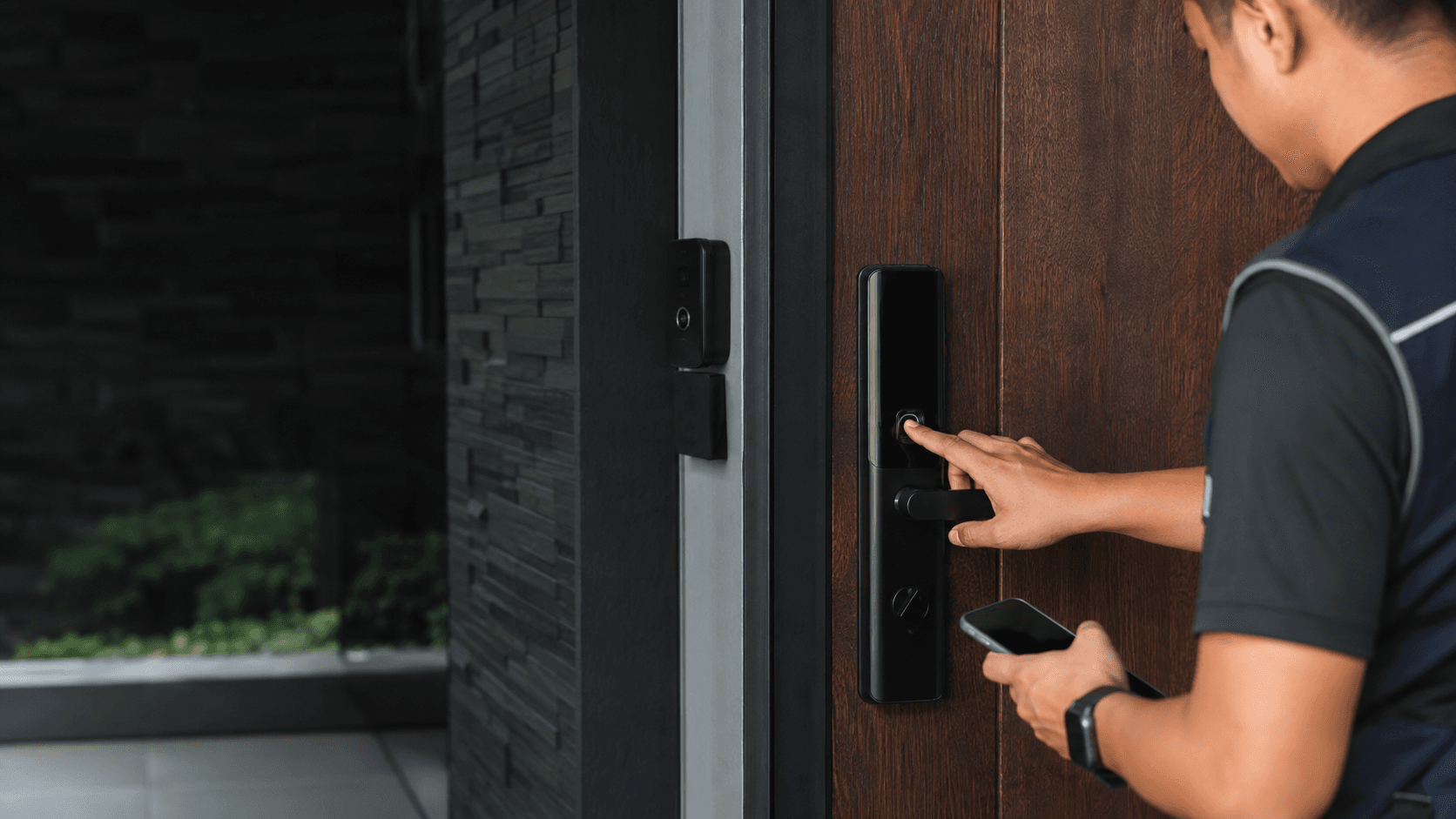
The phrase "godrej electronic door lock with remote" describes a category rather than one fixed product. Godrej builds several digital locks that accept a remote or app-based command, and the differences between them matter more than the shared label. This guide sets out what the remote function actually does, which models carry it, and what to check before buying in Malaysia.
Godrej Electronic Door Lock With Remote: What Matters Before Choosing
Remote capability on a Godrej digital lock is not a single feature. It can mean a Bluetooth low energy (BLE) remote, a Wi-Fi connection through the Godrej Digital Locks app, or a mobile NFC tap. Each method has a different range, a different dependency, and a different failure mode.
A BLE remote works at short range and does not need the home network. Wi-Fi control works from anywhere but depends on the router, the power supply, and the app staying logged in. NFC works only when the phone is physically close to the lock. Buyers who assume "remote" means unlimited distance often end up disappointed with a Bluetooth-only model.
Before comparing models, work through the sequence that determines whether a remote lock suits the door at all:
- Confirm the door type and thickness, since Godrej digital locks are built for wooden doors in most main-door and internal-door listings.
- Check whether the door already has a mortise or rim lock body, because the replacement lock must fit the existing cutout or the door needs modification.
- Decide which access modes are genuinely needed, such as fingerprint, PIN, RFID card, mechanical key, or app control.
- Confirm the power source and whether the model accepts AA batteries or an emergency Type-C supply.
- Plan a backup entry method, because every electronic lock eventually faces a flat battery or a network outage.
- Decide whether the lock will be managed by one person or by several users with different permissions.
That sequence matters because the remote feature sits at the end of it. A lock with excellent app control is still the wrong purchase if the door cannot take the lock body.
Choosing the Right Godrej Electronic Door Lock With Remote
Godrej's own product pages and retail listings show a clear split between models that include remote or app control and models that rely on local entry only. The table below reflects what those listings state.
| Model | Remote or app access | Other access modes | Best fit |
|---|---|---|---|
| Advantis IoT 9 | BLE remote, Wi-Fi, mobile NFC, smart watch, app over Bluetooth | Fingerprint, passcode, RFID card, mechanical override | Main doors where app control and audit features are wanted |
| Catus Connect | Wi-Fi with mobile app | Fingerprint, RFID card, PIN, mechanical key | Wooden main doors needing five access modes |
| Neo Connect | Wi-Fi with mobile app | Fingerprint, PIN, RFID card, mechanical key | Wooden doors where three dead bolts are preferred |
| Advantis Rimtronic RF | No app control listed | PIN, RFID card | Main doors needing simple two-mode entry |
| Catus Touch / Catus Touch Plus | No app control listed | PIN, mechanical key, and fingerprint on the Plus | Main and internal wooden doors on a simpler budget |
The Advantis IoT 9 carries the widest access list of the group, including scheduled access, one-time passwords, dual authentication, and an audit trail. Those features suit a household or small office where different people need different levels of entry. The Catus Connect and Neo Connect cover the same core idea with fewer remote channels.
The Rimtronic RF and Catus Touch lines sit at the other end. They are electronic locks, but the remote element is absent or limited to card and PIN entry at the door. A buyer searching for a godrej electronic door lock with remote should treat those models as a different category.
What is godrej electronic door lock with remote?
It is a Godrej digital door lock that can be operated without touching the lock itself, using a BLE remote, a Wi-Fi app connection, mobile NFC, or a smart watch. The remote function sits alongside fingerprint, PIN, RFID card, and mechanical key entry rather than replacing them.
Digital Door Locks For Smart Security | Godrej Enterprises
Godrej positions its digital lock range around access control rather than around the lock body alone. The company's own product pages describe features such as time-limited passwords, passage mode, anti-prank alarms, break-in alarms, low battery indication, and over-the-air software updates.
Several of those features only make sense with a connected lock. Time-limited passwords and scheduled access let a homeowner issue a code that expires, which is useful for a cleaner, a contractor, or a short-term guest. An audit trail records who entered and when. Over-the-air updates mean the lock firmware can change without a service visit.
Remote access also introduces dependencies that a mechanical lock does not have. A Wi-Fi lock needs a working router and a stable power supply. An app-managed lock needs the phone, the account, and the app version to stay compatible. Godrej addresses part of this with a mechanical override and an emergency Type-C supply on the Advantis IoT 9, but the fallback still has to be planned before installation, not after.
For buyers in Malaysia, the practical question is often about support rather than specification. A connected lock that needs a firmware reset or a replacement part is harder to manage without a local installer who knows the product. That is where a Sarawak-based security system supplier adds value, because the same team that handles CCTV, alarm, and autogate work can also review door condition, user roles, and backup entry before a smart lock is installed.
Practical Considerations for Godrej Electronic Door Lock With Remote
Three constraints decide most purchases: door compatibility, power, and user management.
Door compatibility comes first. Godrej lists most of its digital locks for wooden doors, with separate models for glass doors and cabinet locks. A metal door, a sliding door, or a door with an unusual thickness may not accept the lock body without modification. The existing mortise or rim cutout also has to match, or the door needs new preparation.
Power is the second constraint. Battery-powered locks avoid wiring but need a replacement routine. A lock with Wi-Fi draws more current than a PIN-only model, so battery life expectations should be set accordingly. The emergency Type-C supply on the Advantis IoT 9 exists precisely because a flat battery should not mean a locked-out household.
User management is the third. A standalone smart lock suits a home with a handful of regular users. A business with staff turnover, visitor access, and different permission levels may be better served by an access-control panel rather than a single door lock. That distinction is worth settling before comparing prices, because the two approaches solve different problems.
Remote access also raises a question about who holds the keys to the app. If one person manages all codes and the account, that person becomes a single point of failure. Sharing administrative access across two trusted users is a simple precaution that costs nothing.
How remote access works in practice
A BLE remote sends a short-range signal to the lock, similar to a car key fob. Wi-Fi control routes the command through the Godrej Digital Locks app and the home network, which allows entry management from outside the property. Mobile NFC requires the phone to be tapped near the lock. Each method fails differently, so a lock that supports more than one remote channel is more resilient than a single-channel model.
Making an Informed Choice About
The right model depends on how the door is used, not on the longest feature list. A single main door in a family home is well served by a Catus Connect or Neo Connect, which cover Wi-Fi app control, fingerprint, PIN, RFID card, and a mechanical key. A property that needs scheduled access, audit trails, and multiple remote channels is better matched to the Advantis IoT 9.
A door that only needs keyless entry at the door itself does not need a remote model at all. The Rimtronic RF and Catus Touch lines cover that case at a lower level of complexity, and adding remote control to a door that does not need it only adds dependencies.
Installation quality decides how well any of these locks perform. Door alignment, lock body fit, and battery access all affect daily use, and a poorly fitted electronic lock creates more problems than a well-fitted mechanical one. Buyers in Sarawak can have the door assessed alongside the rest of the property's security setup, which avoids buying a lock that cannot be fitted properly.
Eyonic Sdn Bhd plans, supplies, and installs security and ELV systems across Sarawak, including smart lock door access alongside CCTV, alarm, autogate, and intercom work. The company's founder, Eric Yong, has worked in technical installation of digital security solutions for commercial businesses in Sarawak for more than 10 years. Completed projects include the Kuching Immigration Office, where the focus was arrival flow, staff areas, visitor movement, and dependable daily operation, and KTA Sarawak Sdn Bhd, which needed a practical office setup supporting staff movement, visitor handling, and tidy cabling.
For a smart lock specifically, the review process starts with door condition, user roles, and backup method. For business use, the same review checks whether a standalone smart lock or an access-control panel is the better fit. That step prevents the most common mistake, which is buying a remote lock for a door that cannot support one, or for a site that needs centralised control instead.
Share the location, property type, and required system with Eyonic on WhatsApp at +60 11-5111 7959 for the next practical step.