
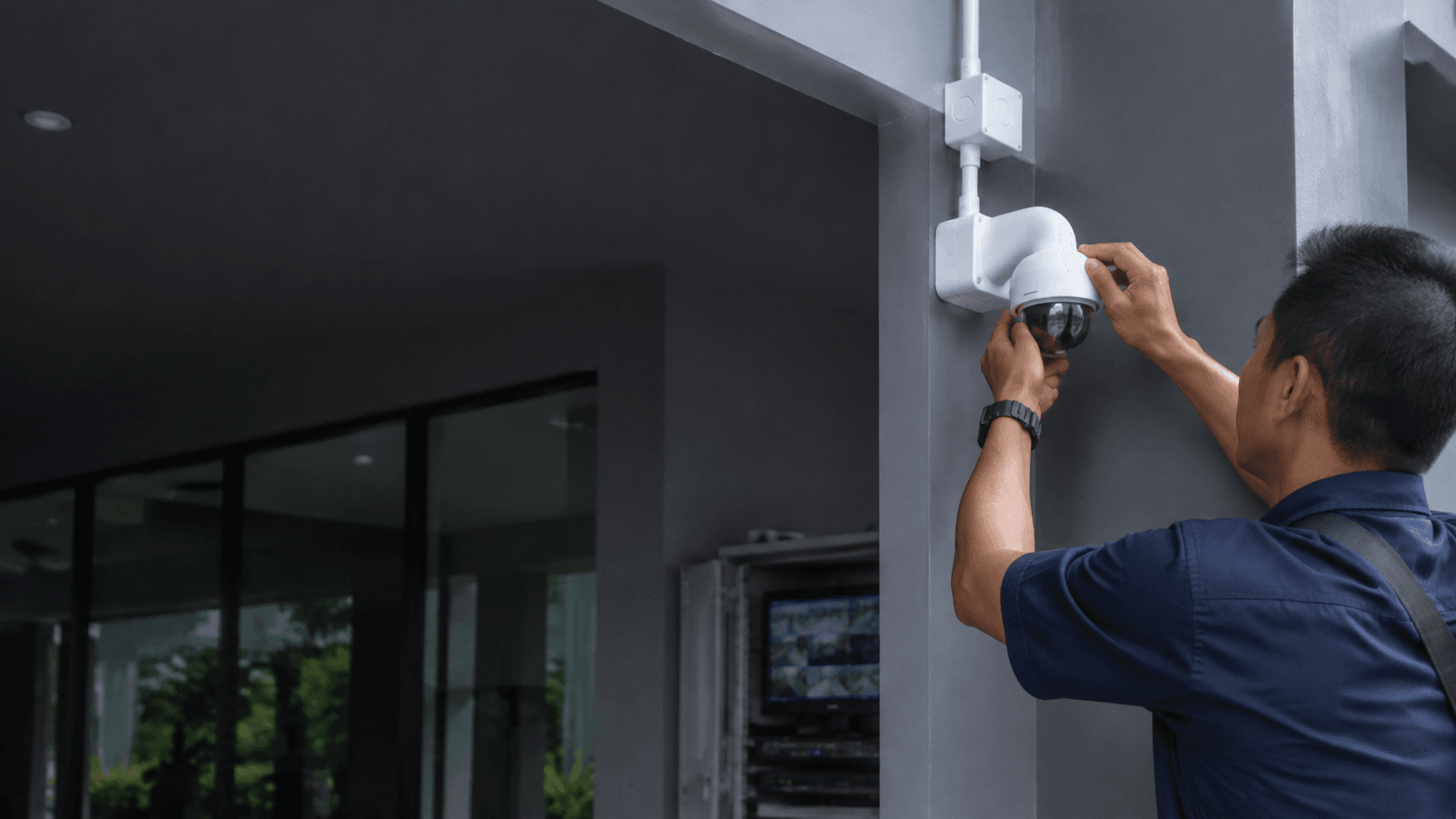
The exact-match query best commercial outdoor security cameras is a buyer's phrase, not a product name. What sits behind it is a decision about coverage: which doors, lanes, and yards need watching, what the light is like after dark, and how the footage gets recorded and reviewed. Eyonic Sdn Bhd plans, supplies, and installs monitoring systems with camera placement, recording, and remote viewing for homes, offices, shops, and industrial sites, and its founder Eric Yong has worked in technical installation of digital security solutions for commercial businesses in Sarawak for more than 10 years.
This guide covers how commercial-grade outdoor cameras differ from consumer kits, how to match them to entrances, perimeters, and parking areas, what to check on site before anything is fixed in place, and what the installation and handover path looks like in Sarawak.
Best Commercial Outdoor Security Cameras for Malaysian Business Sites
The phrase "best commercial outdoor security cameras" points to a category, not a single model. A camera that suits a shophouse entrance in Kuching may be the wrong choice for a warehouse yard with a long approach lane. The useful question is which camera and placement combination covers the specific movement a business needs to see, and whether the recording and remote viewing setup lets someone actually review it later.
Three things drive that answer on most Malaysian commercial sites:
- Site survey. A walk-through of the premises to identify entrances, perimeters, parking areas, and the movement patterns that matter.
- System proposal. A written scope covering camera positions, recording setup, and remote viewing before any work begins.
- Installation. Mounting, cabling, and configuration carried out to the agreed positions.
- Handover. Testing the system with the people who will use it, and confirming they can view and retrieve footage.
That sequence is how Eyonic's CCTV installation process is structured, and it applies whether the site is a single shop lot or a multi-building office compound.
What separates commercial outdoor security cameras from consumer kits
Consumer kits are usually sold as a box with a fixed number of cameras and a phone app. Commercial outdoor installations start from the site instead. The camera count, positions, and recording capacity follow from what needs to be covered, not from what came in the box.
The practical differences show up in four places:
- Placement planning. Commercial work treats each camera as covering a defined zone — an entrance, a gate, a loading bay — rather than aiming for general coverage.
- Cabling and power. Outdoor runs need a route that survives weather and does not create trip hazards or exposed joints. This is decided before installation, not during it.
- Recording setup. Business premises usually need footage retained and retrievable for review, which means the recorder and storage are part of the design.
- Remote viewing. Owners and managers often need to check the site from elsewhere, so mobile viewing is configured and handed over rather than left to the buyer.
None of that requires a particular brand. It requires someone to survey the site and design around it.
Matching Commercial Outdoor Security Cameras to entrances, perimeters, and parking areas
Different zones on the same premises need different treatment. A single camera type across every position usually leaves one area weak.
Entrances and reception points. These carry the highest volume of identifiable movement — staff arriving, visitors, deliveries. The camera needs to see faces and vehicles at the point of entry, which means the position matters more than the model. A camera mounted too high or angled along the wall rather than across the approach will record movement without recording who was involved.
Perimeters and side lanes. These are long, narrow zones. Coverage here is about continuity — gaps between camera fields are where movement goes unrecorded. On a shophouse or factory lot, the perimeter run is often where cabling decisions get made, because the route has to follow the same path as the coverage.
Parking areas and yards. These are open, and the useful detail is often further away than at a doorway. Placement here is about the angle and distance to the point that matters — the gate, the parking bay, the loading area — rather than covering the whole yard evenly.
Eyonic's work for the Kuching Immigration Office focused on arrival flow, staff areas, visitor movement, and dependable daily operation, which is the same zoning logic applied to a public-facing building. A similar approach appears in the KTA Sarawak Sdn Bhd project, where the office setup supported staff movement, visitor handling, tidy cabling, and clearer daily site control.
Lighting, weather, and cabling checks before any camera is fixed in place
Most disappointing installations are decided before the first bracket goes up. Three checks prevent that.
- Lighting conditions. Check the actual light at each position at the times that matter — after dark, under entrance lighting, in the shadow of an awning. Eyonic recommends checking actual lighting conditions before confirming placement for ColorVu-style cameras, because a position that looks fine in daylight can behave differently at night.
- Weather exposure. Note which positions face direct rain, afternoon sun, or standing water. Mounting height and shelter affect how long a camera stays serviceable, and the position should be chosen with that in mind.
- Cabling route. Walk the path the cable will take before committing to camera positions. The route often constrains where cameras can go, and discovering that after mounting means rework.
These checks belong in the survey stage. They are also the reason a proposal written from a photograph or a floor plan alone tends to miss something.
How Eyonic plans and installs Commercial Outdoor Security Cameras in Sarawak
Eyonic Sdn Bhd is a security system supplier based in Sarawak, working with homes, offices, shops, and industrial sites. The installation path runs through four stages, and each one produces something the next stage depends on.
Site survey. The premises are walked to identify entrances, perimeters, parking areas, and the movement that needs to be visible. Lighting and cabling conditions are checked at the same time, since both affect placement.
System proposal. The survey findings become a scope: camera positions, recording setup, and remote viewing. This is the point where the buyer can see what is being covered and what is not, before any commitment to hardware.
Installation. Mounting, cabling, and configuration are carried out to the agreed positions. Tidy cabling matters on commercial premises because it affects both appearance and how easily the system can be serviced later.
Handover. The system is tested with the people who will use it. Mobile viewing is set up so that owners and managers can check the site remotely, and the recording setup is confirmed working.
Eyonic also supplies and installs alarm systems, autogate systems, keyphone intercoms, and Starlink internet in Sarawak, which matters when a camera project needs to sit alongside other site systems rather than be planned in isolation.
What a commercial outdoor camera project costs and what handover includes
Cost depends on camera count, positions, cabling distance, and recording capacity, so a single figure does not apply across sites. Two Eyonic project budgets give a working range for commercial office and public-building work in Sarawak: the Kuching Immigration Office project carried an approximate budget of RM 12,000 to RM 28,000, and the KTA Sarawak Sdn Bhd project carried an approximate budget of RM 8,000 to RM 18,000.
For smaller premises, Eyonic's Hikvision CCTV Package is listed at RM 1,599 and covers camera supply and setup, basic recording configuration, and mobile viewing handover. That package is a starting point rather than a commercial-scale scope; a multi-entrance business site will sit above it.
Handover is the part buyers most often underestimate. It includes confirming the recording setup works, setting up mobile viewing, and walking the user through retrieving footage. A system that records but cannot be reviewed by the people on site has not been handed over.
Questions buyers ask before committing
How many cameras does a business site need? The count follows from the zones identified in the survey — entrances, perimeters, parking, and any internal areas that need coverage. A single-entrance shop and a warehouse with two gates and a yard will not land on the same number.
Can existing cabling be reused? Sometimes. It depends on the condition and route of what is already installed, which is why the cabling check happens during the survey rather than after a proposal is written.
Does the system need internet? Remote viewing does. Local recording and on-site review do not depend on an internet connection, which is worth confirming for sites with unreliable connectivity.
What happens if a camera fails? That is a service question rather than a design one, and it is worth asking before installation so the answer is clear while the system is still being specified.
For sites in Sarawak, sharing the location, property type, and required system with Eyonic on WhatsApp at +60 11-5111 7959 is the practical next step — it gives enough context for a survey to be scoped properly rather than guessed at.