
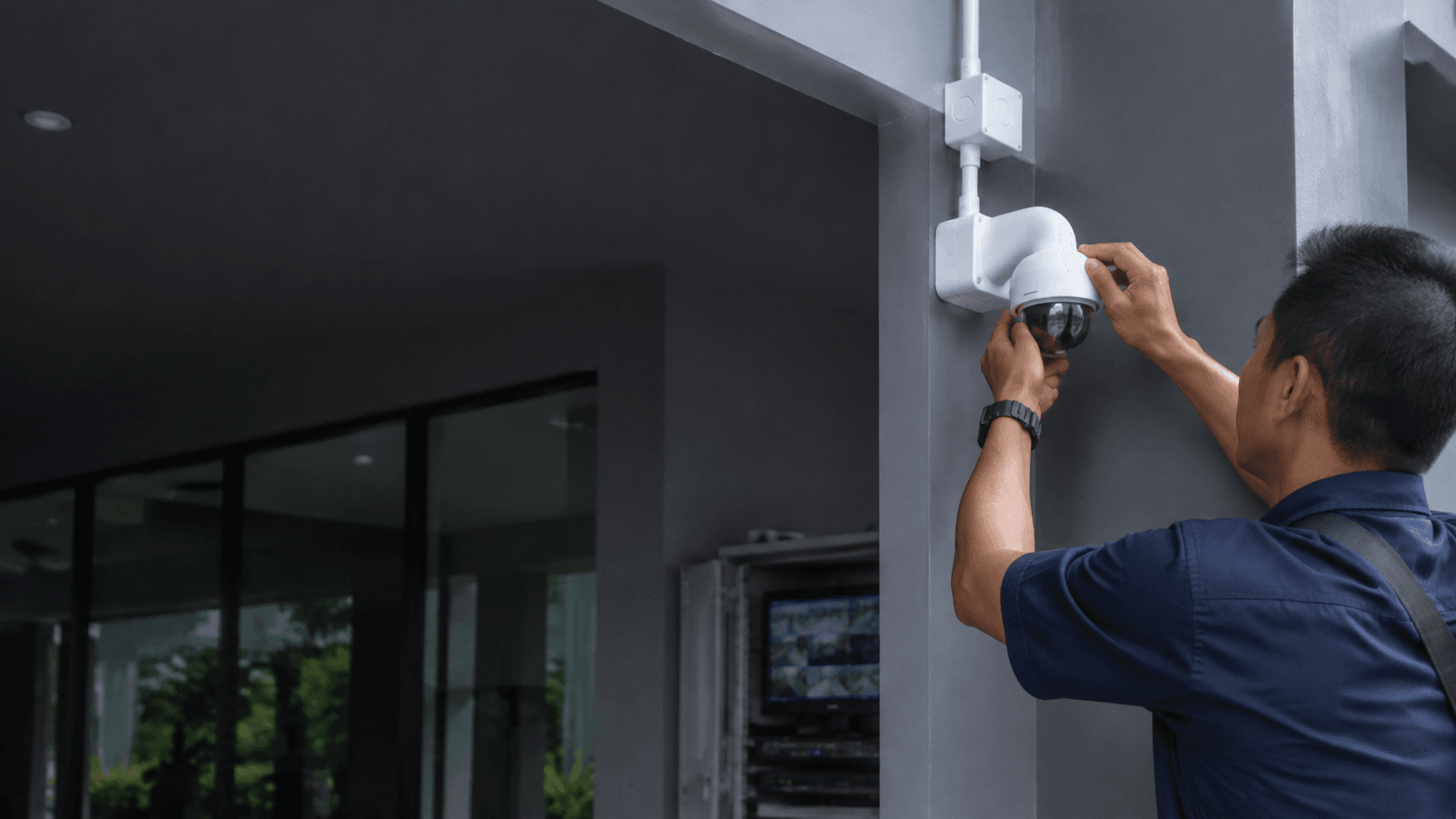
The exact-match query cctv security system describes a package of cameras, a recorder, cabling and viewing software that works as one unit. Eyonic Sdn Bhd is a security system supplier in Sarawak, Malaysia, and its published scope covers planning, supply and installation rather than hardware alone. That distinction matters because most failures in a small installation trace back to placement and configuration, not to the camera model.
This article walks through how the work is sequenced in Sarawak, what the site survey decides, how recording and remote viewing are handed over, and what a public-office project in Kuching shows about realistic scope.
CCTV Security System. What the Scope Usually Covers
A complete cctv security system covers four working parts: cameras, a recorder, the network or cabling that connects them, and the viewing layer that lets someone watch live or recorded footage. Eyonic's published service description names camera placement, recording and remote viewing as part of the same plan, supply and install scope.
That framing is useful because buyers often price cameras first and treat everything else as an afterthought. In practice the recorder determines how many cameras can be added later, the cabling route determines whether the job stays tidy, and the viewing setup determines whether anyone actually uses the system after handover.
Eyonic lists a Hikvision CCTV Package at RM 1,599 covering camera supply and setup, basic recording configuration, and mobile viewing handover. That package describes a defined starting scope rather than a full commercial design, which is why larger sites move to a surveyed proposal instead.
Site Survey and Camera Placement Before Any Hardware Is Chosen
The survey comes first because placement decides what the cameras need to do. Eyonic's installation process runs through site survey, system proposal, installation and handover, in that order.
- Site survey — the property is walked to identify entry points, movement routes, blind spots and where cabling can run cleanly.
- System proposal — camera positions, recorder location and viewing setup are proposed against what the survey found.
- Installation — cameras, recorder and cabling are installed to the agreed positions.
- Handover — recording is configured and live or recorded viewing is set up and explained.
Placement is where a cctv security system succeeds or fails. A camera aimed at a gate but positioned so that headlights wash out the frame at night produces footage nobody can use. A camera covering a corridor but mounted where a pillar blocks half the view leaves a gap that only becomes obvious after an incident.
The survey also settles practical constraints that are hard to change later: whether power is available at each position, whether the cable route crosses a finished ceiling, and whether the recorder can sit somewhere with ventilation and reasonable access.
What the survey should record
A useful survey notes the purpose of each camera position, not just the count. Arrival points, staff areas and visitor movement were the stated focus of Eyonic's Kuching Immigration Office project, which shows how a public building's coverage priorities differ from a home's.
For a shop, the priorities are usually the counter, the entrance and any stock area. For an industrial site, they tend to be perimeter gates, loading areas and plant rooms. For a home, the front gate, car porch and back entrance carry most of the value.
Recording, NVR Setup and Remote Viewing at Handover
Recording configuration decides how far back footage can be reviewed, and that depends on how many cameras run, what resolution they record at, and how much storage the recorder holds. Eyonic's published evidence does not include verified retention figures, so retention should be confirmed against the actual recorder and storage chosen for the site rather than assumed from a package description.
NVR setup covers the recorder's channel configuration, recording schedule and how footage is searched. A recorder that records continuously fills storage faster than one that records on motion, and each choice trades review coverage against how far back the footage reaches.
Remote viewing is the part most users judge the system by. Handover should leave someone able to open the viewing app, find a camera, play back a clip and confirm the recording is live. Eyonic's basic package lists mobile viewing handover as an included step, which puts that confirmation inside the installation rather than leaving it to the buyer.
Questions that come up at handover
Whether the system keeps recording if the internet drops depends on where footage is stored. Local recording on the recorder continues independently of the internet connection; remote viewing is what stops working until the connection returns.
Whether footage can be exported for an incident report depends on the recorder's export options and on someone knowing how to use them. That is worth confirming during handover rather than during an incident.
Kuching Immigration Office. A Public-Office Installation Example
Eyonic completed a project for the Kuching Immigration Office, focused on arrival flow, staff areas, visitor movement and dependable daily operation. The approximate budget for that type of work is RM 12,000 to RM 28,000.
The stated priorities are instructive. A public office is not trying to catch intruders at a perimeter; it is trying to keep a busy arrival area and visitor route visible while staff areas stay covered, and to keep the system running every working day without constant attention. That is a coverage and reliability problem more than a hardware problem.
A second Eyonic project, for KTA Sarawak Sdn Bhd, covered a practical office setup in Kuching supporting staff movement, visitor handling, tidy cabling and clearer daily site control, with an approximate budget of RM 8,000 to RM 18,000. Both examples sit well above the RM 1,599 package level, which reflects the difference between a small defined installation and a surveyed multi-area site.
Lighting Conditions and Camera Choice at the Placement Stage
Lighting is checked before placement is confirmed, not after. Eyonic recommends checking actual lighting conditions before confirming placement for ColorVu-style cameras, which are chosen for their low-light colour performance.
The reason is that low-light capability depends on how much light actually reaches the position at night. A camera that performs well under a porch light may behave differently at an unlit back gate, and a position that looks adequate during a daytime survey can change completely after dark.
This is a placement decision rather than a specification decision. Moving a camera a short distance, or adding a light source, often does more for usable night footage than changing the camera model. It also means the survey is best done with an evening check on the positions that matter most.
Working With a Sarawak Supplier on a
A local supplier matters most after installation. Cabling routes, recorder access and camera positions are all physical details that are easier to adjust when the installer is nearby, and a site visit is easier to arrange when the supplier already knows the property.
Eyonic Sdn Bhd is based in Sarawak and its founder, Eric Yong, has worked in the industry for more than ten years, with experience in technical installation of digital security solutions for commercial businesses in Sarawak. That background is relevant to commercial sites where coverage, cabling and daily reliability all have to hold up together.
Buyers comparing options should ask what the survey will cover, where the recorder will sit, how retention is calculated for the chosen storage, and what happens at handover to confirm remote viewing works. Those four answers separate a planned installation from a box of cameras.
For a next practical step, share the location, property type and required system with Eyonic on WhatsApp at +60 11-5111 7959.